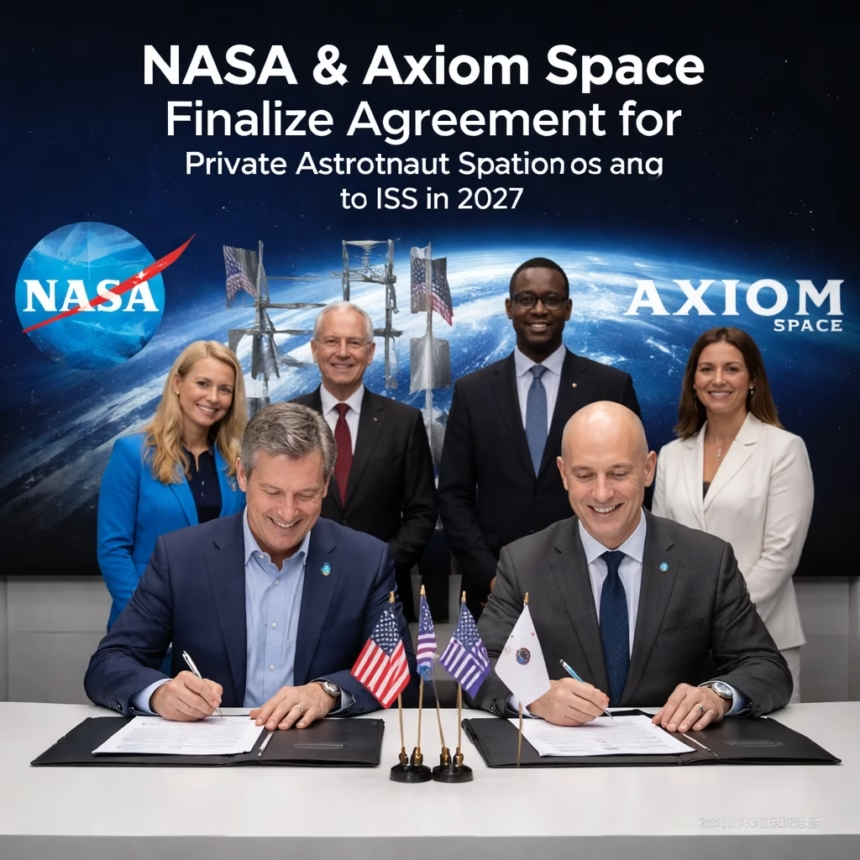
NASA, Axiom Space finalise agreement for private astronaut mission to ISS in 2027

Viral_X
By
Viral_X
10 Min Read
#image_title

Private Spaceflight Soars: NASA & Axiom Greenlight 2027 ISS Mission

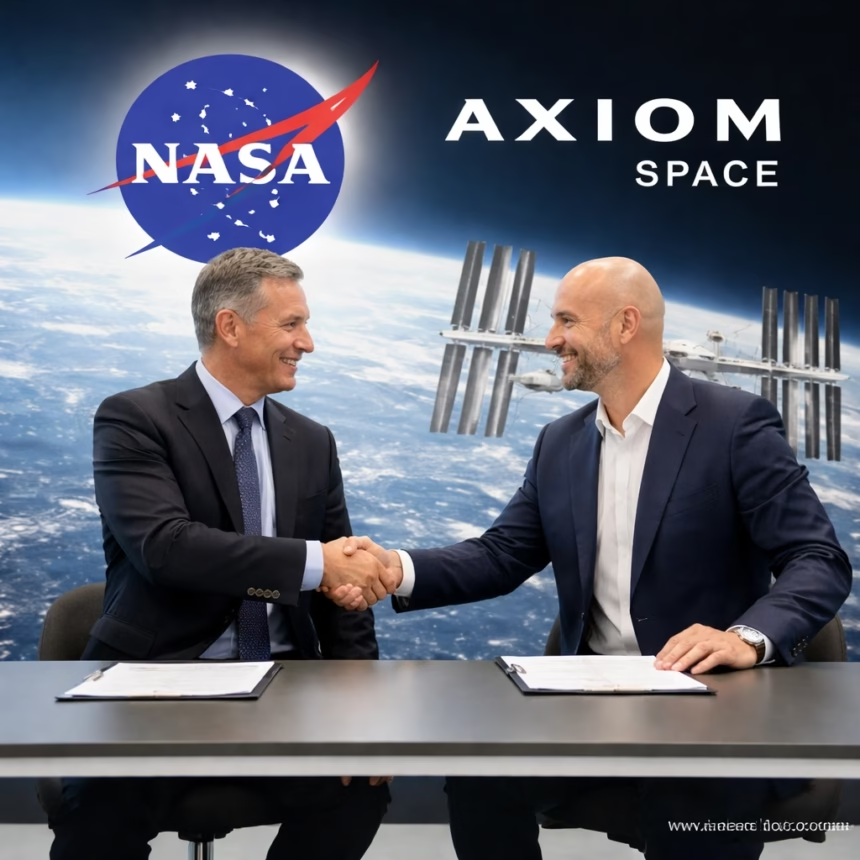
NASA and Axiom Space have officially finalized an agreement for the fourth private astronaut mission to the International Space Station (ISS). This landmark mission, designated Axiom Mission 4 (Ax-4), is targeted for launch in late 2027, representing a significant advancement in the commercialization of low-Earth orbit (LEO).
The agreement solidifies the path for a crew of private astronauts to conduct scientific research, technology demonstrations, and commercial activities aboard the orbiting laboratory, further expanding human presence and enterprise in space.

Background: A New Era for Commercial Spaceflight

The journey towards commercializing low-Earth orbit has been a strategic priority for NASA for over a decade. Recognizing the need to transition from being the sole operator in LEO to a purchaser of services, the agency has actively fostered a robust commercial space economy. This paradigm shift aims to allow NASA to focus its resources on deep space exploration, such as the Artemis missions to the Moon and Mars, while private entities manage routine access and operations in Earth’s immediate vicinity.

NASA’s Commercial LEO Strategy

The International Space Station serves as a crucial proving ground for this strategy. By opening its doors to private astronaut missions (PAMs), NASA provides a unique platform for commercial companies to gain operational experience, develop new technologies, and establish a market for space-based services. This approach is designed to stimulate the development of future commercial space stations, which will eventually succeed the ISS as the primary destination for human activities in LEO.

Axiom Space’s Precedent-Setting Missions

Axiom Space has emerged as a frontrunner in this commercialization effort. The Houston-based company envisions building and operating the world’s first commercial space station, and its private astronaut missions are integral to achieving that goal. Axiom has already successfully executed three private missions to the ISS:

NASA, Axiom Space finalise agreement for private astronaut mission to ISS in 2027

  • Axiom Mission 1 (Ax-1): Launched in April 2022, this historic mission marked the first all-private astronaut crew to visit the ISS. Led by former NASA astronaut Michael López-Alegría, the crew conducted extensive research and outreach activities.
  • Axiom Mission 2 (Ax-2): Launched in May 2023, Ax-2 was commanded by former NASA astronaut Peggy Whitson and featured a diverse crew, including astronauts from Saudi Arabia, further demonstrating the global appeal of private spaceflight.
  • Axiom Mission 3 (Ax-3): Launched in January 2024, this mission included astronauts from Turkey, Italy, and Sweden, showcasing the increasing participation of international partners through commercial agreements.

These missions have proven the viability of integrating private crews and their scientific objectives into the complex operational schedule of the ISS, paving the way for Ax-4 and beyond.

Key Developments: Formalizing Ax-4 and Future Operations

The recent agreement between NASA and Axiom Space for Ax-4 represents the culmination of extensive planning and coordination. It outlines the specific parameters for the mission, ensuring seamless integration with ongoing ISS activities and adherence to safety protocols.

The Ax-4 Crew and Objectives

While the specific crew members for Ax-4 have not yet been publicly announced, the mission is expected to follow the successful model of previous Axiom flights. Typically, an experienced former NASA astronaut commands the mission, guiding a crew of up to three private astronauts. These private individuals often represent various scientific institutions, commercial enterprises, or even national space agencies seeking access to microgravity research opportunities without developing their own launch capabilities.

The mission objectives for Ax-4 will likely encompass a broad range of activities. This includes conducting proprietary scientific experiments in fields such as human health, materials science, and biotechnology. Technology demonstrations aimed at proving new in-space capabilities or products are also a common component. Furthermore, educational outreach and media engagement are often prioritized, bringing the excitement of space exploration to a wider global audience.

Launch Vehicle and Operational Oversight

As with previous Axiom missions, Ax-4 will utilize a SpaceX Crew Dragon spacecraft launched atop a Falcon 9 rocket from NASA’s Kennedy Space Center in Florida. This well-established launch system has proven its reliability in transporting both government and private crews to the ISS. Axiom Space is responsible for procuring the launch services from SpaceX, as well as providing the crew, training, and overall mission management.

NASA’s role in the agreement involves providing essential services, including ISS resources such as power, communications, and life support, as well as crew provisions, waste management, and integration support. Axiom Space reimburses NASA for these services, reinforcing the commercial nature of the endeavor and generating revenue that can be reinvested into NASA’s core exploration programs.

Impact: Reshaping the Space Landscape

The finalization of the Ax-4 agreement carries significant implications across various sectors, further solidifying the trajectory of the commercial space industry and the future of human spaceflight.

Boosting the Commercial Space Economy

This mission underscores the growing maturity and viability of the commercial space economy. It demonstrates a sustained demand for private access to LEO, encouraging further investment and innovation in spacecraft development, astronaut training, and in-space services. The success of these missions builds confidence among potential customers and investors, paving the way for new ventures and expanded opportunities beyond government-led initiatives.

Expanding ISS Utilization and Longevity

For the International Space Station, Ax-4 ensures continued high utilization of its unique microgravity environment. By hosting private astronaut missions, the ISS maximizes its scientific output and operational life. It diversifies the types of research conducted aboard, bringing in new perspectives and funding sources that complement the work of traditional government astronauts. This extended utility is critical as the station approaches its planned deorbit in the coming years, serving as a bridge to future commercial platforms.

Global Access to Space

The Axiom missions offer an unprecedented avenue for nations and entities without their own space launch capabilities to participate directly in human spaceflight. This democratizes access to space, fostering international collaboration and scientific exchange on a broader scale than ever before. It allows countries to develop their own astronaut corps and conduct national research priorities in space, contributing to a more inclusive global space community.

What Next: Milestones on the Horizon

With the agreement for Ax-4 now finalized, several key milestones lie ahead on the path to its targeted late 2027 launch.

Crew Selection and Training Commencement

The immediate next major step will be Axiom Space’s formal announcement of the Ax-4 crew members. Following selection, these individuals will embark on an intensive training regimen, typically lasting more than a year. This comprehensive program covers everything from ISS systems and emergency procedures to scientific payload operations and physical conditioning. Training often occurs at NASA facilities, Axiom Space headquarters, and with international partners, ensuring the crew is fully prepared for the rigors of spaceflight and life aboard the ISS.

Mission Planning and Integration

Concurrent with crew training, detailed mission planning will continue in earnest. This involves close coordination between Axiom Space, NASA, SpaceX, and potentially international partners to finalize payload manifests, flight profiles, rendezvous procedures, and on-orbit schedules. Every aspect of the mission, from launch to docking, on-orbit operations, and return, must be meticulously planned and integrated into the existing ISS operational framework.

Towards Axiom Station and Beyond

Beyond Ax-4, Axiom Space continues to advance its long-term vision for a commercial space station. The experience gained from these private astronaut missions is invaluable for developing the operational protocols, technologies, and customer base necessary for Axiom Station. These missions serve as a critical stepping stone, validating the commercial model for future independent human habitats in low-Earth orbit. The successful execution of Ax-4 will not only add another chapter to private spaceflight but also propel the entire industry closer to a future where commercial space stations are a reality.


Share This Article

NASA, Axiom Space finalise agreement for private astronaut mission to ISS in 2027

Viral_X
By
Viral_X
10 Min Read
#image_title

Orbit Beckons: NASA and Axiom Space Greenlight Private Astronaut Mission to ISS by 2027

NASA and Axiom Space have officially finalized an agreement for a groundbreaking private astronaut mission to the International Space Station (ISS). This landmark collaboration, designated Axiom Mission 4 (Ax-4), is slated to launch in the fall of 2027, marking a significant step in commercial space exploration.
The pact underscores a growing partnership aimed at expanding human presence and research capabilities in low-Earth orbit through private enterprise.

Background: The Dawn of Commercial Spaceflight

The journey towards commercial human spaceflight has been a strategic priority for NASA for over a decade. Recognizing the eventual retirement of the International Space Station, currently funded through 2030, NASA initiated efforts to foster a robust commercial economy in low-Earth orbit (LEO).
This strategy aims to transition from government-funded ISS operations to commercially owned and operated platforms, freeing up NASA resources for deep space exploration missions like Artemis, which targets the Moon and eventually Mars.

Axiom Space’s Vision and Precedent Missions

Founded in 2016, Axiom Space emerged as a frontrunner in this commercialization effort. The Houston-based company's long-term vision involves building and operating the world's first commercial space station, the Axiom Station. This modular station will initially attach to the ISS before becoming a free-flying orbital outpost.
Axiom Space has already established a strong track record with its series of private astronaut missions to the ISS, serving as crucial precursors to its own station. Axiom Mission 1 (Ax-1) made history in April 2022 as the first all-private mission to the ISS, commanded by former NASA astronaut Michael López-Alegría.
Following Ax-1, Axiom Mission 2 (Ax-2) launched in May 2023, commanded by former NASA astronaut Peggy Whitson. Most recently, Axiom Mission 3 (Ax-3) concluded in February 2024, again commanded by López-Alegría, and featured astronauts from various European nations.
These precedent missions have demonstrated the viability of private companies coordinating complex human spaceflight operations, from astronaut training and payload integration to mission execution and post-flight recovery. They have also showcased the diverse range of scientific research and technology demonstrations that can be conducted by private crews.

Key Developments: Finalizing Ax-4

The recent announcement signifies the formalization of the Space Act Agreement between NASA and Axiom Space for Ax-4. This agreement outlines the precise terms, responsibilities, and schedule for the upcoming mission, solidifying the operational framework for the 2027 flight.
Ax-4 is officially targeted for a launch in the fall of 2027. This substantial lead time allows for meticulous planning, comprehensive crew training, and the integration of diverse scientific and technological payloads.

Mission Profile and Logistics

Consistent with previous Axiom missions, Ax-4 is expected to transport a professional Axiom Space commander and up to three private astronauts to the International Space Station. The specific crew members are typically announced closer to the mission date, following their selection and initial training phases.
The mission will utilize a SpaceX Falcon 9 rocket to launch a Crew Dragon spacecraft from NASA's Kennedy Space Center in Florida. The Crew Dragon will then autonomously dock with the ISS, where the crew will reside for approximately 14 days. During their stay, the private astronauts will conduct a predefined schedule of scientific research, technology demonstrations, and outreach activities.
NASA's role in the agreement includes providing the necessary docking port on the ISS, essential on-station resources such as power and communications, and ensuring the safety and integration of the private crew with the existing ISS expedition crew. Axiom Space is responsible for mission planning, crew training, hardware development, and overall mission management.

Impact: Reshaping the Space Landscape

The finalization of the Ax-4 agreement holds profound implications for all stakeholders involved, further solidifying the trajectory of commercial human spaceflight.

For Axiom Space and NASA

For Axiom Space, this agreement represents a critical revenue stream and a significant step in its long-term strategy. Each successful mission not only generates revenue but also builds invaluable operational experience, enhances its brand as a leader in commercial human spaceflight, and validates its business model for the future Axiom Station. It secures a vital slot on the ISS, a highly sought-after commodity.
For NASA, the agreement directly supports its objective of fostering a vibrant commercial LEO economy. By leveraging private companies for routine access to the ISS, NASA can strategically reallocate its resources and focus on its ambitious deep space exploration goals, including the Artemis program's return to the Moon and subsequent missions to Mars. It also helps ensure continuous human presence in LEO as the ISS approaches its retirement.

For Astronauts, Science, and Industry

For individuals, corporations, or nations seeking access to space without developing their own launch capabilities, Axiom's missions provide a unique and increasingly accessible opportunity. Private astronauts gain hands-on experience in microgravity, conduct personal or sponsored research, and contribute directly to scientific advancement and technological innovation.
The scientific and research community benefits from expanded access to orbital laboratories. Private astronaut missions often carry a diverse portfolio of experiments in fields such as human physiology, materials science, advanced manufacturing, and technology development. This broadens the scope of research conducted on the ISS and opens new avenues for non-traditional researchers to access the unique microgravity environment.
More broadly, the success of Ax-4 further legitimizes the commercial space sector. It demonstrates the growing viability of private companies providing end-to-end space services, from crew training and launch to in-orbit operations. This encourages continued investment and innovation across the entire industry, from launch providers and spacecraft manufacturers to payload developers and ground support services.
Furthermore, these missions foster international collaboration. While primarily a US-based commercial venture, Axiom missions frequently include international crew members, providing opportunities for countries without established human spaceflight programs to participate in orbital activities and build their own space capabilities.

What Next: Charting the Course to Orbit and Beyond

With the agreement finalized, several key milestones lie ahead in the lead-up to the Ax-4 mission in 2027.

One of the most anticipated steps will be the formal announcement of the Ax-4 crew. Axiom Space will finalize its selection of the private astronauts, a process that often involves rigorous medical evaluations and mission-specific training requirements. The public announcement of the crew is a major event, often featuring the astronauts and their research objectives.
Following crew selection, the chosen individuals, alongside the Axiom commander, will embark on an intensive training program. This comprehensive regimen includes simulations of ISS systems, emergency procedures, spacewalk preparations (if applicable for the commander), and payload operations. Training typically occurs at various NASA facilities, including the Johnson Space Center in Houston and the Kennedy Space Center in Florida, as well as at SpaceX facilities.
Concurrently, scientific experiments and technology demonstrations slated for Ax-4 will undergo development, testing, and preparation for integration into the Crew Dragon spacecraft and, subsequently, on the ISS. This requires close coordination between researchers, Axiom, and NASA to ensure compatibility and operational readiness.
As the launch window approaches, SpaceX will continue to prepare its Falcon 9 rockets and Crew Dragon spacecraft, conducting manufacturing, testing, and pre-flight checks. Detailed mission operations planning, including daily schedules, communication protocols, and contingency procedures, will be established between Axiom's mission control center in Houston and NASA's ISS flight control.
Beyond Ax-4, Axiom Space has expressed intentions for Ax-5 and subsequent missions, solidifying its presence on the ISS until its own station becomes operational. Concurrently, Axiom Space is progressing with the development of its modular Axiom Station. The first module, AxH1, is slated to launch and attach to the ISS in the mid-2020s, eventually becoming a free-flying commercial destination. The operational experience gained from Ax-4 is invaluable for this larger goal.
This mission contributes significantly to the broader evolution of commercial LEO destinations. It reinforces the capability of private entities to reliably operate human spaceflight missions, ultimately paving the way for a future where multiple private space stations serve diverse customers, fostering innovation, research, and expanding humanity's reach in orbit.

NASA, Axiom Space finalise agreement for private astronaut mission to ISS in 2027

Share This Article