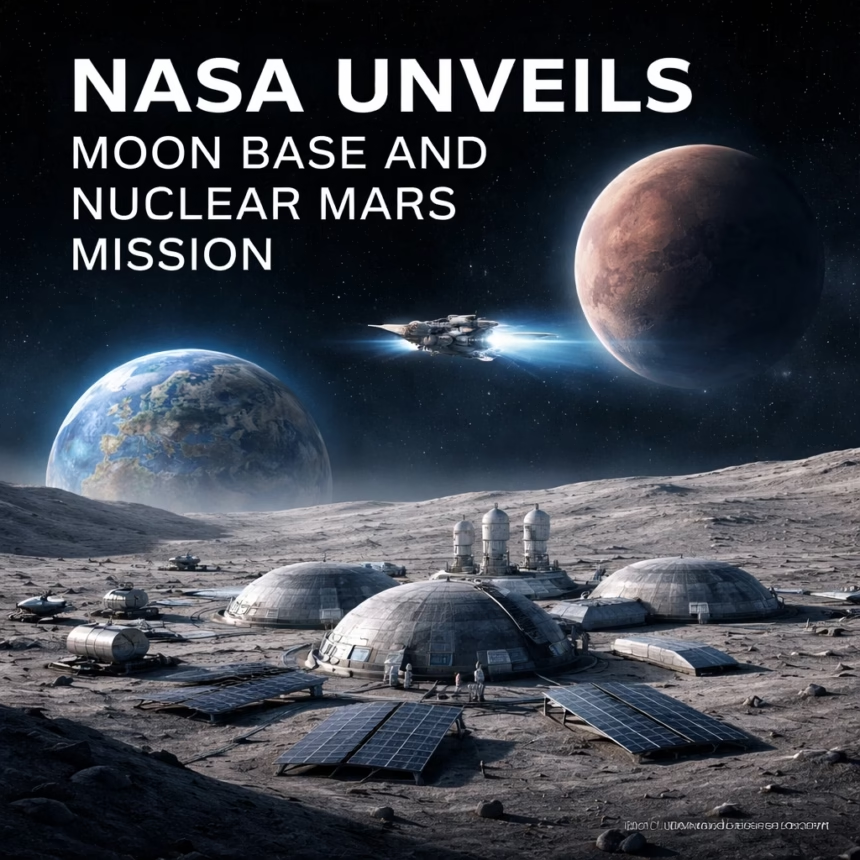
NASA's Ignition Plan: Moon Base & Nuclear Mars Mission
NASA Unleashes "Ignition": Moon Cities and Nuclear Rockets to Mars
NASA has unveiled its audacious "Ignition" plan, a comprehensive strategy detailing the establishment of a permanent human base on the Moon and the deployment of nuclear-powered missions to Mars. This ambitious roadmap, revealed recently at the agency's headquarters in Washington D.C., marks a significant pivot towards sustained deep-space human presence and exploration.
Background: A New Era of Exploration
For decades, NASA has pursued the dream of human expansion beyond Earth. The “Ignition” plan builds upon the foundational work of the Artemis program, which aims to return humans to the Moon by 2026 with Artemis III, establishing a long-term presence. This new strategy represents a crucial acceleration and expansion of those initial goals, integrating lunar development directly into the pathway for Mars colonization. Historically, concepts for nuclear propulsion to Mars have been studied since the 1960s with programs like NERVA (Nuclear Engine for Rocket Vehicle Application), but lacked the political will and technological maturity for full implementation. “Ignition” signals a renewed commitment, leveraging advancements in materials science, robotics, and miniaturization.
The agency’s long-term vision has always included Mars, with numerous robotic missions like the Perseverance rover providing invaluable data. However, human missions present immense challenges related to travel time, radiation exposure, and payload capacity. “Ignition” directly addresses these hurdles, proposing solutions that could redefine space travel and human capability beyond Earth’s orbit.
More Read

Key Developments: Lunar Outposts and Faster Transit
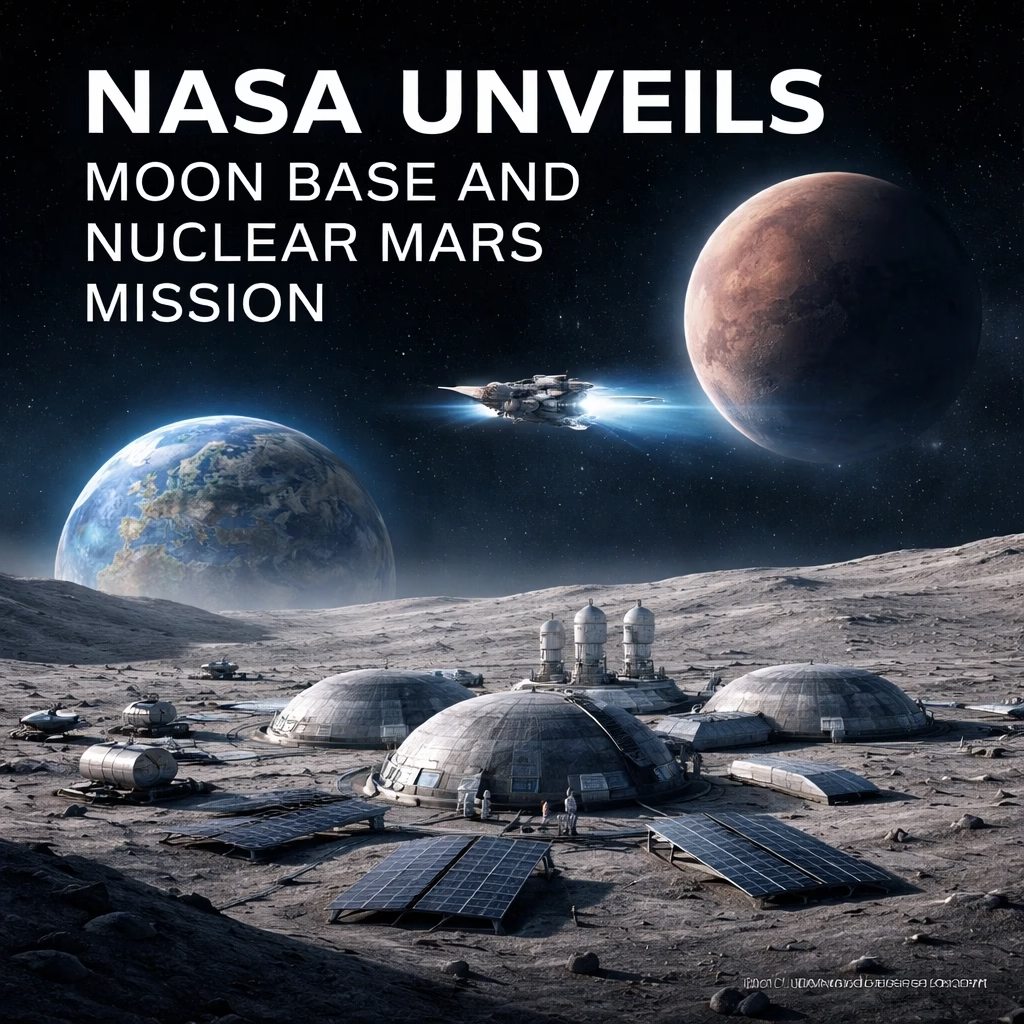
Central to the “Ignition” plan is the development of the “Lunar Gateway” orbital outpost and a subsequent surface base, provisionally named “Artemis Base Camp.” This lunar habitat, envisioned near the Moon’s South Pole, will leverage abundant water ice resources for propellant production and life support. NASA plans to deploy Fission Surface Power systems, small modular nuclear reactors, to provide continuous, high-power energy for the base, enabling extensive scientific research, resource extraction, and manufacturing. This self-sustaining lunar ecosystem is not merely a scientific endeavor but also a critical proving ground and staging area for future Mars missions, reducing reliance on Earth-launched supplies.
The most groundbreaking aspect of “Ignition” for Mars exploration involves advanced propulsion. NASA is committing to Nuclear Thermal Propulsion (NTP) technology, which uses a nuclear reactor to heat hydrogen propellant to extreme temperatures, expelling it through a nozzle for thrust. This technology promises to drastically cut transit times to Mars from the current seven to nine months down to as little as 45 days. Such a reduction significantly mitigates risks associated with cosmic radiation exposure for astronauts, reduces the psychological toll of long voyages, and lessens the amount of supplies needed, making crewed missions to the Red Planet far more feasible and safer. Initial test flights for NTP engines are projected within the next decade, accelerating the timeline for human deep-space travel.
Impact: A Multi-Planetary Future
The “Ignition” plan carries profound implications across multiple sectors. Scientifically, it opens unprecedented opportunities for astrobiological discovery on Mars, potentially uncovering signs of past or present life, and for understanding lunar geology and the solar system’s formation. The Moon base will serve as a unique observatory, shielded from Earth’s interference, and a laboratory for advanced materials science and manufacturing in a low-gravity vacuum.

Technologically, the development required for “Ignition” will foster innovation in areas such as advanced robotics, artificial intelligence, closed-loop life support systems, radiation shielding, and autonomous systems. These advancements are expected to have significant terrestrial spin-offs, benefiting industries from healthcare to energy production. Economically, the plan promises to spur job growth in aerospace, engineering, and manufacturing, while also fostering a burgeoning commercial space economy. Private companies are anticipated to play crucial roles in logistics, habitat construction, and resource utilization, creating new markets and opportunities.
Geopolitically, “Ignition” could solidify America’s leadership in space exploration, while also emphasizing international collaboration. Partnerships with space agencies from Europe, Japan, Canada, and others are crucial components, sharing both the immense costs and the scientific rewards. This collective human endeavor aims to unite nations under a common goal: becoming a multi-planetary species, securing humanity’s long-term future beyond Earth.
What Next: Milestones on the Horizon
The immediate future for “Ignition” involves several critical milestones. The Artemis program will continue its progression, with Artemis II conducting a crewed lunar flyby in 2024, followed by the highly anticipated Artemis III mission, which will land astronauts near the Moon’s South Pole in 2026. These missions are vital for testing lunar surface operations, resource prospecting, and validating technologies essential for the permanent base.
Concurrently, significant research and development efforts are underway for the Nuclear Thermal Propulsion system. NASA, in collaboration with the Department of Energy and private contractors, aims to conduct ground tests of a full-scale NTP engine within the next five to seven years. This testing phase is crucial for demonstrating the technology’s safety and reliability before it can be integrated into a crewed Mars transport vehicle. Funding approvals from Congress will be paramount for maintaining the ambitious schedule, requiring sustained political and public support.
Beyond hardware development, international partnerships will be solidified through formal agreements, outlining roles and responsibilities for the lunar base and future Mars missions. The first crewed mission to Mars under the “Ignition” plan is optimistically targeted for the early 2040s, representing a monumental leap in human exploration. Each step, from robotic precursors to orbital demonstrations, builds towards this ultimate goal, redefining humanity’s place in the cosmos.