
Cosmic Veil Revealed: New Telescope Uncovers Surprising Detail Around Distant Comet
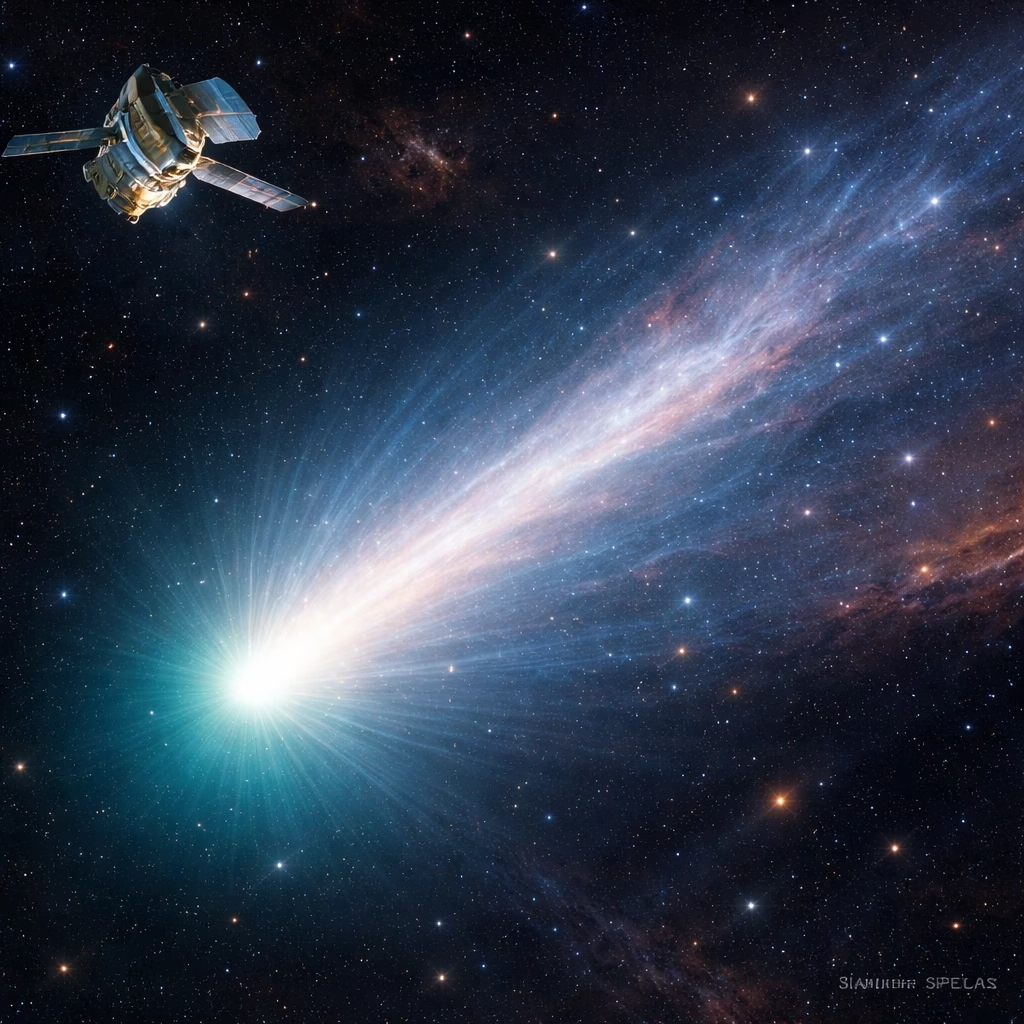
NASA’s SPHEREx mission has made a significant discovery, revealing a bright envelope surrounding Comet 3I/Atlas, a periodic comet last observed in 2019. The findings, announced on April 23, 2024, offer new insights into the comet’s composition and evolution, providing valuable data for understanding the early solar system.
Background
Comets are icy remnants from the formation of the solar system, often described as "dirty snowballs." They release gas and dust as they approach the Sun, creating a visible coma (atmosphere) and a tail. 3I/Atlas, discovered in 2019 by the ATLAS (Asteroid Terrestrial-impact Last Alert System) survey, has a relatively long orbital period of approximately 7.9 years. Studying comets like 3I/Atlas helps scientists understand the materials that seeded the planets and the conditions present during the solar system’s infancy.
SPHEREx (Space Telescope for High-redshift Exoplanets) is a NASA mission designed to map the chemical composition of the universe by observing infrared light from hundreds of thousands of galaxies. While primarily focused on exoplanets, SPHEREx’s capabilities extend to studying objects within our own solar system, including comets and asteroids. Its unique spectrograph allows it to analyze the light reflected from these objects, revealing the presence of various molecules.
More Read

Key Developments
SPHEREx, currently in commissioning and calibration phase, initially observed 3I/Atlas in March 2024. Initial data revealed the presence of a surprisingly bright and extensive envelope surrounding the comet’s nucleus – the solid core of the comet. This envelope is significantly larger than previously observed in similar comets. Further analysis confirmed the presence of methanol, a simple organic molecule, within this envelope. The brightness and extent of the envelope are unexpected and are prompting new research questions.
The observations were made using SPHEREx's Near-Infrared Spectrograph (NIRSpec), which measures the wavelengths of light reflected from the comet. This allows scientists to identify the chemical composition of the material making up the envelope.
Impact
This discovery has implications for understanding the evolution of cometary comae and the processes that release volatile materials from the nucleus. The presence of a large, bright envelope suggests that 3I/Atlas is undergoing significant outgassing, releasing substantial amounts of gas and dust as it journeys closer to the Sun.
More Read

The findings are of interest to planetary scientists, astronomers, and astrobiologists. Understanding the composition of cometary envelopes can provide clues about the building blocks of life and the delivery of water and organic molecules to early Earth. The data will also refine models of cometary activity and help predict future cometary behavior. The scientific community is particularly interested in comparing the envelope characteristics of 3I/Atlas with those of other comets to identify common patterns and variations.
What Next
SPHEREx will continue to observe 3I/Atlas as it approaches perihelion (the point in its orbit closest to the Sun), providing a more detailed understanding of the envelope’s structure and composition. Future observations will focus on mapping the distribution of methanol and other molecules within the envelope, as well as studying the dynamics of the outgassing process.
Further Investigation
Scientists plan to use SPHEREx to study other comets in the future, searching for similar bright envelopes and investigating the factors that contribute to their formation. This will involve analyzing data from a wide range of comets, including both well-studied and previously unobserved objects. The mission's data will also be made publicly available to the scientific community, encouraging further research and collaboration.
The data collected by SPHEREx is expected to significantly advance our understanding of comets and their role in the evolution of the solar system. The ongoing observations of 3I/Atlas represent just the beginning of this exciting new chapter in cometary science.