Jensen Huang Rewrites OpenAI Investment History: 'Never a Commitment'
Jensen Huang, CEO of Nvidia, recently delivered a significant clarification regarding his company's financial ties with OpenAI, the leading artificial intelligence research organization. During a recent press briefing, Huang asserted that any perceived direct investment commitment from Nvidia into OpenAI was inaccurate, characterizing the relationship instead as a broader, collaborative effort to foster the AI ecosystem.
This statement challenges a widely held assumption within the tech industry and among investors about the nature of Nvidia's support for one of its most prominent customers. It underscores the complex dynamics at play as hardware giants navigate relationships with the burgeoning AI software sector.
Background: The AI Ecosystem and Nvidia’s Pervasive Influence
Nvidia has long stood as the undisputed titan in the realm of artificial intelligence hardware, particularly through its high-performance Graphics Processing Units (GPUs). These specialized processors are the foundational engines powering nearly all advanced AI research and development, from large language models to complex neural networks.
OpenAI, catapulted into global prominence with the launch of ChatGPT in late 2022, represents the vanguard of generative AI. Its groundbreaking models demand immense computational power, making Nvidia's hardware not just preferred, but essential for its operations and continued innovation. This symbiotic relationship has often led to speculation about deeper financial integration.
Nvidia’s Role as the AI Enabler
For years, Nvidia has actively cultivated the AI ecosystem, not just by selling hardware, but also by providing software platforms like CUDA and investing in promising startups. The company's strategy involves empowering developers and researchers globally, thereby expanding the market for its core products.
This approach has seen Nvidia make strategic equity investments in numerous AI companies. Notable examples include Inflection AI, Cohere, Mistral AI, and Recursion Pharmaceuticals, signaling a clear pattern of direct financial backing for entities deemed crucial to the future of AI. The absence of a similar, publicly acknowledged equity stake in OpenAI has often been a point of quiet discussion.
The general perception, fueled by Nvidia's critical hardware supply and Huang's vocal support for OpenAI's advancements, often blurred the lines between a customer-supplier relationship and a more formal investment partnership. Industry analysts and media outlets frequently grouped OpenAI among the AI innovators receiving substantial backing from Nvidia.
Key Developments: Clarifying the Financial Relationship
Huang's recent remarks served to explicitly differentiate Nvidia's engagement with OpenAI from its direct investment activities. His words cut through the existing narrative, offering a nuanced perspective on how Nvidia perceives its role in supporting the AI industry's frontrunners.
The clarification comes at a time of intense scrutiny on the power dynamics within the AI sector, particularly regarding the relationships between dominant hardware providers and leading AI model developers. As the industry matures, the nature of these collaborations is becoming increasingly important for competitive and regulatory considerations.

Huang’s Direct Statement
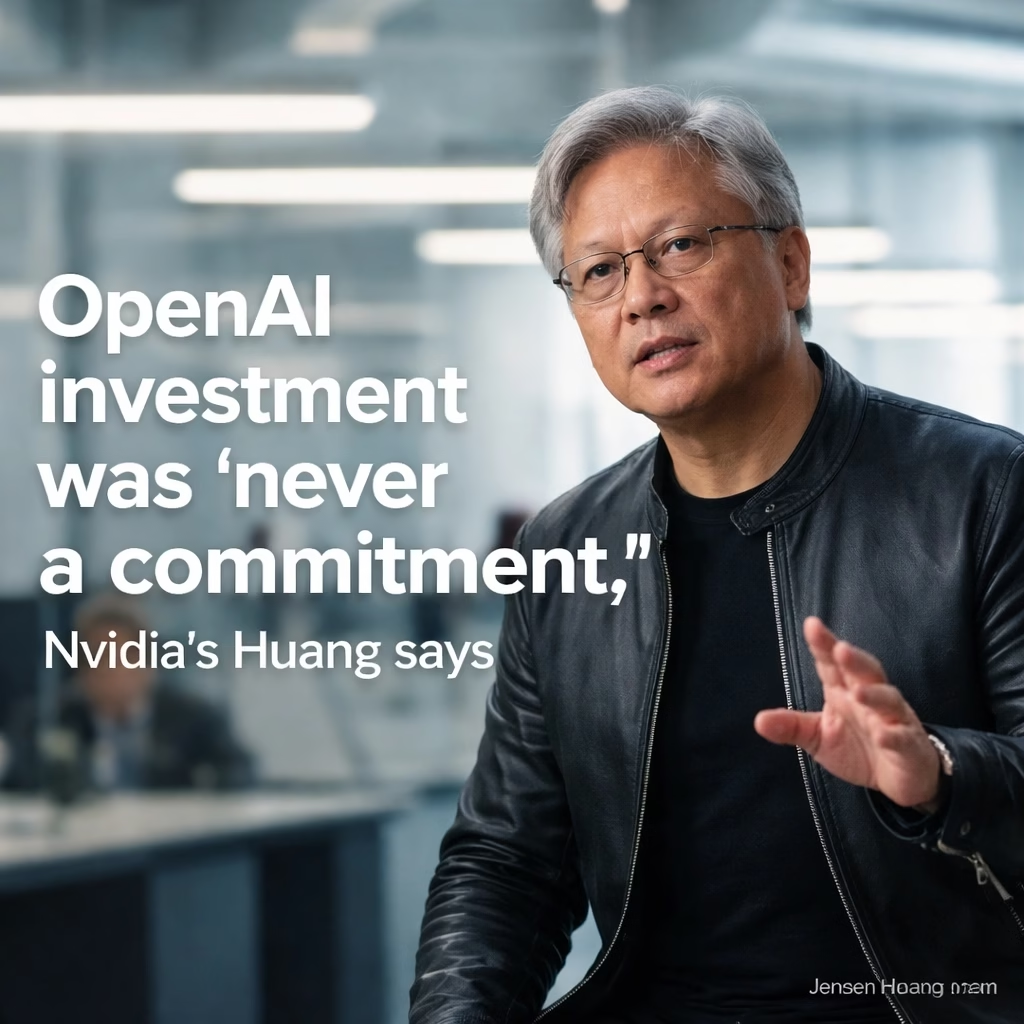
During the briefing, Huang was unequivocal. He stated, "It was never a commitment. It was just, you know, we always want to help the ecosystem." This phrasing is crucial, as it reframes Nvidia's support for OpenAI not as a venture capital endeavor, but as an intrinsic part of its broader mission to advance AI technology.
This "help" typically manifests in several ways: providing early access to cutting-edge GPUs, offering technical expertise for optimizing AI workloads, and fostering collaborative research on hardware-software co-design. These forms of support are invaluable to a company like OpenAI, which operates at the very frontier of AI development and requires the most advanced computational infrastructure available.
The distinction highlighted by Huang suggests that while Nvidia is indispensable to OpenAI's operational capabilities, this does not translate into an equity stake or a binding financial commitment akin to an investment. Instead, it positions Nvidia as a strategic partner and critical enabler, rather than a direct shareholder in OpenAI's corporate structure.
This clarification also subtly contrasts with OpenAI's primary financial backing, which famously comes from Microsoft. Microsoft's multi-billion dollar investment in OpenAI includes significant cloud computing credits and an exclusive partnership for commercializing OpenAI's models through Azure AI services.
Impact: Reshaping Perceptions and Strategic Positioning
Jensen Huang's statement carries implications for how both Nvidia and OpenAI are perceived within the rapidly evolving AI landscape. It challenges pre-existing assumptions and prompts a re-evaluation of the strategic alliances defining the industry.
For OpenAI, the practical impact on its operations or funding is likely minimal, given its substantial financial and infrastructural backing from Microsoft. However, it does clarify the narrative around its diverse support network, emphasizing Microsoft as its core strategic and financial partner, while Nvidia remains its critical hardware supplier and technological collaborator.
More Read

Implications for OpenAI and Nvidia
Nvidia, by drawing a clear line, reinforces its position as the neutral, indispensable "picks and shovels" provider in the AI gold rush. This stance could be strategically beneficial, allowing Nvidia to maintain strong relationships with all major AI players—including competitors of OpenAI—without appearing to favor one through direct equity investment.
This neutrality is paramount in an industry where major tech giants are fiercely competing to develop their own foundational models and AI platforms. Nvidia supplies hardware to virtually all of them, from Google's DeepMind to Meta's AI research and Amazon's AWS AI initiatives. Avoiding perceived favoritism through direct investment in a single entity like OpenAI helps Nvidia sustain its broad market penetration.
For investors, the clarification may solidify Nvidia's image as a pure-play hardware and platform provider, whose growth is tied to the overall expansion of the AI market rather than the individual success of specific AI startups it might invest in. It underscores that Nvidia's primary value proposition lies in its technological leadership and manufacturing prowess, not its venture capital portfolio.
The broader AI industry might also take note. It could signal a trend where hardware providers, while deeply embedded in the ecosystem, prefer to maintain a degree of financial separation from their key customers, especially those with significant alternative funding. This approach could mitigate potential antitrust concerns by demonstrating a focus on enabling competition rather than consolidating power through cross-ownership.
What Next: The Evolving Landscape of AI Collaboration
The relationship between hardware innovators like Nvidia and AI model developers such as OpenAI will continue to evolve, driven by relentless technological advancements and shifting market dynamics. Huang's recent comments provide a clearer lens through which to view these complex interdependencies.
Nvidia is expected to maintain its aggressive roadmap for next-generation AI accelerators, with architectures like Blackwell already set to push the boundaries of computational power. These advancements will continue to be critical for OpenAI and other AI labs as they develop increasingly sophisticated and resource-intensive models.
Future of AI Hardware and Software Synergy
OpenAI, for its part, will continue its focus on developing advanced generative AI models, likely culminating in future iterations beyond GPT-4. Its reliance on state-of-the-art GPUs will only deepen, ensuring that the operational relationship with Nvidia remains robust, even without a direct equity investment.
The "ecosystem" approach championed by Huang will likely persist, with Nvidia continuing to engage in various forms of support for a wide array of AI startups and research institutions. This includes strategic partnerships, joint development projects, and potentially future equity investments in companies that align with its long-term vision for AI infrastructure.
Future statements from Nvidia executives may further elaborate on the distinctions between strategic partnerships, collaborative development, and direct financial investments, providing more transparency to the market. This clarity is vital as the AI industry matures and stakeholders seek a deeper understanding of the intricate web of relationships that define it.
Ultimately, while the perception of a direct investment commitment has been dispelled, the fundamental, symbiotic relationship between Nvidia's hardware and OpenAI's software innovation remains undiminished. It is a relationship built on technological necessity and mutual benefit, underpinning the rapid advancements witnessed across the artificial intelligence frontier.