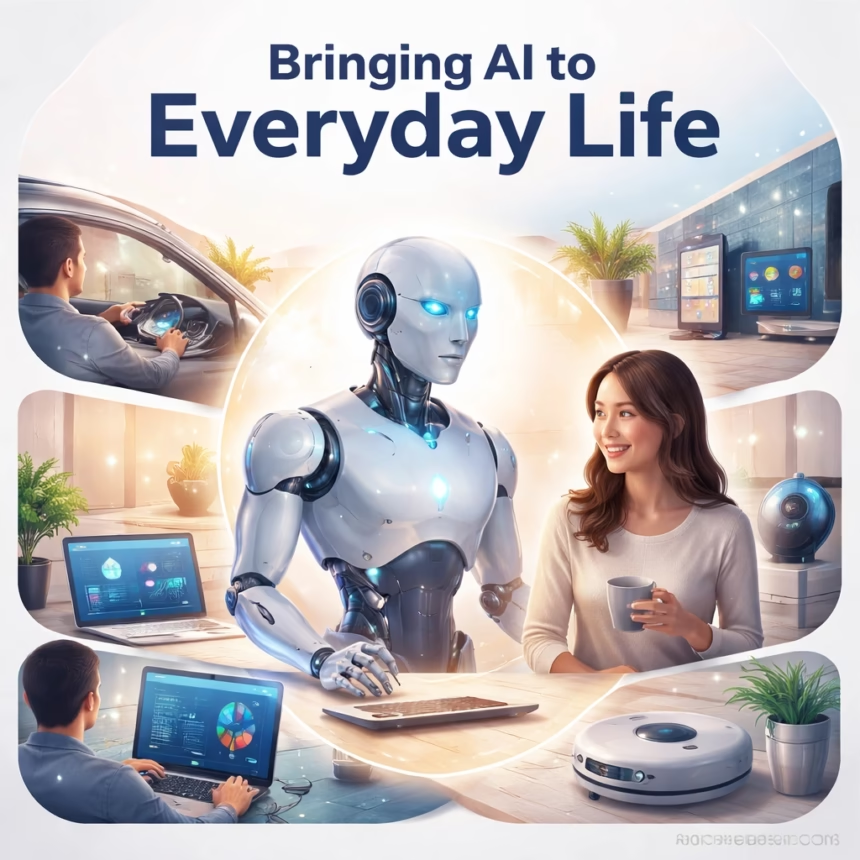
San Francisco, CA – OpenAI, the leading artificial intelligence research and deployment company, announced a significant expansion of its efforts to integrate AI into everyday applications on November 8, 2023. The initiative aims to make AI tools more accessible and useful to a broader global audience, moving beyond specialized developer use cases.

Background: From Research Lab to Everyday Tool
Founded in December 2015, OpenAI initially focused on fundamental AI research, driven by a mission to ensure that artificial general intelligence (AGI) benefits all of humanity. Early breakthroughs included the development of the GPT (Generative Pre-trained Transformer) series of language models, starting with GPT-1 in 2018. These models demonstrated remarkable capabilities in natural language processing, sparking widespread interest and investment in the field.
Over the past few years, OpenAI has rapidly evolved, transitioning from a primarily research-oriented organization to a commercially driven entity. Key milestones include the release of GPT-2 (2019), GPT-3 (2020), and the highly advanced GPT-4 (March 2023). The company also launched DALL-E (2021), an AI system that creates images from textual descriptions, and ChatGPT (November 2022), a conversational AI chatbot that quickly gained global popularity.
Key Developments: Democratizing AI Access
The recent announcement details a multi-pronged strategy to broaden AI adoption. A central element is the expansion of OpenAI's API (Application Programming Interface), making its models more readily available to developers worldwide. This allows businesses to integrate AI functionality into their existing products and services with relatively minimal technical expertise.

Furthermore, OpenAI is actively partnering with major technology companies. A significant collaboration with Microsoft, initiated in 2019, continues to be crucial, with Microsoft investing billions of dollars in OpenAI and integrating its AI technology into products like Microsoft 365 and Azure cloud services. The company is also exploring partnerships with smaller startups to facilitate the development of specialized AI applications.
Another key development is the focus on creating more user-friendly interfaces. OpenAI is investing in tools and platforms that abstract away the complexities of AI model management, enabling non-technical users to leverage its capabilities. This includes improvements to ChatGPT's interface and the development of new tools for creating and customizing AI agents.
Impact: Reshaping Industries and Daily Life
The widespread adoption of OpenAI's AI technology is poised to have a profound impact across numerous sectors. In customer service, AI-powered chatbots are becoming increasingly prevalent, providing instant support and resolving common queries. In content creation, tools like DALL-E and ChatGPT are empowering users to generate text, images, and even code with unprecedented ease.
More Read

The impact extends to education, with AI tools offering personalized learning experiences and automated grading assistance. In healthcare, AI is being used for drug discovery, medical image analysis, and patient monitoring. Retail is seeing AI-driven recommendations and personalized shopping experiences. However, the shift also raises concerns about job displacement in certain fields and the potential for misuse of AI technology.
Specifically, the increased accessibility of powerful language models like GPT-4 has spurred a wave of innovation in areas like coding assistance, automated writing, and data analysis. This is particularly impacting software development, where AI tools are being used to accelerate the coding process and improve code quality. Small businesses are also benefiting, gaining access to AI capabilities previously only available to larger corporations.
What Next: Towards Ubiquitous AI
AI Agents and Personal Assistants
OpenAI is heavily investing in the development of AI agents – autonomous AI systems capable of performing complex tasks. These agents are envisioned as personal assistants that can manage schedules, automate workflows, and proactively address user needs. The company aims to release more sophisticated AI agent platforms in 2024.
Multimodal AI
A key area of future development is multimodal AI, which allows models to process and generate information across different modalities, such as text, images, and audio. This will enable more natural and intuitive interactions with AI systems. OpenAI is actively working on improving the capabilities of GPT-4 in this area.
Safety and Ethical Considerations
Recognizing the potential risks associated with advanced AI, OpenAI is committed to prioritizing safety and ethical considerations. This includes investing in research to mitigate bias, prevent misuse, and ensure that AI systems are aligned with human values. The company is actively collaborating with policymakers and researchers to develop responsible AI guidelines.
OpenAI’s ultimate goal is to make AI a beneficial tool for everyone, transforming how we work, learn, and interact with the world around us. The coming years will be critical in shaping the future of AI and ensuring that its potential is realized responsibly.