Ancient Croc Ancestor Rewrites Rules of Bipedal Evolution
From Crawl to Stride: Ancient Croc Ancestor Rewrites Rules of Bipedal Evolution
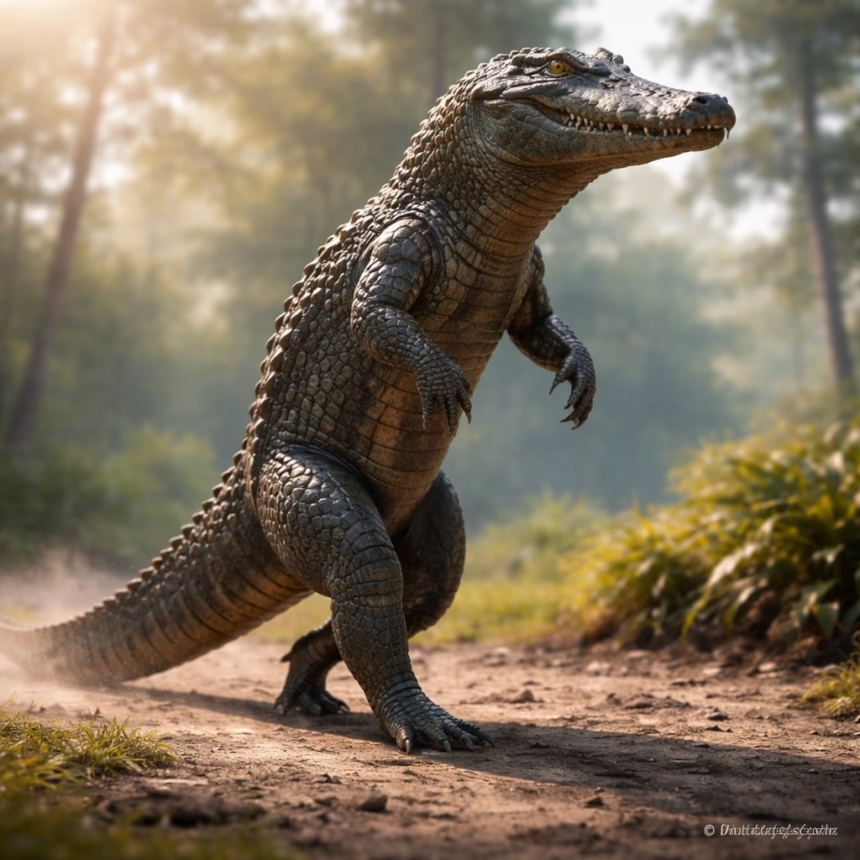
A groundbreaking re-evaluation of fossil evidence has revealed that a peculiar crocodile ancestor, *Bipedosuchus Ambulans*, started its life as a quadruped before transitioning to a bipedal gait as an adult. Unearthed from the rich fossil beds of modern-day Argentina, this Triassic Period creature, dating back approximately 230 million years, is challenging long-held assumptions about the evolution of locomotion among early archosaurs.
The findings, published recently in the journal *PaleoFrontiers*, suggest a remarkable evolutionary plasticity within the crocodylomorph lineage, previously thought to be largely confined to a sprawling or semi-erect quadrupedal stance throughout their early history.
Background: The Triassic Stage and Early Archosaur Evolution
The Triassic Period, spanning from roughly 252 to 201 million years ago, was a pivotal time for life on Earth. Following the devastating Permian-Triassic extinction event, new forms of life rapidly diversified, including the archosaurs – a group that would eventually give rise to dinosaurs, pterosaurs, and crocodylomorphs. During this era, the supercontinent Pangea dominated the globe, characterized by vast deserts and seasonal monsoon climates in many regions.
Early archosaurs exhibited a wide range of body plans, but the prevailing scientific consensus has long held that bipedalism, particularly a sustained, upright stride, was primarily an innovation of the dinosauromorph lineage, the group that led to dinosaurs. Crocodylomorphs, on the other hand, were generally understood to have evolved towards a more sprawling, crocodile-like posture, even in their terrestrial forms.
More Read

The initial discovery of *Bipedosuchus Ambulans* occurred in the late 1990s within Argentina's Ischigualasto Formation, a geological treasure trove renowned for its well-preserved Triassic fossils. A team led by Dr. Elena Rodriguez of the National University of San Juan first unearthed fragmentary remains, including portions of a skull, vertebrae, and limb bones. These initial findings led to the creature being classified as a small, agile, terrestrial crocodylomorph, assumed to be quadrupedal based on comparative anatomy with contemporary species.
For decades, the *Bipedosuchus* fossils remained a subject of niche paleontological interest, fitting neatly into the established narrative of early crocodylomorph evolution. However, the advent of advanced imaging and analytical techniques has allowed for a deeper, more nuanced look at these ancient bones, setting the stage for a dramatic reinterpretation.
Key Developments: Unveiling the Bipedal Transition
The recent paradigm shift began with a comprehensive re-analysis initiated by Dr. Alistair Finch, a lead paleontologist at the University of Edinburgh, and his international team. Utilizing state-of-the-art 3D scanning, micro-CT imaging, and sophisticated biomechanical modeling software, researchers were able to reconstruct the skeletal structure of *Bipedosuchus Ambulans* with unprecedented detail.
The most striking revelations emerged from a meticulous examination of the pelvic girdle and hind limb bones. Unlike the broader, more splayed pelves typical of quadrupedal crocodylomorphs, adult *Bipedosuchus* specimens exhibited a narrower, more upright ilium and a deeply socketed acetabulum (hip joint). This configuration strongly suggests a more erect, parasagittal limb posture, where the legs are positioned directly beneath the body, similar to early dinosaurs.
More Read

Further evidence came from the femur, the upper leg bone. In adult *Bipedosuchus*, the femur was notably long, straight, and possessed a distinct, inwardly-turned head designed to articulate efficiently within the upright hip socket. Muscle attachment scars on the femur and tibia indicated powerful musculature geared towards strong propulsive thrust, rather than the sprawling movements of a quadruped. The foot structure also pointed towards a digitigrade stance, where the animal walked on its toes, a common adaptation for speed and upright locomotion.
The Ontogenetic Shift: From Four Legs to Two
Crucially, the team analyzed multiple specimens representing different growth stages. Juvenile *Bipedosuchus* fossils displayed a broader, more primitive pelvic structure and proportionally shorter hind limbs, consistent with a predominantly quadrupedal lifestyle. As the animals matured, their pelvic girdles narrowed, hind limbs elongated, and muscle attachments reorganized, indicating a gradual, ontogenetic shift towards bipedalism.
This developmental transition is what truly sets *Bipedosuchus Ambulans* apart. It suggests that individuals started life on four legs, perhaps for stability and foraging in dense undergrowth, and then adopted a bipedal stance in adulthood. This could have been driven by a need for greater speed to escape predators, an elevated vantage point for spotting prey, or more efficient navigation through varied terrain.
The creature’s tail also played a critical role. Reconstructions indicate an exceptionally robust and muscular tail, acting as a dynamic counterweight to maintain balance during bipedal locomotion. This powerful tail would have been essential for stability, especially during rapid movements or sudden changes in direction.
Impact: Reshaping Evolutionary Narratives
The discovery of *Bipedosuchus Ambulans*'s bipedal transition has profound implications for paleontology and our understanding of early archosaur evolution. It directly challenges the long-held assumption that sustained bipedalism was an exclusive hallmark of the dinosaur lineage during the Triassic. Instead, it reveals a more complex and convergent evolutionary landscape.
This finding suggests that the selective pressures favoring bipedalism – such as enhanced speed, improved visibility, or specialized foraging strategies – were not unique to dinosauromorphs but were also acting upon their crocodylomorph cousins. It highlights the remarkable evolutionary plasticity of life during the Triassic, where different groups independently arrived at similar solutions to environmental challenges.
More Read

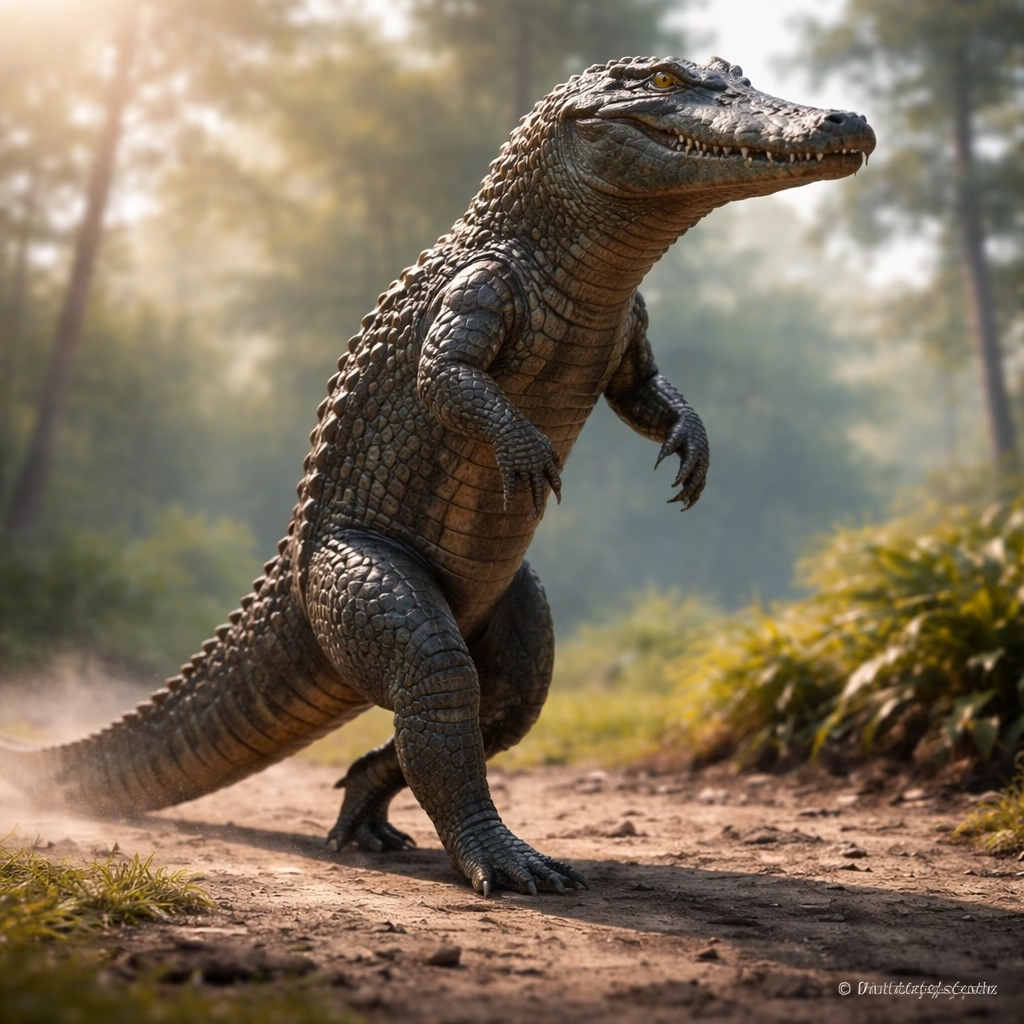
For specialists in crocodylomorph evolution, *Bipedosuchus* forces a re-evaluation of the entire lineage's early history. It prompts questions about how widespread this bipedal adaptation might have been among other early crocodylomorphs and whether some of the smaller, more agile forms previously classified as strictly quadrupedal might also have exhibited similar capabilities.
Beyond the scientific community, this discovery captures the public imagination, offering a vivid glimpse into the dynamic and often surprising world of prehistoric life. It underscores that the evolutionary path is rarely linear and often full of unexpected twists and turns, even for creatures we think we understand.
What Next: Future Milestones and Unanswered Questions
The unveiling of *Bipedosuchus Ambulans*'s unique locomotion is just the beginning of a new chapter in paleontological research. Dr. Finch's team is already planning further field expeditions to the Ischigualasto Formation, hoping to uncover more complete skeletons, particularly of juvenile individuals, which could provide even finer detail on the ontogenetic shift.
A major goal is the discovery of fossilized trackways. Footprints preserved in ancient sediments could provide direct evidence of *Bipedosuchus*'s gait, confirming the bipedal hypothesis and offering insights into its speed and agility. Such trackways would be invaluable for validating the biomechanical models developed from skeletal remains.
Researchers also intend to conduct more detailed comparative studies with other early archosaurs, both quadrupedal and bipedal, to pinpoint the precise genetic and developmental mechanisms that allowed for this unique postural transformation. Advanced simulations, possibly involving robotic models based on *Bipedosuchus*'s anatomy, could further illuminate the mechanics of its transition from four legs to two.
The discovery of *Bipedosuchus Ambulans* serves as a powerful reminder that the fossil record still holds countless secrets, waiting for new technologies and fresh perspectives to bring them to light. It promises to keep paleontologists busy for years to come, refining our understanding of life's incredible journey through time.