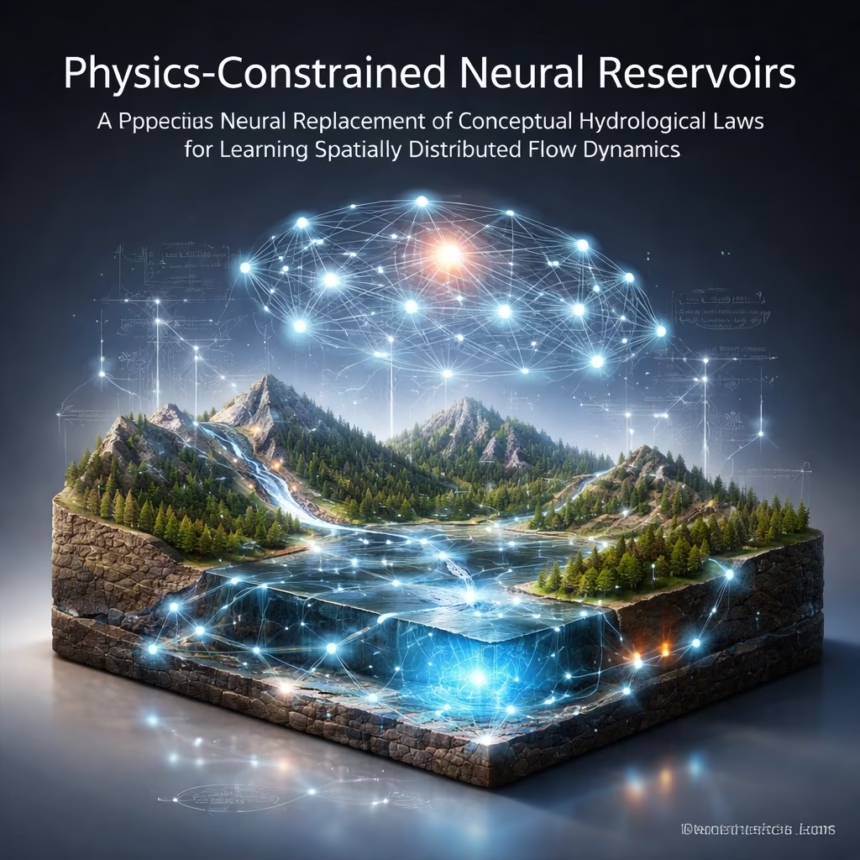
AI Breakthrough: Predicting Rivers with Artificial Brains
Researchers at the Swiss Federal Institute of Technology (ETH Zurich) have unveiled a novel artificial intelligence system that promises a significant leap in predicting complex river flow dynamics. The system, leveraging physics-constrained neural networks, aims to replace traditional, often simplified, hydrological models with a more nuanced and accurate approach, particularly relevant in regions facing increasing flood risks. The research, published in *Nature Communications* on October 26, 2023, showcases promising results in simulating river behavior.
Background: The Limits of Traditional Hydrology
For decades, hydrologists have relied on mathematical models to forecast river flows, a critical task for flood management, water resource planning, and hydropower generation. These models often incorporate simplified representations of physical processes like gravity, fluid dynamics, and soil interactions. While effective in many scenarios, they struggle to accurately capture the intricate, spatially distributed behavior of rivers, especially in complex terrains. Traditional models frequently require extensive calibration using historical data and can be computationally expensive.
The limitations of these models became increasingly apparent following major flood events in Europe, Asia, and North America throughout the 21st century. Events like the 2018 flooding in Italy and the 2021 floods in Germany highlighted the need for more sophisticated predictive capabilities.
Key Developments: Neural Networks with Physical Constraints
The ETH Zurich team, led by Professor Markus Gross, has developed a neural network architecture specifically designed to address these shortcomings. This "physics-constrained neural reservoir" integrates the power of deep learning with fundamental physical laws governing fluid flow. Instead of simply learning from data, the network is structured to respect principles like conservation of mass and momentum. This constraint helps prevent the network from generating physically implausible solutions.
More Read

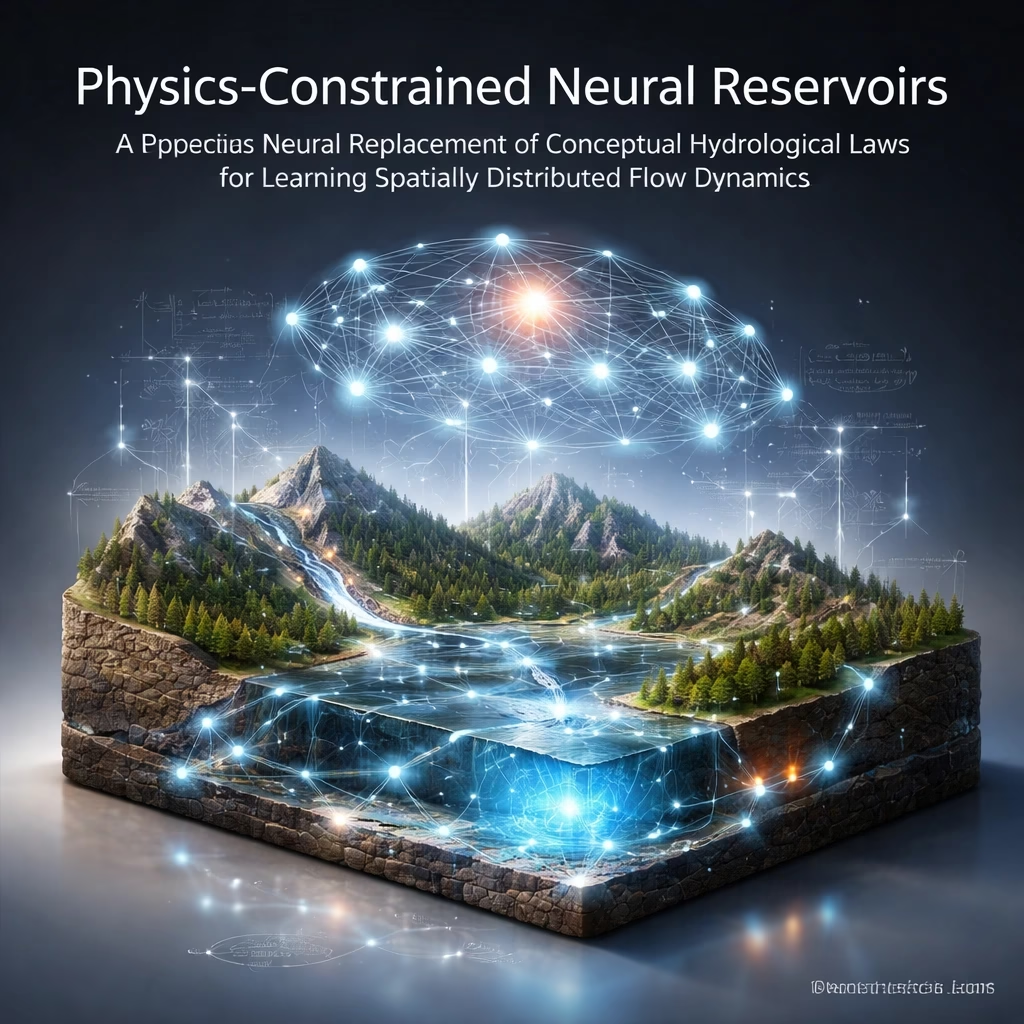
The core innovation lies in using a "reservoir computing" approach, a type of recurrent neural network. This allows the system to efficiently process sequential data representing river flow over time. The network is trained on high-resolution topographical data from the Swiss National Centre for Hydrology (SNH) and historical flow measurements from various river systems in Switzerland. Experiments have shown the AI can accurately predict river flow up to several days in advance, often outperforming traditional models, particularly in areas with complex channel geometries.
How it Works
The system utilizes a recurrent neural network where the “reservoir” is a randomly connected network that processes the input data. This reservoir is then followed by a readout layer that predicts future flow. By incorporating physical constraints into the reservoir’s architecture and training process, the system is guided towards solutions that are physically realistic.
More Read

Impact: Reshaping Flood Risk Management
The potential impact of this technology is substantial. Accurate river flow predictions are crucial for early warning systems, enabling timely evacuations and mitigating flood damage. The system could also assist in optimizing reservoir operations for water supply and flood control. Beyond Switzerland, the technology has broad applicability to regions with significant river networks, including those in the United States, India, and Brazil.
Local authorities and water management agencies are key stakeholders that stand to benefit from this advancement. The system offers a more reliable tool for assessing flood risks and making informed decisions about infrastructure investments and disaster preparedness strategies.
What Next: Towards Real-Time Forecasting
The ETH Zurich team is currently focused on improving the system's computational efficiency and expanding its applicability to a wider range of river systems. A key goal is to develop a real-time forecasting capability that can provide up-to-the-minute predictions based on live sensor data. They are also working on incorporating additional physical processes, such as sediment transport and vegetation effects, to further enhance the model's accuracy.
Future research will also explore the integration of the AI system with existing hydrological models, creating a hybrid approach that combines the strengths of both data-driven and physically-based methods. The team plans to collaborate with several international research institutions and water management agencies to validate the system's performance in diverse geographical settings by 2025.
Potential Challenges
Despite the promising results, challenges remain. The system’s performance is heavily reliant on the quality and availability of high-resolution topographical and flow data. Furthermore, the computational cost of training and running the network can be significant, requiring powerful computing infrastructure.