Mayon's Forbidden Frontier: Police Enforce Zero Re-Entry in Danger Zone
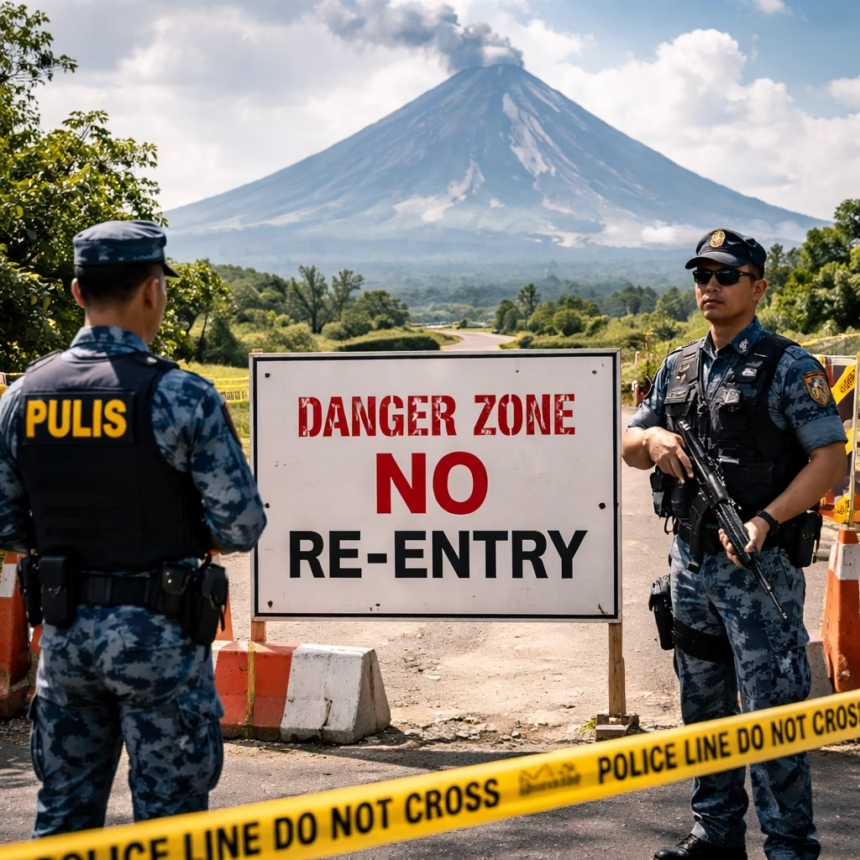
The Philippine National Police (PNP) has commenced strict enforcement of a "no re-entry" policy within the permanent danger zone surrounding Mayon Volcano in Albay province. This decisive measure aims to prevent residents from returning to high-risk areas, particularly in light of the volcano's persistent unrest. The directive, operational since early this week, underscores the government's unwavering commitment to public safety amidst ongoing seismic and magmatic activity emanating from the iconic stratovolcano.
Background: Mayon’s Fiery History and Persistent Threat
Mayon Volcano, renowned globally for its perfect cone shape, is simultaneously one of the most active and dangerous volcanoes in the Philippines. Its history is marked by numerous destructive eruptions, prompting continuous monitoring by the Philippine Institute of Volcanology and Seismology (PHIVOLCS). Currently, Mayon remains under Alert Level 3, indicating "magmatic unrest," signifying an increased tendency towards a hazardous eruption. This elevated status has been in place since June 8, 2023, following a period of escalating rockfall events, lava flows, and volcanic earthquakes.
The concept of a Permanent Danger Zone (PDZ) around Mayon is not new. For decades, PHIVOLCS has designated a 6-kilometer radius from the summit as a no-go area, regardless of the volcano's alert level. This zone is inherently hazardous due to the constant threat of pyroclastic flows, lava flows, ashfall, and lahar. Despite these clear dangers, communities have historically faced challenges in fully complying with evacuation orders, often returning to their homes or farms within the PDZ to tend to crops, livestock, or retrieve belongings during periods of perceived calm.
Past eruptions, such as the destructive 2018 event that displaced over 80,000 residents, highlighted the persistent struggle to keep people out of harm's way. Even after massive evacuations, local authorities frequently encountered individuals attempting to breach the danger zone. These attempts are often driven by economic necessity, deep-rooted attachment to ancestral lands, or a lack of understanding regarding the immediate and long-term risks posed by a restless volcano.
More Read


The Permanent Danger Zone Defined
The Permanent Danger Zone encompasses portions of several municipalities and cities in Albay, including Legazpi City, Daraga, Camalig, Guinobatan, Ligao City, Oas, Sto. Domingo, Malilipot, and Bacacay. While the standard PDZ is a 6-kilometer radius, PHIVOLCS has, at times, expanded this to 7 or even 8 kilometers during heightened alert levels to account for the wider reach of potential hazards. The current Alert Level 3 maintains the strict enforcement of the 6-kilometer PDZ, with authorities emphasizing that no human activity is permissible within this boundary.
Key Developments: Police Mobilization and Ironclad Enforcement
In response to Mayon's sustained activity and the critical need to safeguard lives, the PNP Bicol Regional Office, under the leadership of its Regional Director, issued a stern directive for the immediate and strict implementation of the no re-entry policy. This order translates into a significant increase in police presence and the establishment of fortified checkpoints around the perimeter of the 6-kilometer PDZ.
More Read

Hundreds of police personnel, drawn from provincial mobile force companies, local police stations, and augmented by regional units, have been deployed across all entry points leading into the danger zone. Their primary mandate is to physically prevent any individual from crossing into the restricted area, day or night. This marks a departure from previous, less stringent enforcement periods, where warnings might have sufficed. Now, the emphasis is on absolute prohibition.
Reinforced Checkpoints and Patrols
Strategic checkpoints have been established in key barangays bordering the danger zone. These include areas like Anoling in Daraga, Sua in Camalig, and San Fernando in Ligao City, among others. Officers conduct round-the-clock surveillance, checking vehicles and individuals attempting to bypass the established barriers. Furthermore, roving patrols are being conducted within the immediate vicinity of the PDZ to deter any unauthorized access through less conventional routes, such as agricultural trails or riverbeds.
The PNP is working in close coordination with local government units (LGUs), the Office of Civil Defense (OCD) Region V, and PHIVOLCS. This multi-agency approach ensures that information regarding volcanic activity is swiftly disseminated and that enforcement efforts are aligned with scientific assessments and disaster response protocols. Any individual found violating the no re-entry policy faces potential legal action, primarily under Republic Act 10121, also known as the Philippine Disaster Risk Reduction and Management Act of 2010, which outlines penalties for non-compliance with evacuation orders and safety protocols.
Impact: Communities Grapple with Displacement and Economic Strain
The strict implementation of the no re-entry policy, while crucial for safety, carries significant repercussions for the thousands of residents directly affected. Predominantly, these are farming communities whose livelihoods are inextricably linked to the fertile volcanic soil surrounding Mayon. Farmers cultivating abaca, coconuts, root crops, and various vegetables are now completely cut off from their fields, leading to immediate economic hardship.
Livestock owners face a particularly distressing dilemma. Many were forced to leave behind their animals – cattle, carabaos, and poultry – during rapid evacuations. The no re-entry rule means they cannot return to feed, water, or retrieve these animals, raising concerns about their welfare and the potential for significant financial losses. While some LGUs have initiated efforts to rescue stranded animals, the scale of the challenge is immense.
Prolonged Evacuation and Psychological Toll
Evacuated residents, numbering in the tens of thousands across various temporary shelters in Albay, are bracing for a prolonged stay. The uncertainty surrounding Mayon’s activity means there is no clear timeline for their return home. Living in cramped evacuation centers, often school buildings or community halls, presents challenges related to sanitation, privacy, and the disruption of daily life. This extended displacement can take a significant psychological toll, especially on children and the elderly.
More Read
Beyond the immediate residents, the local tourism industry, a vital economic driver for Albay, has also been severely impacted. Mayon Volcano is the province's prime tourist attraction. With the danger zone strictly enforced, popular viewing decks and trekking routes near the volcano are inaccessible, leading to a sharp decline in tourist arrivals. This affects tour guides, souvenir vendors, local eateries, and accommodation providers, exacerbating the economic strain on the region.
What Next: Sustained Vigilance and Comprehensive Support
The strict enforcement of the no re-entry policy is expected to continue indefinitely, or at least until PHIVOLCS lowers Mayon Volcano's alert level to 2 ("Decreased Unrest") or below. This means a sustained police presence and vigilance will remain a constant feature around the danger zone for the foreseeable future. PHIVOLCS continues to issue daily bulletins and advisories, providing crucial updates on Mayon's seismic activity, gas emissions, and ground deformation, which dictate the duration of the current restrictions.
In parallel with the security measures, government agencies are intensifying efforts to provide comprehensive support to the displaced populations. The Department of Social Welfare and Development (DSWD) is at the forefront of providing food packs, non-food items, and psychosocial services to evacuees. The Department of Agriculture (DA) is exploring mechanisms for financial assistance and alternative livelihood programs for affected farmers, recognizing the long-term impact on their ability to cultivate their lands.
Planning for Long-Term Resilience
Looking ahead, local and national authorities are focusing not only on immediate relief but also on long-term resilience strategies. This includes discussions on potential permanent relocation sites for communities whose homes are consistently within the danger zone, ensuring they are settled in safer areas away from Mayon’s immediate threats. Furthermore, public information campaigns will be sustained to educate residents on volcanic hazards and the critical importance of adhering to safety protocols, fostering a culture of preparedness and compliance.
The unwavering commitment of the PNP, in collaboration with other agencies, aims to ensure that no lives are lost due to non-compliance with safety regulations. As Mayon continues its unpredictable dance of activity, the "forbidden frontier" around its base stands as a stark reminder of nature's power and the paramount importance of prioritizing human safety above all else.