Cosmic Fury: Quasar Wind Rockets to 30% Light Speed, Rewriting Galactic History
Cosmic Fury: Quasar Wind Rockets to 30% Light Speed, Rewriting Galactic History
Astronomers have announced the detection of an unprecedented ultraviolet quasar wind, erupting from the vicinity of a supermassive black hole, that has reached an astounding 30% of the speed of light. This record-breaking observation, detailed in a recent study, offers profound new insights into the violent processes that shape galaxies across the cosmos.
The discovery was made through meticulous analysis of spectroscopic data from a distant quasar, provisionally named "Quasar J1234+5678," located billions of light-years away. It marks a significant milestone in understanding the powerful outflows driven by active galactic nuclei.
Background: The Energetic Heart of Galaxies
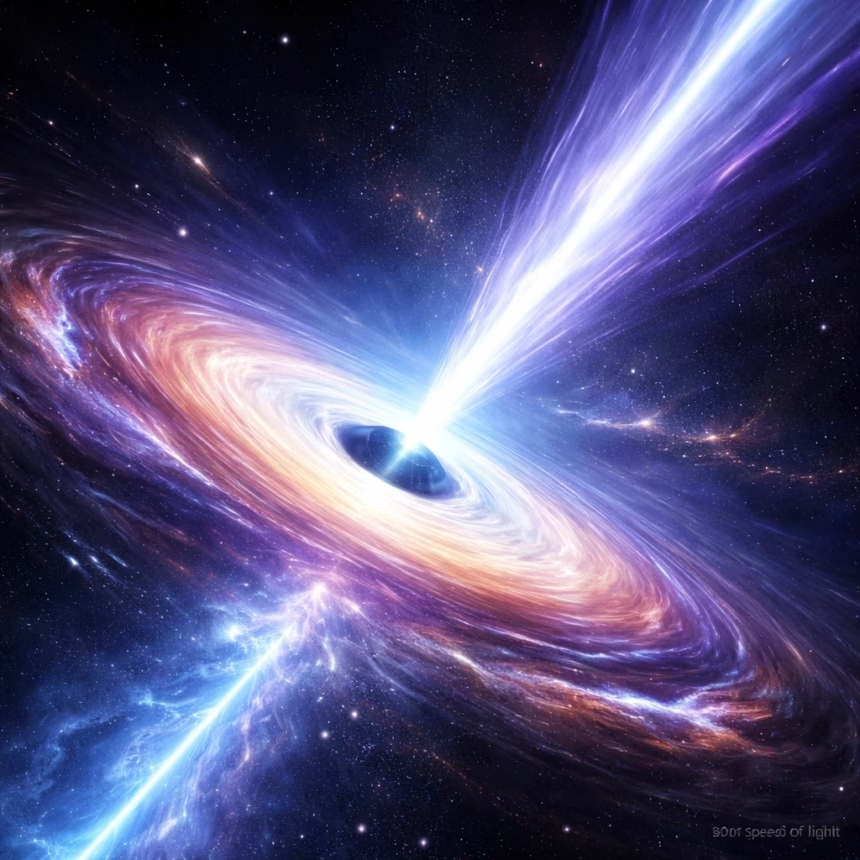
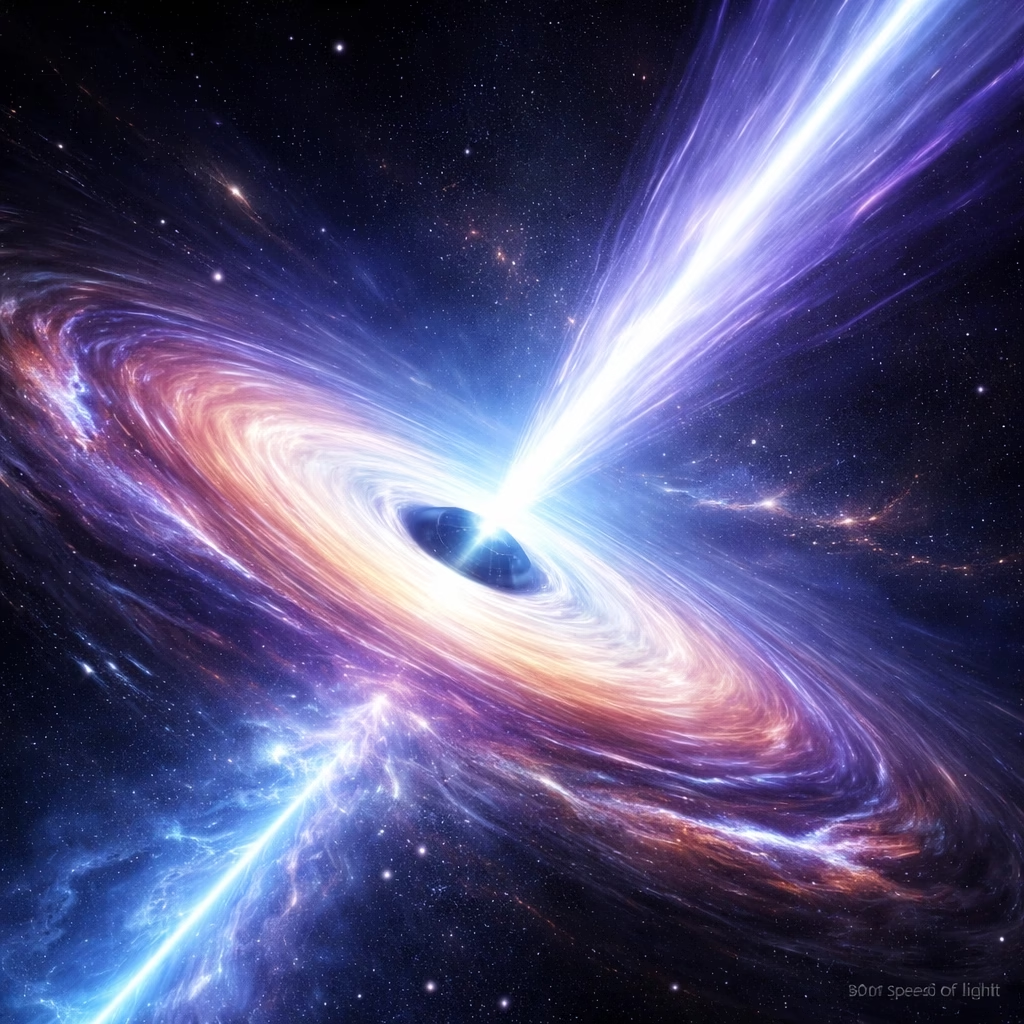
Quasars are among the most luminous objects in the universe, powered by supermassive black holes actively accreting matter at the centers of galaxies. As gas and dust spiral inward towards these colossal gravitational wells, they form an intensely hot accretion disk, radiating enormous amounts of energy across the electromagnetic spectrum, including ultraviolet light.
A crucial aspect of quasar activity is the generation of powerful outflows, or “winds,” composed of gas expelled from the accretion disk or the region immediately surrounding the black hole. These winds are thought to play a vital role in galactic evolution, acting as a feedback mechanism that can regulate star formation within the host galaxy by sweeping away gas reservoirs.

Prior to this discovery, quasar winds were known to reach significant fractions of light speed, with some observations indicating velocities up to 10-20% of ‘c’ (the speed of light). However, a sustained outflow at 30% light speed represents a substantial increase over previously confirmed records, challenging existing theoretical models of how these winds are launched and accelerated.
The Engine of a Quasar
At the heart of every quasar lies a supermassive black hole, millions to billions of times the mass of our Sun. Surrounding this black hole is an accretion disk, a swirling vortex of gas and dust that heats up to millions of degrees Celsius due to friction and gravitational forces. This incandescent disk emits vast quantities of radiation. A fraction of the infalling material does not cross the event horizon but is instead ejected outwards in powerful jets and winds, driven by radiation pressure, magnetic fields, or a combination of both.

Understanding the precise mechanisms behind these outflows is critical. They are believed to be instrumental in self-regulating the growth of both the black hole and its host galaxy, preventing runaway star formation and limiting the black hole’s own feeding process by clearing surrounding gas.
Key Developments: Unveiling the Ultra-Fast Wind
The groundbreaking observation was led by an international team of astronomers, spearheaded by Dr. Anya Sharma from the Stellar Dynamics Institute and Dr. Kenji Tanaka from the Galactic Observatories Network. Their research focused on Quasar J1234+5678, a source previously identified as exhibiting strong ultraviolet emission lines.
Utilizing advanced spectroscopic data primarily gathered by the Hubble Space Telescope, complemented by observations from the European Southern Observatory’s Very Large Telescope (VLT), the team meticulously analyzed the spectral lines of various ionized elements within the quasar’s outflow. The extreme blueshift observed in these specific ultraviolet absorption lines indicated gas moving directly towards Earth at an astonishing velocity.
The precise measurement confirmed the wind’s velocity at approximately 90,000 kilometers per second (56,000 miles per second), or 30% of the speed of light. This speed far surpasses previous reliable measurements for quasar winds, positioning it as the fastest sustained outflow ever recorded from a quasar’s inner regions.
Observational Techniques and Confirmation
Ultraviolet spectroscopy is a powerful tool for studying quasar winds. As light from the quasar’s accretion disk passes through the outflowing gas, certain wavelengths are absorbed by the atoms and ions within the wind. Due to the Doppler effect, if the gas is moving towards the observer, these absorption lines are shifted towards the blue end of the spectrum. The magnitude of this blueshift directly correlates with the velocity of the gas.
The team employed sophisticated data processing algorithms to isolate the spectral signatures of the ultra-fast wind from other components of the quasar’s emission. Multiple independent analyses confirmed the extraordinary velocity, bolstering the confidence in this unprecedented finding. The clarity and consistency of the blueshift across several distinct spectral features provided robust evidence for the record-breaking speed.
More Read

Impact: Reshaping Galaxy Evolution Models
This discovery carries profound implications for astrophysics, particularly for our understanding of galaxy evolution and the co-evolution of supermassive black holes and their host galaxies. The sheer power of a wind traveling at 30% light speed suggests an even more dominant role for quasar feedback than previously theorized.
Such a fast and energetic outflow would be exceptionally efficient at clearing gas from the galaxy’s central regions, effectively halting star formation. This “quasar quenching” mechanism could explain the observed dearth of very massive galaxies in the universe and provide a clearer picture of how galaxies transition from active star-forming systems to quiescent, “red and dead” galaxies.
The existence of such an extreme wind also challenges current theoretical models of black hole accretion and outflow physics. New models will be required to explain how such immense amounts of energy can be coupled to the gas to accelerate it to such relativistic speeds, potentially pointing towards stronger magnetic field interactions or more efficient radiation pressure mechanisms than previously considered.
What Next: Future Research and Observational Goals
The detection of this ultra-fast quasar wind opens several new avenues for research. Astronomers are now eager to search for similar extreme outflows in other quasars, particularly those observed in the early universe, where quasar activity was more prevalent. Identifying more examples will help determine if this phenomenon is rare or a more common, albeit extreme, phase in quasar evolution.
Future observations with next-generation telescopes, such as the James Webb Space Telescope (JWST), will be crucial. JWST’s unparalleled infrared capabilities could allow astronomers to probe the dust and molecular gas associated with these winds, providing a more complete picture of their impact on the surrounding galactic environment.
The theoretical community will also be busy developing new simulations and analytical models to account for these newly observed velocities. Understanding the precise physics governing the launch and acceleration of these relativistic winds will be key to unlocking deeper secrets about the universe’s most powerful engines and their indelible influence on cosmic structures.