RFK Jr.'s Vaccine Claims: A Real-World Reckoning Looms
RFK Jr.'s Vaccine Claims: A Real-World Reckoning Looms
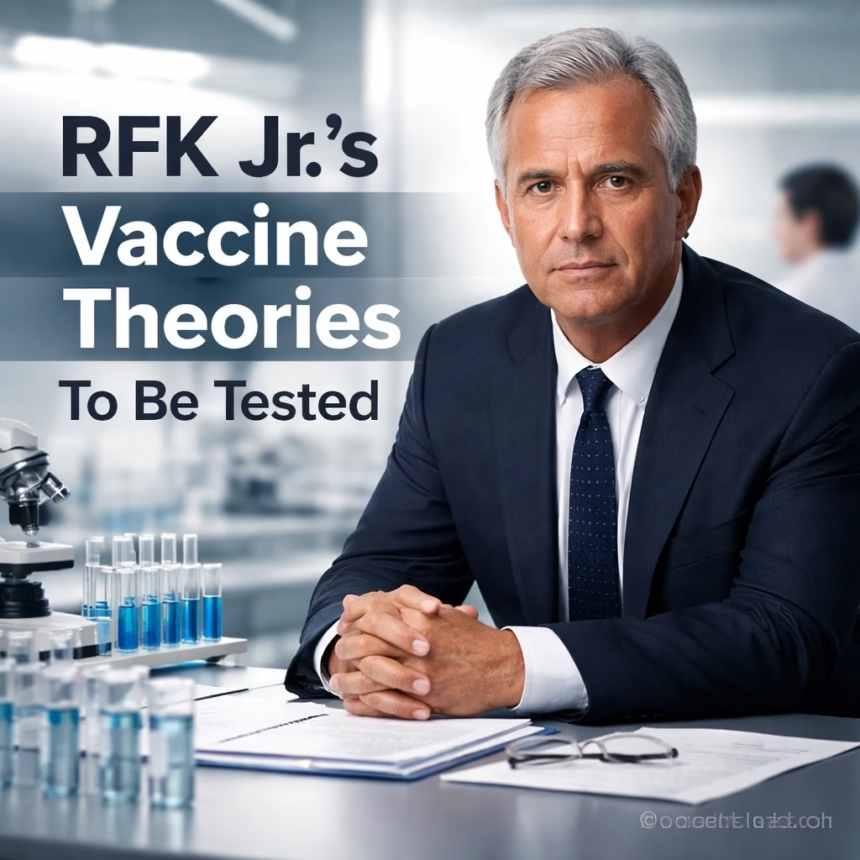
Robert F. Kennedy Jr.'s long-standing skepticism regarding vaccine safety is facing an unprecedented test as his independent presidential campaign progresses and public health debates intensify across the United States. His theories, once largely confined to activist circles, are now central to a national political discourse, demanding closer examination in the context of established scientific consensus and policy implications. This scrutiny comes amidst ongoing public health challenges and a heightened awareness of vaccine efficacy and safety worldwide.
Background: Decades of Doubt and Advocacy
Robert F. Kennedy Jr. emerged as a prominent figure in the vaccine skepticism movement in the early 2000s. Initially, his concerns focused on the alleged link between thimerosal, a mercury-containing preservative once used in some vaccines, and autism. Despite extensive scientific studies refuting this connection, Kennedy continued to champion the narrative, amplifying it through books, articles, and public speaking engagements.
In 2016, Kennedy co-founded the Children’s Health Defense (CHD), an organization dedicated to investigating and exposing what it describes as “health threats” to children, with a significant emphasis on vaccine safety and alleged government and pharmaceutical industry corruption. Under his leadership, CHD has become a leading voice in challenging established public health guidelines, particularly regarding childhood immunization schedules and the safety profiles of various vaccines.
His advocacy gained further traction during the COVID-19 pandemic. Kennedy became a vocal critic of COVID-19 vaccines, questioning their efficacy, safety, and the motives behind their rapid development and widespread distribution. He frequently cited anecdotal reports and selectively interpreted data to support claims of severe adverse effects, often drawing sharp rebukes from medical professionals and public health organizations like the Centers for Disease Control and Prevention (CDC) and the World Health Organization (WHO).
Throughout this period, Kennedy leveraged various platforms, from podcasts and social media to public rallies, to disseminate his views. His arguments frequently blend environmental concerns, criticisms of corporate influence, and libertarian principles, resonating with a segment of the population distrustful of large institutions and conventional medicine.
Key Developments: Campaign Trail Scrutiny and Policy Proposals
Kennedy’s decision to run for president, first as a Democrat and then as an independent, fundamentally shifted the context of his vaccine advocacy. What was once a specialized activist stance is now a direct political platform, subject to mainstream media interrogation, voter scrutiny, and the demands of policy formulation. His campaign has forced a national conversation on topics previously relegated to niche online communities.
More Read

During campaign events and interviews, Kennedy has been pressed repeatedly to clarify his position on vaccines. While he often states he is not “anti-vaccine,” he consistently advocates for greater transparency, more rigorous safety testing, and the removal of vaccine mandates. He proposes an overhaul of the vaccine approval process, suggesting it should be entirely independent of pharmaceutical industry funding and influence. He also calls for increased funding for research into vaccine adverse events and the establishment of a “vaccine court” system that is more responsive to alleged injuries.
This political spotlight has intensified fact-checking efforts by news organizations and watchdog groups. His claims are now juxtaposed directly against the consensus of medical science, forcing a more direct confrontation between his narratives and evidence-based public health recommendations. Social media platforms, while still a conduit for his messaging, have also faced pressure to address misinformation, leading to varying degrees of content moderation on his posts and those of his supporters.
The elevation of his views to the national political stage means that his theories are no longer just abstract discussions; they carry the potential weight of future policy. His campaign has inadvertently become a real-time experiment in how a candidate’s long-held, controversial health beliefs interact with the demands of governing and the expectations of a diverse electorate.
Impact: Reaching Beyond the Campaign
The prominence of RFK Jr.’s vaccine theories in the presidential race has far-reaching implications, extending well beyond the ballot box to influence public health, scientific discourse, and political strategy.
Public Health Institutions Under Pressure
Organizations like the CDC, FDA, and state health departments are facing renewed challenges to their authority and credibility. Kennedy’s campaign narrative often frames these institutions as compromised or untrustworthy, compelling them to redouble efforts in public education and transparent communication. This creates an environment where evidence-based recommendations must contend with deep-seated skepticism, potentially eroding public trust in crucial health guidance.
Parents and Vaccination Decisions
For parents, Kennedy’s platform introduces additional layers of complexity into vaccination decisions. While many remain confident in established science, his arguments resonate with vaccine-hesitant individuals seeking alternatives to mainstream information. This could exacerbate existing trends of declining childhood vaccination rates in some areas, raising concerns among epidemiologists about potential outbreaks of preventable diseases like measles, mumps, and polio, which have seen resurgences in recent years in various U.S. communities.
The Pharmaceutical Industry and Scientific Community
The pharmaceutical industry faces intensified scrutiny regarding vaccine development, testing protocols, and regulatory oversight. Kennedy’s criticisms push for greater transparency and accountability, which could lead to calls for reform in how new vaccines are brought to market. Simultaneously, the scientific community is challenged to more effectively counter misinformation, not just with data, but with compelling narratives that address public anxieties and build trust in the scientific process.
Political Landscape and Future Elections
Politically, Kennedy’s stance forces other candidates and parties to articulate their positions on vaccine policy and public health more clearly. It highlights a growing divide between those who prioritize individual autonomy in health decisions and those who emphasize collective public health and scientific consensus. This dynamic could shape future political debates and influence how health policy is discussed and enacted at both federal and state levels, potentially leading to new legislative proposals regarding vaccine mandates, research funding, and regulatory bodies.
What Next: Milestones and Lingering Questions
As the presidential campaign progresses, several key milestones and questions will determine the ultimate test of RFK Jr.’s vaccine theories and their broader impact on American society.
Debates and Public Forums
Upcoming presidential debates and major public forums will provide critical junctures where Kennedy will be challenged directly by moderators, opponents, and potentially voters on his health claims. His ability to articulate his positions under pressure, and the public’s reaction to his arguments versus those of mainstream candidates, will offer significant insight into the resonance of his message beyond his core supporters.
Electoral Performance and Policy Influence
His performance in the general election will be the most direct measure of public acceptance for his views. Even if he does not win, a substantial vote share could signal a significant segment of the electorate is receptive to his critiques of public health. This could, in turn, influence the platforms of major parties, compelling them to address issues of vaccine transparency, regulatory oversight, and public trust more directly in future policy discussions.
Ongoing Public Health Challenges
The continued presence of infectious diseases, including new variants of COVID-19 or potential outbreaks of other vaccine-preventable illnesses, will continuously test the efficacy of established public health strategies. Should such events occur, the debate around vaccine mandates and public health interventions will intensify, placing Kennedy’s theories into an immediate, real-world context.
Rethinking Public Health Communication
Regardless of the election’s outcome, Kennedy’s campaign has highlighted a critical need for public health authorities to refine their communication strategies. Moving forward, there will likely be increased emphasis on engaging with skeptical populations, addressing misinformation proactively, and fostering trust through greater transparency and accessibility of scientific information. The challenge will be to bridge the gap between scientific consensus and public perception in an increasingly polarized information environment.
The coming months will not only test a political candidate but also the resilience of public health institutions, the clarity of scientific communication, and the discernment of the American electorate in navigating complex health information.