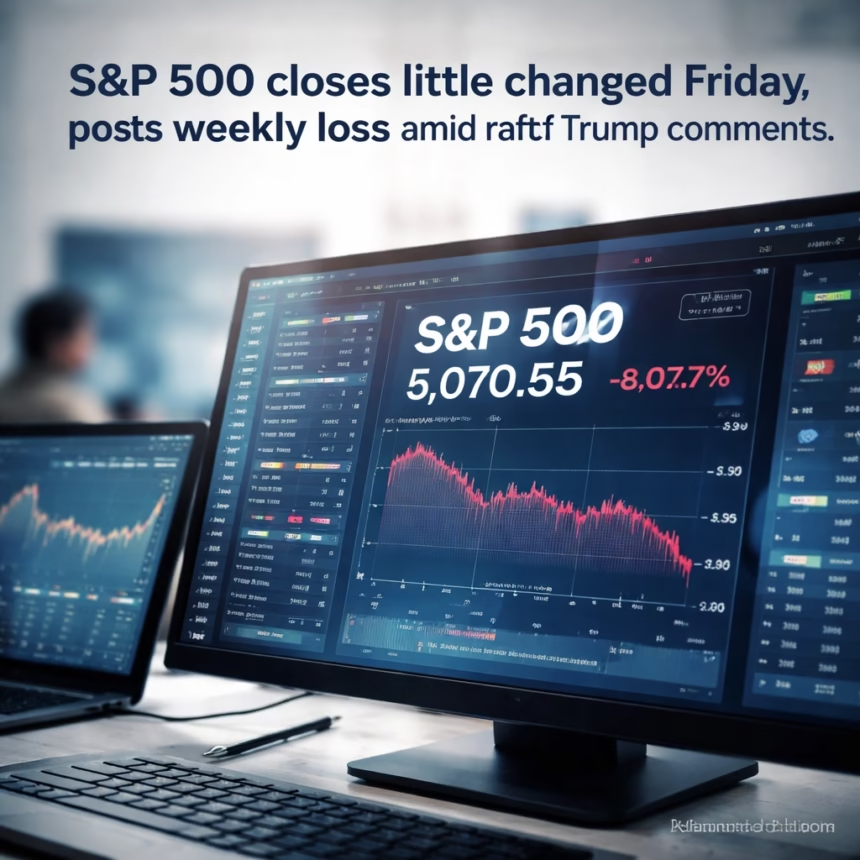
Wall Street ended the week with a slight dip, finishing Friday with minimal change for the S&P 500, but ultimately securing a weekly loss. The market's performance was significantly influenced by a series of recent comments from former President Donald Trump, adding to broader economic concerns. The close occurred on Friday, November 3, 2023, in New York City.
Background: A Week of Uncertainty
The stock market has been navigating a period of heightened volatility in recent weeks. Investor sentiment has been particularly sensitive to economic data releases, inflation figures, and, notably, political developments. The Federal Reserve's monetary policy stance, particularly regarding interest rate hikes, also continues to be a major factor shaping market direction. The S&P 500, a benchmark of the U.S. stock market, has experienced fluctuating performance throughout October and November, reflecting a complex interplay of these forces.
Following the release of stronger-than-expected economic data in early November, there was initial optimism. However, this optimism has been tempered by concerns about potential further interest rate increases and the ongoing geopolitical landscape. The market has been closely watching for signals from the Federal Reserve and for any indications of a potential slowdown in economic growth.
Key Developments: Trump’s Influence
A significant catalyst for the market's recent movements has been a series of statements made by former President Donald Trump regarding his economic policies and potential future actions. Over the past week, Trump has repeatedly emphasized his commitment to deregulation and tax cuts, while simultaneously questioning the current direction of the Federal Reserve.
Specifically, Trump has voiced criticism of Federal Reserve Chair Jerome Powell's approach to inflation, suggesting that the Fed is being too aggressive. He has also reiterated promises to cut taxes if elected, a policy that would likely stimulate economic activity but could also exacerbate inflationary pressures. These comments have fueled uncertainty among investors about the future economic outlook and the potential impact of future political decisions on corporate earnings.
More Read

Furthermore, discussions surrounding the upcoming 2024 presidential election have added to the market's nervousness. Investors are assessing the potential implications of different political outcomes on economic policy and market stability. The market's sensitivity to political rhetoric underscores the interconnectedness of financial markets and political events.
Impact: Investors and Businesses Feel the Chill
The market's volatility has impacted a wide range of investors, from individual retail investors to large institutional funds. The weekly loss in the S&P 500 has reduced the overall value of portfolios, particularly for those heavily invested in equities. This decline has led to increased scrutiny of investment strategies and a greater emphasis on risk management.
Businesses are also feeling the effects of market uncertainty. Companies are facing higher borrowing costs due to rising interest rates, which can dampen investment and expansion plans. Consumer confidence, which is closely tied to market sentiment, has also been affected, potentially leading to reduced spending. The potential for a recession, a concern that has been simmering throughout the year, remains a significant risk.
More Read

What Next: Watching the Fed and the Election
Federal Reserve Outlook
The Federal Reserve’s next policy meeting is scheduled for December 13-14, 2023. Investors will be closely analyzing the Fed’s statements and projections for future interest rate hikes. A dovish signal – suggesting a pause or slowdown in rate increases – could provide a boost to the market, while a hawkish stance – indicating further rate hikes – could trigger renewed selling pressure.
2024 Presidential Election
The 2024 presidential election will continue to be a major factor influencing market sentiment. As the election draws closer, investors will be paying close attention to the candidates’ economic platforms and their potential impact on policies related to taxation, regulation, and trade. Any significant shifts in the political landscape could lead to further market volatility.
Economic data releases in the coming weeks, including inflation reports and employment figures, will also play a critical role in shaping market direction. The market is currently awaiting the next Consumer Price Index (CPI) report, which will provide further insights into the pace of inflation.
The S&P 500 will likely remain sensitive to both economic data and political developments in the near term. Investors are expected to adopt a cautious approach, carefully assessing the risks and opportunities in the current market environment.