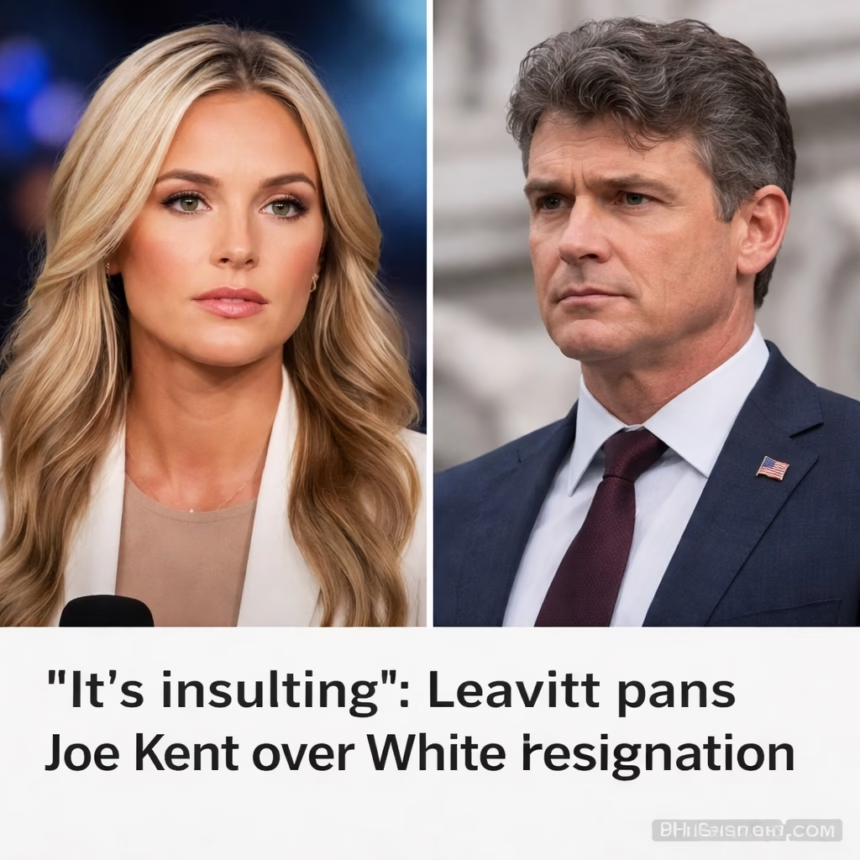
New Hampshire Republican Karoline Leavitt recently launched a scathing critique against fellow GOP congressional candidate Joe Kent, labeling his past White House resignation as "insulting." The public denouncement injects a new layer of friction into the ongoing Republican primary battles, drawing sharp attention to candidates' past employment records and perceived loyalty within conservative circles.
Background: A Clash of Conservative Stalwarts
The controversy centers on Joe Kent, a former U.S. Army Special Forces officer and Gold Star husband, who served in a national security role during the Trump administration. Kent, a prominent figure in the America First movement, resigned from his White House position prior to the end of President Donald Trump's term. While the exact circumstances of his departure have been subject to varying interpretations, Leavitt's recent comments have reignited scrutiny.
Karoline Leavitt, herself a former aide in the Trump White House press office, is a rising star in the Republican Party. At 26, she is one of the youngest individuals to seek a congressional seat and has positioned herself as a staunch conservative and loyalist to former President Trump. Her campaign for New Hampshire's First Congressional District (NH-01) has garnered significant attention, particularly for her vocal support of the former president.
Kent’s Tenure and Resignation
Joe Kent’s service in the Trump administration was largely within the national security apparatus, where his military background was seen as an asset. His resignation, which occurred in late 2020, was publicly framed by Kent as a personal decision, though some reports at the time hinted at policy disagreements or a desire to pursue other opportunities. Leavitt’s recent remarks suggest a more critical interpretation, implying a perceived lack of commitment or a departure under less than honorable circumstances from a “loyalist” perspective.
The Political Landscape
Both Leavitt and Kent operate within a Republican Party heavily influenced by Donald Trump and the America First agenda. Success in many GOP primaries often hinges on demonstrating unwavering loyalty to the former president and his policies. This dynamic frequently leads to intra-party challenges where candidates seek to outflank opponents on conservative credentials and perceived allegiance to Trump. Leavitt’s criticism of Kent can be understood within this competitive framework, aiming to draw a stark contrast.
More Read

Key Developments: Leavitt’s Accusation and Its Implications
Leavitt's specific accusation, delivered during a recent campaign event or interview, branded Kent's White House resignation as "insulting." While she did not elaborate extensively on the precise nature of the insult, her statement implies that Kent's departure was not in line with the expectations of a committed Trump supporter or that it somehow undermined the administration during a critical period. This direct attack from one pro-Trump candidate to another is a notable escalation in the ongoing battle for the party's direction.
The “Insulting” Charge
The use of the word “insulting” by Leavitt is particularly potent. It suggests not merely a policy disagreement or a personal choice, but a perceived affront to the values or leadership of the Trump administration itself. For candidates who build their platforms on loyalty to Trump, any perceived wavering or early departure from his team can be leveraged by rivals as a sign of weakness or insufficient commitment. Leavitt’s comments aim to cast doubt on Kent’s ultimate fidelity, despite his strong public support for Trump post-presidency.
Kent’s Context: Washington’s 3rd District
Joe Kent is running in Washington’s 3rd Congressional District (WA-03), a district that has seen significant political shifts. He gained national prominence by challenging incumbent Republican Representative Jaime Herrera Beutler, one of the ten House Republicans who voted to impeach former President Trump. Kent successfully unseated Herrera Beutler in the 2022 primary, largely on an America First platform, demonstrating his appeal to the conservative base. This history makes Leavitt’s attack on his Trump loyalty particularly intriguing, as Kent has arguably proven his credentials through electoral victory against an impeachment voter.

Impact: Shifting Dynamics in the GOP
Leavitt's direct challenge to Kent has immediate repercussions for both campaigns and the broader Republican ecosystem. For Kent, it forces a re-litigation of a past event, potentially distracting from his current campaign messaging and requiring a defense of his past actions. While Kent has a strong conservative base, questions about his White House tenure could be exploited by general election opponents or used by other primary challengers in future cycles.
For Leavitt, the move is a calculated risk. It positions her as an uncompromising Trump loyalist, potentially energizing her base in New Hampshire's competitive NH-01 primary. However, it also risks alienating some Republicans who may view such attacks as counterproductive infighting, especially when directed at another prominent figure aligned with the America First movement. The strategy underscores the intense competition for the mantle of "most Trump-aligned" in certain GOP races.
The Loyalty Litmus Test
This incident highlights the pervasive “loyalty litmus test” within the contemporary Republican Party. Candidates are often judged not just on their policy positions, but on their perceived unwavering support for Donald Trump. Past actions, even those predating current campaigns, are scrutinized for any hint of deviation. Leavitt’s criticism of Kent exemplifies this trend, turning a past employment decision into a political weapon.
Potential for Broader Division
While both Leavitt and Kent represent the conservative wing of the GOP, this public spat reveals potential fault lines even within that segment. It suggests a hierarchy of loyalty, where those who remained in the administration until the very end, or who never expressed any public dissent, might be seen as more “pure” than those who departed earlier. This internal scrutinizing could lead to further divisions as the party navigates its post-Trump identity while still heavily influenced by him.
What Next: Campaign Responses and Future Implications
The immediate aftermath of Leavitt's remarks will likely see responses from Joe Kent's campaign. His team will almost certainly issue a statement defending his record and perhaps counter-accusing Leavitt of engaging in divisive tactics. Kent's supporters are expected to rally behind him, emphasizing his military service and his successful challenge against an anti-Trump incumbent as proof of his loyalty and conservative bona fides.
More Read

As the primary season progresses, this incident could be brought up in debates, campaign advertisements, and media interviews. Other candidates in both NH-01 and WA-03 might seize upon the controversy, either to defend Kent, criticize Leavitt, or to further their own narratives of unwavering loyalty or unity.
Upcoming Primary Elections
Both Karoline Leavitt and Joe Kent face significant primary challenges in their respective districts. Leavitt is vying for the Republican nomination in New Hampshire’s First Congressional District, a swing district that is a perennial target for both parties. Kent, having won his primary in 2022, is likely preparing for a potential re-election bid, though his district, Washington’s 3rd, remains competitive.
The outcome of these primaries will be a crucial test of how effective such "loyalty" attacks are in mobilizing the base and influencing undecided voters. Should Leavitt's attack gain traction, it could set a precedent for similar criticisms in other races. Conversely, if it backfires, it might signal a limit to how far candidates can push the loyalty narrative against fellow conservatives.
General Election Ramifications
Beyond the primaries, the long-term impact on the general election campaigns for both candidates remains to be seen. While these internal GOP disputes can energize a base, they can also provide ammunition for Democratic opponents who might highlight Republican infighting and perceived extremism. The ability of both Leavitt and Kent to unite their party after potentially bruising primary battles will be critical for their general election prospects in their competitive districts.