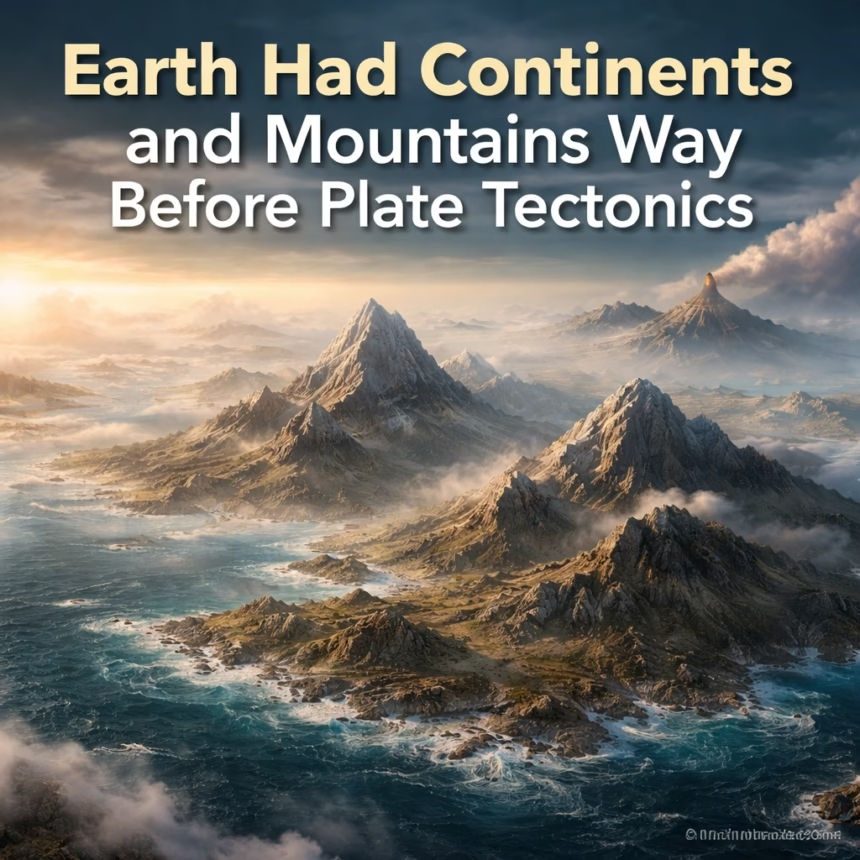
Earth's Hidden Past: Scientists Uncover Mountains and Continents Billions of Years Before Plate Tectonics
A groundbreaking international study has revealed compelling evidence that Earth possessed extensive continents and towering mountain ranges billions of years earlier than previously understood. Published recently in the journal Nature Geoscience, this research challenges long-held theories about our planet's early geological evolution, pushing back the timeline for complex landmass formation by a significant margin. The findings, based on meticulous analysis of ancient crustal rocks, suggest a dynamic primordial Earth far different from current models.
Background: The Prevailing Narrative of Early Earth
For decades, the scientific consensus held that Earth's modern-style plate tectonics began approximately 3.0 to 2.5 billion years ago, during the Archean Eon. This process, characterized by the movement and interaction of large lithospheric plates, was thought to be the primary driver for the formation of stable continental crust and the majestic mountain belts we see today. Before this period, often referred to as the Hadean (4.6 to 4.0 billion years ago) and early Archean Eons, Earth was largely envisioned as a "water world" with only small, ephemeral volcanic islands or thin, unstable protocrusts.
The prevailing view suggested that early Earth's higher internal heat prevented the rigid, cool lithosphere necessary for sustained subduction – a key component of plate tectonics where one plate slides beneath another. Instead, a more stagnant lid or episodic overturn regime was hypothesized, where a thick, unmoving surface crust might have periodically delaminated and sunk into the mantle.
The Onset of Modern Tectonics
The Archean Eon (4.0 to 2.5 billion years ago) marked a pivotal transition. Geologists believed that as Earth gradually cooled, its outer layers became sufficiently rigid to initiate and sustain plate tectonics. This led to the formation of the first stable continental nuclei, known as cratons, such as the Pilbara Craton in Western Australia, the Kaapvaal Craton in South Africa, and the Slave Craton in Canada. These ancient blocks of crust have preserved some of Earth’s oldest rocks, offering critical insights into planetary evolution.
More Read

Traditional methods for studying early Earth relied heavily on isotopic analyses of these cratonic rocks, particularly zircons – tiny, resilient minerals that can lock in chronological and geochemical information. While some studies hinted at crustal differentiation prior to 3.0 billion years ago, definitive evidence for large-scale, stable continents and mountain-building processes akin to those driven by modern plate tectonics remained elusive.
Key Developments: Unveiling a Primordial Landscape
The recent study, led by researchers from Monash University in Australia and the University of Colorado Boulder, focused on exquisitely preserved rock samples from some of Earth's oldest continental fragments. Their investigation primarily involved detailed geochemical and isotopic analysis of ancient zircons and other minerals found within Archean cratons, particularly from the Pilbara Craton in Western Australia, dating back as far as 3.8 to 3.2 billion years ago.
Novel Geochemical Signatures
The team employed advanced analytical techniques, including oxygen isotope analysis and trace element geochemistry, to reconstruct the conditions under which these ancient rocks formed. They discovered specific geochemical signatures indicative of extensive interaction with surface water and significant crustal thickening, processes typically associated with continental landmasses and mountain ranges. These signatures were observed in rocks dating to between 3.8 and 3.2 billion years ago, far predating the generally accepted onset of widespread plate tectonics.
More Read

Crucially, the zircons exhibited patterns of fractionation and alteration consistent with the weathering and erosion of large landmasses, followed by the deposition of sediments and their subsequent burial and metamorphism. This geological cycle requires both elevated topography (mountains) and the presence of significant bodies of water (oceans/lakes) to facilitate erosion and transport.
Evidence for Pre-Tectonic Mountain Building
The researchers propose that these early continents and mountains did not form via modern subduction-driven plate tectonics. Instead, they suggest alternative mechanisms were at play in the Archean Eon. These mechanisms likely involved processes such as plume tectonics, where massive plumes of hot material rising from the deep mantle caused localized crustal thickening and uplift. Another possibility is “sagduction,” a process where denser crustal blocks sag downwards into the mantle, causing adjacent, lighter crust to be squeezed upwards.
These findings suggest a dynamic, vertically driven tectonic regime, distinct from the horizontal motion dominant in modern plate tectonics. This earlier regime would have been capable of generating significant topographic relief and stable continental crust, providing the necessary conditions for erosion and sedimentation observed in the geochemical record.
Impact: Reshaping Our Understanding of Earth’s Past
This discovery fundamentally alters our understanding of Earth's earliest history, with profound implications across multiple scientific disciplines.
Geology and Geophysics
The new evidence necessitates a revision of geological textbooks regarding the timing and mechanisms of continental formation. It suggests that the processes leading to stable landmasses and mountain belts were active much earlier and under different tectonic regimes than previously thought. This will prompt geophysicists to re-evaluate models of Earth’s thermal evolution and mantle convection during the Archean, exploring how such extensive crustal differentiation could occur without a fully developed plate tectonic system.
Origin and Evolution of Life
The presence of continents and mountains billions of years ago provides a more diverse and complex environment for the origin and early evolution of life. Land-water interfaces, hydrothermal systems within evolving crust, and varied mineral availability from weathered rocks could have offered crucial niches and chemical gradients for abiogenesis and the sustenance of early microbial ecosystems. This pushes back the potential for terrestrial habitats for early life, moving beyond the traditional “ocean world” view.

Atmospheric and Climatic Evolution
Early continents and mountains would have significantly influenced Earth’s ancient atmosphere and climate. Enhanced weathering of silicate rocks on landmasses could have acted as a powerful sink for atmospheric carbon dioxide, potentially influencing global temperatures and contributing to climate stability or fluctuations. The interaction between land, water, and atmosphere would have been far more complex than previously modeled for a predominantly oceanic early Earth.
Planetary Science
Beyond Earth, these findings offer new perspectives for understanding the geological evolution of other rocky planets, such as Mars and Venus, and exoplanets. If Earth could develop complex landforms through non-plate tectonic mechanisms, it suggests a broader range of evolutionary pathways for planetary surfaces, potentially increasing the likelihood of finding diverse geological features on other worlds.
What Next: Future Research and Milestones
This groundbreaking research opens numerous avenues for future scientific inquiry. Researchers will undoubtedly seek to replicate and expand upon these findings by analyzing more ancient rock samples from other cratonic regions globally, including the Isua Supracrustal Belt in Greenland and the Kaapvaal Craton in South Africa, to confirm the widespread nature of these early continental formations.
Advanced computational modeling will be crucial to simulate the proposed pre-plate tectonic mechanisms, such as plume tectonics and sagduction, to understand their efficiency and capacity to generate significant crustal thickening and uplift under Archean thermal conditions. Further refinement of radiometric dating techniques will also be essential to pinpoint the exact timing of these events with even greater precision.
The interdisciplinary implications will drive collaborations between geologists, geochemists, astrobiologists, and atmospheric scientists. Understanding the interplay between early continental formation, the emergence of life, and the evolution of Earth's atmosphere will be a major focus. Ultimately, this discovery lays the groundwork for developing a more comprehensive and nuanced model of Earth's earliest billions of years, moving beyond simplified narratives to embrace a truly dynamic and complex primordial planet.