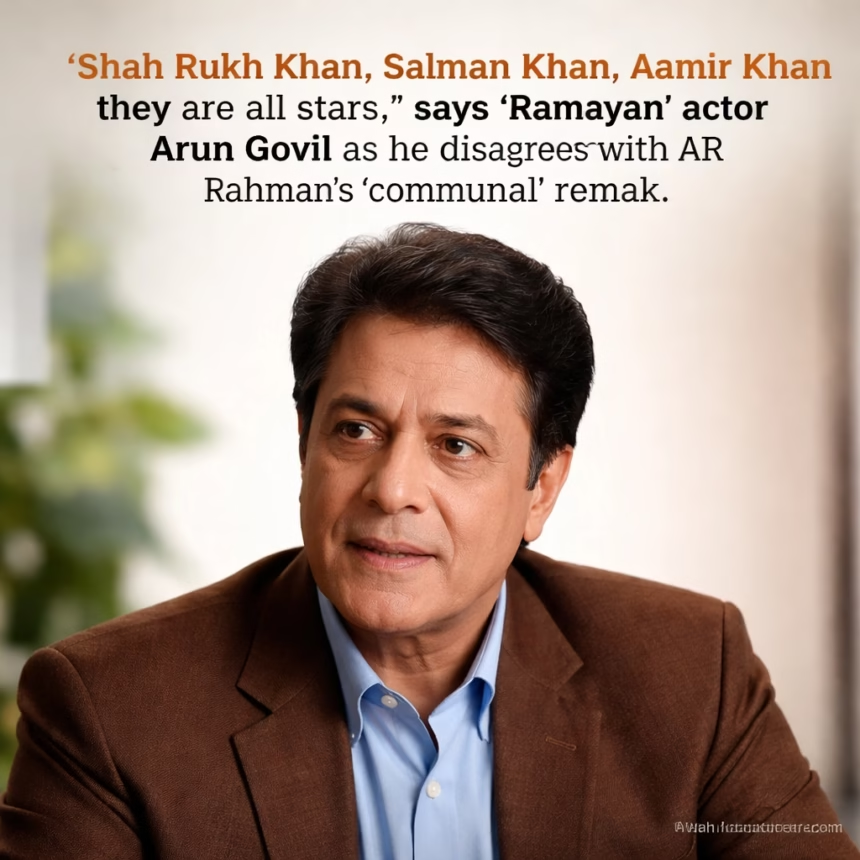
‘Shah Rukh Khan, Salman Khan, Aamir Khan they are all stars,’ says ‘Ramayan’ actor Arun Govil as he disagrees with AR Rahman’s ‘communal’ remark

Viral_X
By
Viral_X
10 Min Read
#image_title

Arun Govil Rejects AR Rahman's 'Communal' Remark: "Shah Rukh, Salman, Aamir Khan Are All Stars"

Arun Govil Rejects AR Rahman's 'Communal' Remark: "Shah Rukh, Salman, Aamir Khan Are All Stars"

Veteran actor Arun Govil, revered for his portrayal of Lord Ram in the iconic 1987 television series 'Ramayan', has publicly disagreed with Oscar-winning music composer AR Rahman's recent remarks. Govil challenged the perceived communal undertones of Rahman's comments regarding the Hindi film industry, specifically championing the universal stardom of Shah Rukh Khan, Salman Khan, and Aamir Khan. The actor's statement, made during a recent media interaction, has reignited discussions about religious identity and meritocracy within Bollywood.

Background to the Controversy

The core of the controversy traces back to statements made by AR Rahman in July 2020. At that time, Rahman claimed a "gang" in Bollywood was actively working against him, spreading "false rumours" and hindering his opportunities to secure work. While Rahman did not explicitly use the term "communal," his comments were widely interpreted by sections of the media and public as suggesting a systematic bias within the industry. This interpretation fueled a broader debate about the alleged existence of lobbies and potential discrimination based on factors beyond artistic merit in the Hindi film fraternity.

Rahman, a globally celebrated musician with an impressive array of accolades including two Academy Awards, two Grammy Awards, and numerous other international and national honors, had spoken about feeling sidelined in Bollywood despite his international success. His original statement, "I don't say no to good movies, but I think there is a gang, which is spreading some false rumours about me, which is why I am not getting offers," sparked significant discourse. He later clarified that his remarks pertained to a "misunderstanding" and were not directed against any specific individual. However, the perception of communal bias, particularly within ongoing discussions about nepotism and power structures in Bollywood, persisted in certain public narratives.

Arun Govil, on the other hand, achieved national recognition through 'Ramayan', a television series that broke viewership records and became a cultural phenomenon in India. His portrayal of Lord Ram earned him immense respect and a unique standing in public consciousness, lending significant weight to his statements on cultural and social issues. Govil's career spans several decades, and he has maintained a respected public profile. His entry into politics, joining the Bharatiya Janata Party (BJP) in 2021, further contextualizes his public statements within a broader sociopolitical landscape. The "Khan trio"—Shah Rukh Khan, Salman Khan, and Aamir Khan—represent an unparalleled era of superstardom in Indian cinema, dominating box office collections and popular culture for over three decades, with their appeal largely transcending religious affiliations among millions of fans globally.

Key Developments in the Debate

Arun Govil's direct rebuttal emerged during a recent media interaction where he was questioned about Rahman's earlier remarks and their communal interpretations. Govil unequivocally stated, "Shah Rukh Khan, Salman Khan, Aamir Khan they are all stars. What is communal in it?" He challenged the very notion of attaching communal labels to the success of these actors, asserting that their stardom is a direct outcome of their extraordinary talent, relentless hard work, and profound connection with audiences, entirely independent of their religious backgrounds.

"Their talent, their hard work, their dedication, their passion, their commitment, their performance, their fan following, all these things make them stars. What is communal in it? What is Hindu-Muslim in it?" Govil asserted. His comments underscored a meritocratic perspective on the film industry, arguing that attributing religious identity to their success or failure was an unnecessary and divisive approach. Govil's statements effectively countered the narrative that communal factors dictate success or hinder opportunities for individuals at the pinnacle of Bollywood.

This forceful statement by Govil has resonated across various platforms, particularly on social media, where discussions about Bollywood's internal dynamics and external perceptions frequently unfold. His remarks are widely seen as a direct counter-narrative to the idea that religious identity plays a significant role in determining stardom or opportunities at the highest echelons of the industry. The timing of Govil's intervention also coincides with a period of heightened scrutiny on the Indian film industry regarding issues of diversity, representation, and the perceived influence of various groups.

Impact of the Statements

The immediate impact of Arun Govil's statement has been to intensify the ongoing public discourse surrounding communalism and meritocracy within the Indian entertainment industry.

For the Khans—Shah Rukh, Salman, and Aamir—who have not directly commented on this specific exchange, Govil's defense reinforces their image as universal stars whose appeal transcends religious boundaries. This perception is largely held by their vast fan bases and serves as a powerful counter-argument to any claims of communal bias at the pinnacle of stardom.

For AR Rahman, Govil's comments implicitly challenge the basis of the "communal" interpretation of Rahman's earlier remarks. This brings Rahman's past statements back under public scrutiny, prompting a re-evaluation of the context and intent behind his words from 2020. While Rahman himself clarified his statements were about a "misunderstanding," the communal angle, once introduced into public discourse, often tends to linger.

For Arun Govil, his clear stance has positioned him as a vocal advocate for secularism and meritocracy within the film industry. His statements are likely to be welcomed by those who champion a non-sectarian approach to evaluating talent and success in Bollywood. It also reinforces his public image as a figure who articulates his views on matters of national interest, leveraging the respect he commands from his iconic role.

For the Indian Film Industry itself, this debate underscores the internal and external pressures on Bollywood to address perceptions of favoritism, discrimination, and communal divides. It highlights the industry's ongoing struggle to present a unified, inclusive front amidst diverse viewpoints and political currents. Such discussions often lead to introspection within the industry about how it manages its talent, promotes inclusivity, and communicates with the public.

The public discourse is also significantly affected, as the exchange between Govil and the perceived implications of Rahman's comments fuels wider societal conversations about secularism, religious harmony, and the role of cultural figures in shaping public opinion. It provides substantial fodder for debates on social media, news channels, and in daily conversations about the nature of Indian society and its entertainment landscape.

What Lies Ahead

The recent remarks by Arun Govil are expected to sustain the conversation around communalism and merit in the Indian film industry for the foreseeable future.

It remains to be seen if AR Rahman or his representatives will issue any further statements or clarifications in light of Govil's direct challenge. Other prominent figures within Bollywood might also weigh in, either supporting Govil's perspective or offering alternative viewpoints, potentially broadening the scope of the debate.

Media outlets are likely to continue exploring the nuances of this discussion, inviting industry experts, cultural commentators, and social analysts to share their insights. This could lead to deeper investigations into the historical and contemporary dynamics of power, representation, and religious identity within Bollywood.

The public's perception of both Govil and Rahman, as well as the broader film industry, could be further shaped by how this dialogue evolves. Govil's firm stance may solidify his image as a voice of reason against perceived divisive narratives, while Rahman's earlier comments will continue to be interpreted through various lenses.

'Shah Rukh Khan, Salman Khan, Aamir Khan they are all stars,' says 'Ramayan' actor Arun Govil as he disagrees with AR Rahman's 'communal' remark

While immediate policy changes might not occur, such public debates often prompt internal discussions within film bodies, production houses, and talent agencies about fostering a more inclusive and merit-based environment. There might be a renewed emphasis on promoting talent irrespective of background. Given Arun Govil's political affiliations and the sensitive nature of communal discussions in India, the debate could also take on political dimensions, with various political factions using it to further their narratives regarding secularism, minority rights, and national identity. The discussion is poised to remain a significant topic in cultural and social commentary.


Share This Article
Leave a Comment

Leave a Reply

‘Shah Rukh Khan, Salman Khan, Aamir Khan they are all stars,’ says ‘Ramayan’ actor Arun Govil as he disagrees with AR Rahman’s ‘communal’ remark

Viral_X
By
Viral_X
11 Min Read
#image_title

In a recent development echoing across the Indian entertainment landscape, veteran actor Arun Govil, widely revered for his portrayal of Lord Ram in Ramanand Sagar's iconic 'Ramayan,' has publicly disagreed with music maestro AR Rahman's comments regarding the "three Khans" of Bollywood – Shah Rukh Khan, Salman Khan, and Aamir Khan. Govil emphasized that the trio's star power is universal and transcends any religious affiliations, directly countering what some perceived as a communal undertone in Rahman's earlier statement.

'Shah Rukh Khan, Salman Khan, Aamir Khan they are all stars,' says 'Ramayan' actor Arun Govil as he disagrees with AR Rahman's 'communal' remark

The Spark: AR Rahman’s Controversial Comments

The Original Remark

The controversy ignited following an interview where AR Rahman, while discussing the performance of films and the reception of actors, made observations that were interpreted by many as linking the success and acceptance of Shah Rukh Khan, Salman Khan, and Aamir Khan to their religious identity. Rahman reportedly suggested that the “three Khans” are “different” and implied that their consistent box office dominance and widespread appeal were unique given certain societal dynamics. While Rahman’s full context was debated, the excerpt that circulated widely led to accusations of a communal angle, suggesting that their Muslim identity was being highlighted as a factor in their stardom, either positively or negatively depending on interpretation, rather than their talent alone. This sparked considerable discussion online and within media circles about the role of religion in the Indian film industry.

The Khan Dynasty

Shah Rukh Khan, Salman Khan, and Aamir Khan have collectively dominated the Indian film industry for over three decades, establishing themselves as unparalleled superstars. Each has carved a distinct niche: Shah Rukh Khan as the ‘King of Romance’ with a global fan base, Salman Khan as the ‘Bhaijaan’ known for his action-packed blockbusters and charismatic persona, and Aamir Khan as the ‘Perfectionist’ renowned for his selective, high-concept films often carrying social messages. Their films consistently rank among the highest-grossing Indian movies, and their influence extends beyond the box office, shaping cultural trends and global perceptions of Indian cinema. Their collective longevity and continued relevance in a highly competitive industry are testaments to their immense talent, hard work, and unique connection with audiences across demographics, languages, and religions.

Industry’s Undercurrents

Discussions about religion, identity, and representation in Bollywood are not new. The industry, often seen as a melting pot of cultures, has periodically faced scrutiny regarding its portrayal of various communities, the religious backgrounds of its stars, and the narratives it promotes. In recent years, with the rise of social media and heightened political polarization, these discussions have become more frequent and intense. Comments from public figures, especially those as influential as AR Rahman, often amplify these underlying debates, forcing a re-evaluation of how success and identity are perceived within the industry and by the larger public.

Arun Govil Steps In: A Counter-Narrative

Govil’s Stance

In response to the growing discourse surrounding AR Rahman’s remarks, Arun Govil offered a clear and unequivocal rebuttal. Speaking to various media outlets, Govil asserted, “Shah Rukh Khan, Salman Khan, Aamir Khan, they are all stars. They are all very good actors. Their films run because they are good actors. There is no communal angle to it.” He firmly rejected the notion that the Khans’ success could or should be attributed to their religious identity, emphasizing that their widespread appeal is purely a function of their talent and the quality of their work. Govil’s statement underscored a belief in meritocracy, suggesting that stardom in Bollywood is earned through performance and audience connection, irrespective of personal beliefs or background.

‘Ramayan’ Actor’s Perspective

Arun Govil’s words carry significant weight, particularly in the current socio-political climate. His iconic portrayal of Lord Ram in the late 1980s television series ‘Ramayan’ cemented his image as a revered cultural figure across India. The show, which garnered unprecedented viewership and became a cornerstone of Indian television history, associated Govil with values of righteousness, universality, and cultural heritage. His recent foray into politics, joining the Bharatiya Janata Party (BJP), further positions him as a voice that resonates with a particular segment of the Indian populace. Therefore, his disagreement with Rahman’s perceived communal remark is seen not just as an industry insider’s opinion but as a statement from a figure deeply embedded in the cultural and, more recently, political fabric of the nation.

Wider Industry Silence (or limited reactions)

While Rahman’s initial comments generated considerable online chatter, the broader Bollywood industry has largely maintained a cautious silence or offered nuanced responses. Few prominent figures have directly addressed Rahman’s statement or Govil’s counter-argument, highlighting the sensitive nature of the topic. This silence could be attributed to a desire to avoid further controversy, or perhaps a belief that such discussions detract from the artistic contributions of the individuals involved. However, Govil’s direct intervention stands out as one of the most forthright responses, providing a clear counter-narrative to the idea of a communal lens on stardom.

Unpacking the Impact: Repercussions and Debates

For the Khans

The three Khans, despite their individual and collective dominance, have often been subjects of public scrutiny, particularly concerning their religious identity in an increasingly polarized society. While their star power is largely impervious to such debates, comments like Rahman’s, and subsequent rebuttals like Govil’s, keep the conversation alive. For the Khans, who have consistently projected an image of secularism and universal appeal, these discussions serve as a reminder of the ongoing societal dialogue around identity and representation, even as they continue to deliver blockbusters and command immense fan loyalty.

For AR Rahman

AR Rahman, a globally acclaimed musician and a recipient of multiple Academy Awards, is largely seen as an icon who transcends boundaries. His comments, however, put him in an uncomfortable spotlight, leading to calls for clarification and prompting discussions about his intent. The incident might prompt Rahman to offer further context or clarify his original statement to prevent misinterpretation, particularly given his stature as a figure who has consistently promoted unity and artistic expression free from prejudice.

For Arun Govil

Arun Govil’s intervention reinforces his public persona as a defender of traditional values and a voice against perceived divisive narratives. His statement aligns with a viewpoint that emphasizes national unity and secularism through cultural integration, resonating with his image as Lord Ram and his current political affiliations. This stance could further solidify his position as a respected cultural commentator in the eyes of his supporters.

Bollywood’s Identity Crisis

The exchange between Rahman and Govil brings to the forefront Bollywood’s ongoing struggle with its identity in modern India. Once seen as a symbol of India’s secular fabric, the industry now frequently grapples with debates about representation, historical narratives, and the influence of religious and political ideologies. This incident underscores the pressure on public figures to navigate sensitive topics carefully and highlights the industry’s internal discussions about how to uphold its diverse and inclusive image while facing external scrutiny.

Public Discourse

The public’s reaction to this debate has been varied. Social media platforms have seen a surge in discussions, with users aligning with either Rahman’s initial perceived intent or Govil’s counter-argument. The incident has become a talking point in news debates and opinion pieces, reflecting the broader societal conversation about secularism, identity, and the role of celebrities in shaping public opinion in India.

The Road Ahead: What to Expect

Potential for Further Dialogue

It remains to be seen whether AR Rahman will offer a direct response or clarification to Arun Govil’s statement. Similarly, the Khans themselves, known for their measured responses to controversies, might choose to address the underlying sentiment of the debate, or continue to let their work speak for itself. The incident could also prompt other industry veterans to weigh in, further enriching or complicating the discourse.

Industry’s Evolving Narrative

The ongoing debate about identity and success in Bollywood is likely to influence future content creation. Filmmakers and actors might become more conscious of how their work and public statements are perceived through various lenses, including religious and political ones. This could lead to more nuanced storytelling, or conversely, a more cautious approach to sensitive subjects, as the industry navigates a complex and often polarized environment.

The Political Lens

Given Arun Govil’s political association and the sensitive nature of religious identity in India, the debate could acquire political dimensions. Political commentators and parties might leverage such discussions to further their respective narratives, intertwining cultural discourse with broader political agendas. This highlights the increasing confluence of entertainment, culture, and politics in contemporary India.

Enduring Stardom

Despite these ongoing debates, the enduring star power of Shah Rukh Khan, Salman Khan, and Aamir Khan is unlikely to diminish. Their decades of contribution to Indian cinema, their global appeal, and their ability to connect with diverse audiences through their performances firmly establish them as cinematic legends. Arun Govil’s statement, by emphasizing their talent over any other factor, ultimately reinforces the idea that true stardom transcends superficial divisions, resting solely on artistic merit and the unwavering love of their fans.

Share This Article
Leave a Comment

Leave a Reply