Scribbled Secrets: Sociologists Unravel the Hidden Language of Doodles
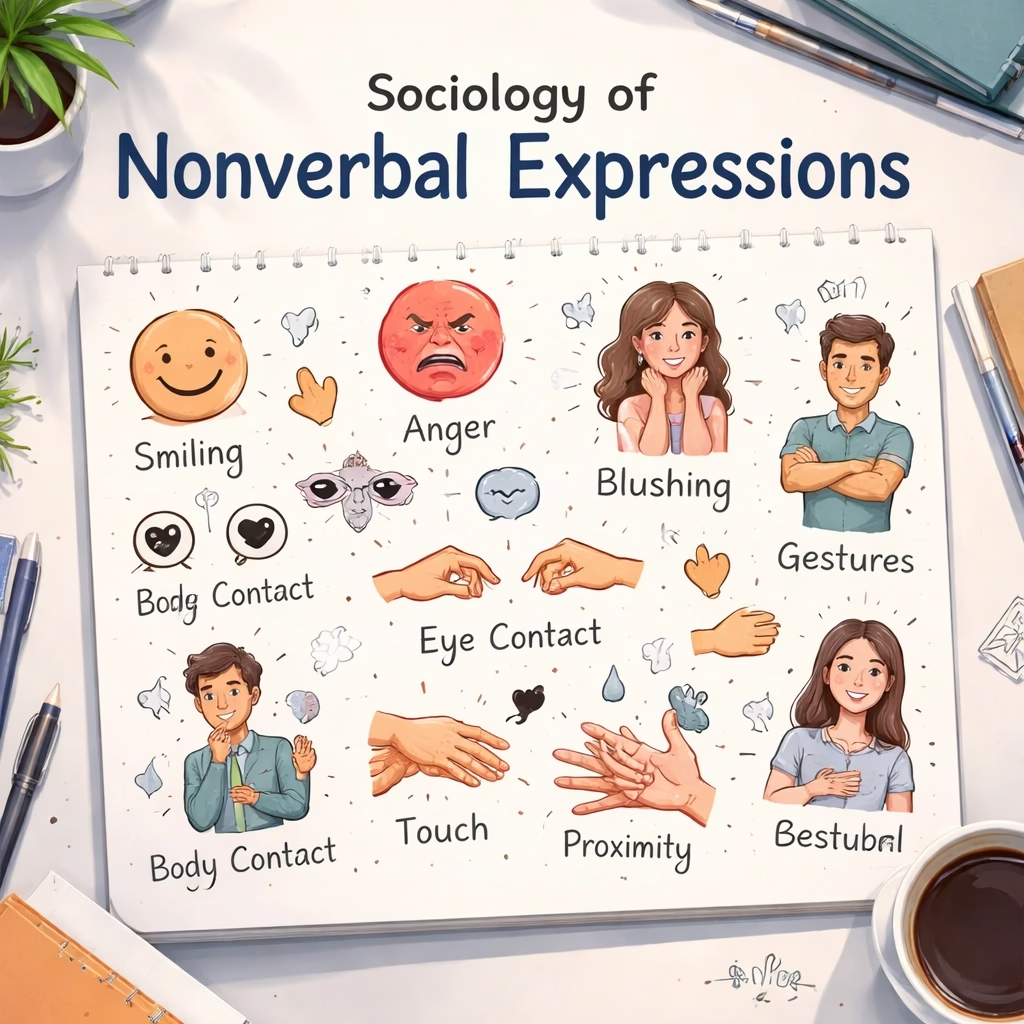
A burgeoning interdisciplinary field is shedding new light on how spontaneous drawings reflect and influence human interaction. Researchers across major universities are now delving into the sociological implications of doodles, revealing profound insights into communication patterns in an increasingly visual world.
This emerging area of study, often termed "sociosemiotics of spontaneous graphics," seeks to decode the nonverbal cues embedded in our everyday scribbles, from margin notes to digital sketches.
Background: From Cave Walls to Cognitive Science
The act of doodling is as old as humanity itself, with rudimentary marks found in prehistoric cave art in Lascaux, France, dating back over 17,000 years. Medieval marginalia, often intricate and symbolic, adorned manuscripts throughout Europe, providing glimpses into the daily lives and satirical observations of scribes and monks.
For centuries, doodles were largely dismissed as idle distractions. Early psychological inquiries, notably by figures like Carl Jung in the early 20th century, began to explore them as expressions of the subconscious. However, these interpretations often focused on individual psyche rather than social dynamics.
The 1960s saw a shift towards cognitive psychology, with researchers like Dr. Robert A. Ornstein at Stanford University suggesting doodling could aid concentration and memory retention. Yet, the sociological dimension remained largely unexplored.
It wasn't until the late 1990s and early 2000s that academics began to systematically consider doodles as social artifacts. Dr. Anya Sharma, then at the University of Cambridge, published a seminal paper in 2003, "Beyond Words: Doodles as Social Commentary," arguing that collective doodling in public spaces, such as classroom desks or bathroom stalls, constituted a form of anonymous social discourse.
This laid the groundwork for the current wave of sociological research, moving beyond individual psychological states to examine how doodles function within social groups, communicate identity, and even facilitate collective action.
Key Developments: Digitalization and Data-Driven Insights
The advent of digital technology has dramatically reshaped the landscape of doodle research. The proliferation of tablets, interactive whiteboards, and collaborative online platforms like Miro and Jamboard has created vast new datasets for analysis.
The Rise of Digital Doodling
Digital doodling is no longer confined to personal notes; it's integrated into professional meetings, educational settings, and social media. A study by the Institute for Social Informatics in Berlin in 2018 found that over 60% of participants in virtual meetings engaged in some form of digital sketching, often unconsciously, during presentations.
This digital shift allows for unprecedented data collection, capturing not just the final image but also the process—stroke order, pressure, timing, and collaborative contributions. This process data offers richer insights into cognitive and social states.
AI and Machine Learning for Interpretation
Perhaps the most significant recent development is the application of artificial intelligence and machine learning. Researchers at the University of Tokyo, led by Professor Kenji Tanaka, developed "DoodleNet" in 2021, a neural network capable of categorizing and identifying common doodle motifs, such as arrows, stars, or abstract patterns, with over 90% accuracy.
More advanced AI models are now being trained to analyze the emotional tone and social context of doodles. For instance, a collaborative project between MIT's Media Lab and the University of Amsterdam, launched in 2022, is using computer vision to track doodle evolution in shared digital spaces, identifying patterns indicative of agreement, dissent, or creative problem-solving within teams.
Big Data and Cross-Cultural Analysis
The sheer volume of doodle data available from online forums, social media, and collaborative documents facilitates large-scale cross-cultural studies. Dr. Elena Petrova at the University of Geneva recently published findings from a comparative study of doodles from corporate meeting notes in Seoul, London, and São Paulo. Her research, published in "Journal of Visual Sociology" in April 2023, revealed distinct cultural patterns in the use of geometric shapes versus organic forms, correlating with national communication styles.
Impact: Shaping Communication and Understanding
The insights gleaned from doodle sociology are having a tangible impact across various domains, from personal well-being to corporate strategy.
Individual Expression and Well-being
For individuals, doodling serves as a powerful, often subconscious, outlet for expression. Studies from the University of California, Berkeley, demonstrate that doodling during stressful situations can reduce cortisol levels and improve emotional regulation. Therapists are increasingly incorporating structured doodling exercises into art therapy, recognizing its potential as a non-threatening means of communication for clients struggling with verbal expression.
Group Dynamics and Collaboration
In group settings, doodles act as informal communication channels. A team at the Wharton School of Business observed in 2020 that teams whose members frequently doodled collaboratively on shared whiteboards during brainstorming sessions reported higher levels of engagement and innovation. These shared visual notes fostered a sense of collective ownership and facilitated nonverbal agreement or disagreement.
Corporate Strategy and Branding
Businesses are taking note. Market research firms are analyzing consumer-generated doodles related to products or brands to gauge subconscious perceptions and emotional responses. Furthermore, companies like Google and Microsoft have invested in doodle-friendly interfaces, recognizing that these spontaneous marks can enhance user experience and foster creativity among employees.
Education and Learning
Educators are exploring how doodling can enhance learning. A pilot program in secondary schools in Portland, Oregon, initiated in September 2023, encourages students to doodle in their notebooks as a memory aid and a tool for processing complex information. Early results suggest improved retention rates and increased student engagement, particularly in subjects requiring abstract thinking.
More Read

What Next: Ethical Frameworks and Practical Integration
As the field matures, researchers anticipate several key milestones and challenges. The next five years are expected to see significant advancements in both theoretical frameworks and practical applications.
Developing a Universal Doodle Lexicon
A primary goal is the development of a standardized "doodle lexicon" or taxonomy. Dr. Leo Chen, leading a consortium of universities in Europe and Asia, announced in January 2024 plans for a multi-year project to create a comprehensive, cross-cultural database of doodle motifs and their associated sociological interpretations. This lexicon would provide a common language for researchers and practitioners.
Ethical Considerations and Privacy
The increasing ability to interpret subconscious expressions raises significant ethical concerns. Discussions are underway at institutions like the Digital Ethics Center in Ottawa regarding data privacy, informed consent for doodle analysis, and the potential for misinterpretation or misuse of deeply personal nonverbal data. Establishing robust ethical guidelines is paramount.
Integration into AI-Powered Tools
Expect to see doodle analysis integrated into AI-powered collaboration tools, offering real-time insights into team dynamics or individual stress levels. Imagine a meeting platform that subtly suggests a break when collective doodles indicate high cognitive load, or an educational app that adapts content based on a student's visual note-taking style.
Dedicated Research Centers and Funding
The growing recognition of this field is likely to lead to increased funding and the establishment of dedicated research centers. The University of Sydney recently announced a new "Center for Visual Communication Studies," slated to open in late 2025, with a significant focus on doodle sociology and its applications in public policy and design.
From the margins of ancient texts to the screens of modern devices, doodles are far more than idle scribbles. They are a rich, often overlooked, tapestry of human communication, and sociologists are just beginning to unravel their profound significance.