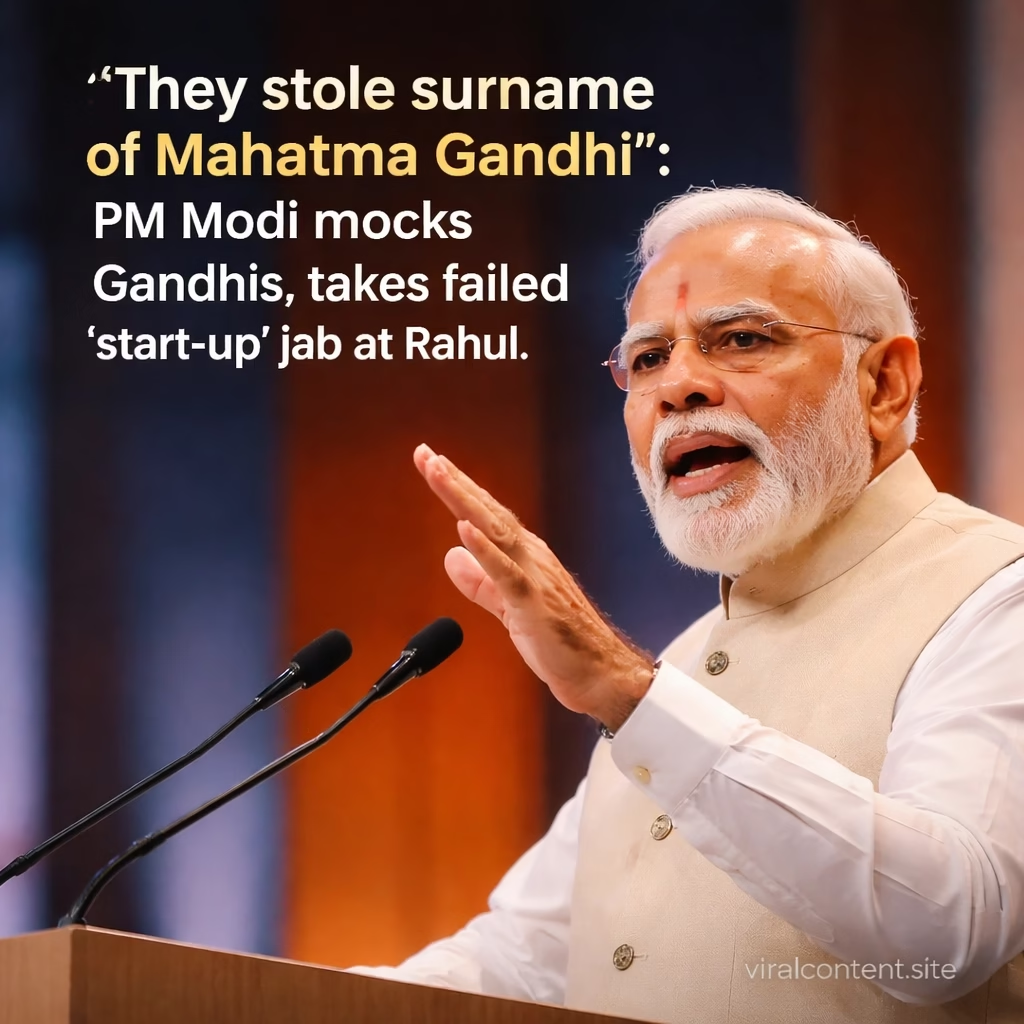
In a recent political broadside, Prime Minister Narendra Modi accused the Nehru-Gandhi family of "stealing" the surname of Mahatma Gandhi, while simultaneously mocking Congress leader Rahul Gandhi's political trajectory as a "failed start-up." The sharp remarks, delivered during a public address, have intensified the already fractious political discourse in India, drawing swift condemnation from the opposition and rallying support from the ruling Bharatiya Janata Party (BJP). This latest verbal volley underscores the deep-seated rivalry between the nation's two dominant political forces and their contrasting interpretations of India's historical and contemporary leadership.
Background: A Legacy Under Scrutiny
The contentious relationship between the BJP and the Indian National Congress, particularly the Nehru-Gandhi dynasty, forms a foundational element of modern Indian politics. For decades, the BJP has sought to challenge the Congress's historical narrative and its perceived monopoly over the legacy of India's freedom struggle. At the heart of this contest lies the figure of Mahatma Gandhi, revered nationwide as the Father of the Nation.
The 'Gandhi' surname itself has been a point of contention for years. While Mohandas Karamchand Gandhi, revered as Mahatma Gandhi, is globally recognized, the political family that has led the Congress party for much of independent India's history—Jawaharlal Nehru, Indira Gandhi, Rajiv Gandhi, Sonia Gandhi, and Rahul Gandhi—bears the same surname through Feroze Gandhi, Indira Gandhi's husband. Feroze Gandhi, though a Parsi by birth, adopted the surname 'Gandhi' earlier in his life, reportedly influenced by Mahatma Gandhi's non-cooperation movement. Critically, Feroze Gandhi was not related by blood to Mahatma Gandhi. This distinction has frequently been highlighted by critics to question the Nehru-Gandhi family's direct claim to Mahatma Gandhi's legacy, often implying a deliberate appropriation for political mileage.
Rahul Gandhi, the scion of this prominent political family, has been a central figure in the Congress party for nearly two decades. His political career, marked by various roles including Member of Parliament and Congress President, has been a frequent target of BJP criticism. Despite his lineage, Rahul Gandhi has faced challenges in consolidating leadership and delivering electoral victories, particularly against the formidable electoral machine of the BJP under PM Modi. His attempts to rejuvenate the Congress party and connect with the masses, such as through the recent 'Bharat Jodo Yatra' (Unite India March), are often framed by the BJP as ineffective or lacking substance, leading to jibes about his political acumen and leadership capabilities.
Key Developments: Modi’s Latest Barbs
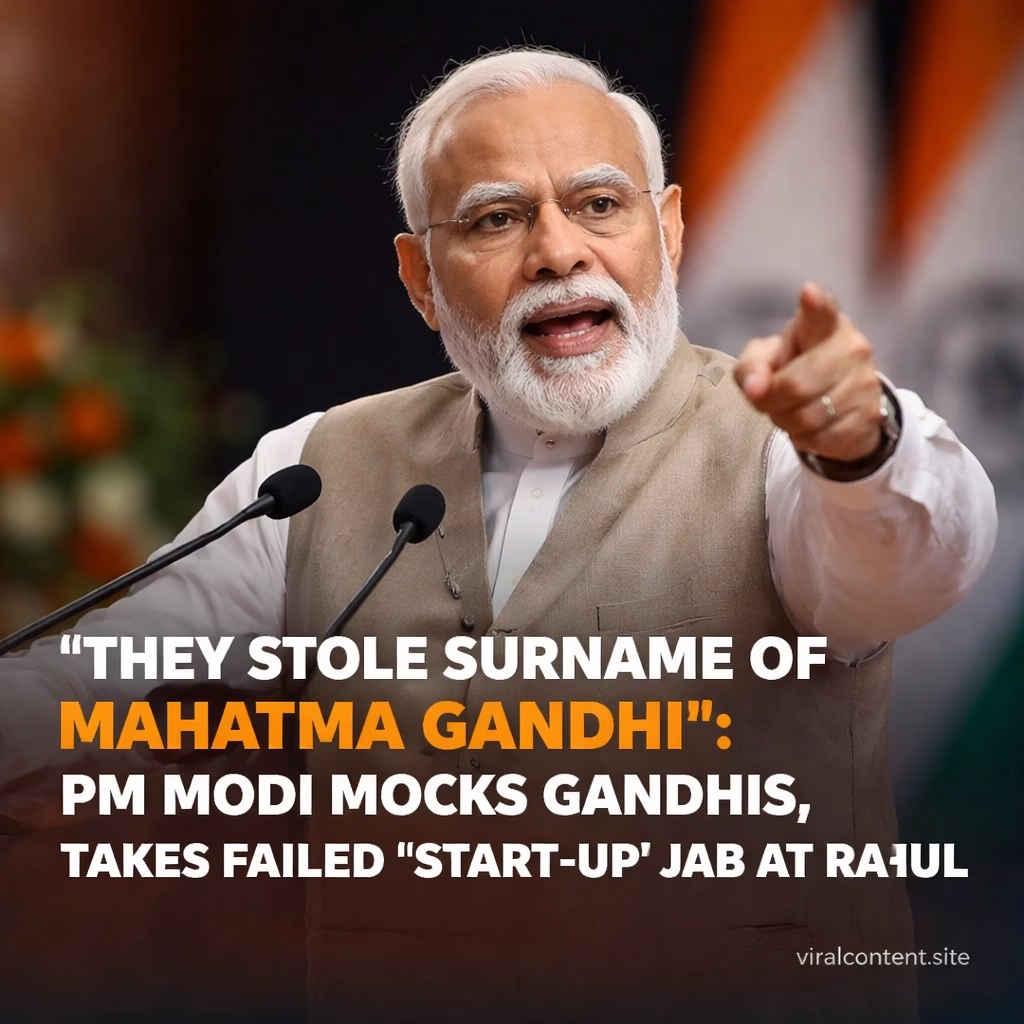
Prime Minister Modi's recent comments represent a significant escalation in the rhetoric against the Gandhi family. Speaking at a public rally in a politically crucial state, the Prime Minister directly questioned the family's right to use the Gandhi surname. "They are not even related to Mahatma Gandhi," Modi reportedly stated, "but they shamelessly stole his surname. They do not have the right to use it." This accusation explicitly played on the historical fact that the Nehru-Gandhi family's surname connection to Mahatma Gandhi is not through direct bloodline.

The ‘Failed Start-up’ Analogy
Beyond the surname controversy, PM Modi also took aim at Rahul Gandhi's political career, employing a contemporary analogy. "Some people tried to launch a 'start-up' in politics," Modi remarked, "but it failed to take off. Their every attempt has been a failure, and they continue to fail." This jab was widely interpreted as a direct reference to Rahul Gandhi's leadership of the Congress party and his electoral track record. The term 'start-up' carries connotations of innovation, risk-taking, and, crucially, the high rate of failure in new ventures. By likening Rahul Gandhi's political journey to a "failed start-up," Modi aimed to diminish his credibility and reinforce the narrative of his political ineffectiveness.
The timing of these remarks is also pertinent, coming amidst preparations for upcoming state assembly elections and the looming general elections. Such pointed attacks serve to energize the BJP's electoral base, reinforce their narrative against the Congress, and potentially sow doubt among swing voters regarding the opposition's leadership.

Impact: Echoes Across the Political Spectrum
The Prime Minister's statements immediately reverberated across India's political landscape, eliciting strong reactions from various quarters.
Congress’s Vehement Defense
The Indian National Congress swiftly condemned PM Modi's remarks as "baseless," "malicious," and "beneath the dignity of the Prime Minister's office." Congress leaders highlighted the family's sacrifices for the nation, including the assassinations of Indira Gandhi and Rajiv Gandhi, arguing that their commitment to India's ideals transcends any surname. They emphasized that the 'Gandhi' surname has become synonymous with a legacy of struggle, sacrifice, and service to the nation, irrespective of biological lineage. Many also pointed out that Mahatma Gandhi himself considered the Nehru family as his political heirs and close associates. Rahul Gandhi, while not directly addressing the "start-up" remark, has consistently asserted his commitment to fighting for democratic values and the rights of the common people, often framing his political struggle as a battle against divisive forces.
BJP’s Reinforcement of Narrative
For the BJP, Modi's statements align perfectly with their long-standing strategy of challenging the Congress's dynastic politics and questioning the Nehru-Gandhi family's historical preeminence. Party spokespersons and leaders quickly rallied behind the Prime Minister, amplifying his accusations and reiterating the claim that the Congress has exploited national symbols and legacies for personal and political gain. The remarks are seen as a calculated move to further erode the Congress's traditional support base and consolidate the BJP's nationalist agenda.
Public and Media Reaction
The comments have sparked extensive debate in mainstream media and on social media platforms. Analysts have discussed the ethical implications of such personal attacks in political discourse, while others have delved into the historical accuracy and political motivations behind the 'stolen surname' claim. Public opinion remains divided, with supporters of the BJP applauding the Prime Minister's directness and critics decrying the perceived trivialization of Mahatma Gandhi's legacy and the use of personal attacks in lieu of policy debates. The controversy is likely to keep the focus on personalities rather than substantive issues, at least in the short term.
What Next: Escalating Rhetoric Towards Elections
The political fallout from PM Modi's comments is expected to continue shaping the national discourse in the coming weeks and months.
Continued Verbal Sparring
The Congress party is unlikely to let these accusations go unchallenged. Expect further counter-attacks, with Congress leaders likely to remind the public of the BJP's own historical connections (or lack thereof) to the freedom movement, and to accuse the government of diverting attention from pressing economic and social issues. Rahul Gandhi himself may respond more directly to the "failed start-up" jibe, perhaps by emphasizing his commitment to long-term political struggle over short-term electoral gains.
More Read

Weaponization in Electoral Campaigns
As India gears up for crucial state elections and the 2024 general elections, these remarks will undoubtedly be weaponized by both sides. The BJP will likely continue to question the Congress's lineage and leadership, while the Congress will portray the BJP's attacks as disrespectful to national icons and a sign of desperation. The debate over historical legacies, dynastic politics, and leadership effectiveness will remain central to the electoral narrative.
Focus on Policy vs. Personality
A key question remains whether the political discourse will eventually shift back to substantive policy debates concerning the economy, employment, social justice, and development. While personal attacks and historical revisionism often dominate headlines, voters ultimately seek solutions to their everyday problems. The challenge for both the ruling party and the opposition will be to balance their political messaging with tangible proposals that address the concerns of the electorate, even amidst the ongoing war of words.
The latest salvo from PM Modi ensures that the 'Gandhi' surname and Rahul Gandhi's political journey will remain hot-button issues, keeping the political pot boiling as the nation inches closer to its next major electoral showdown.