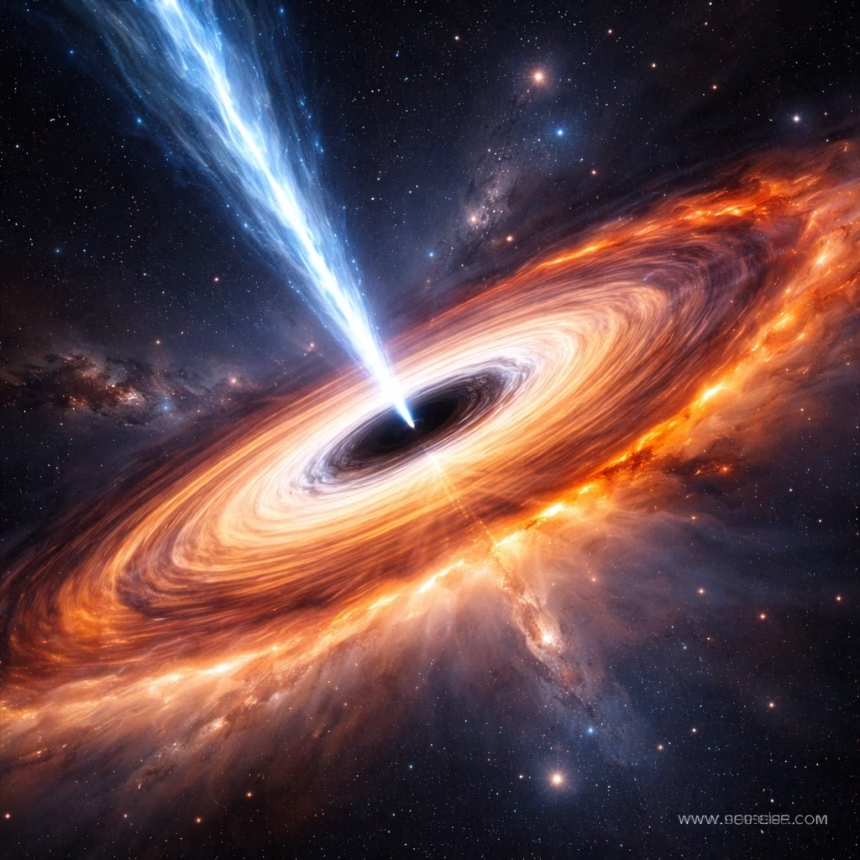
A supermassive black hole located in a distant galaxy has been observed ejecting matter for several years following a stellar meal, a phenomenon that challenges existing astronomical models. This unprecedented, long-duration outflow, initially detected in 2018, originates from the galaxy designated AT2018hyz, approximately 665 million light-years from Earth. Recent observations confirm the black hole’s persistent "belching" activity, providing a unique window into the aftermath of a star's demise.
Background: The Stellar Demise and Initial Flare
The event began as a Tidal Disruption Event (TDE), a cosmic phenomenon where a star ventures too close to a supermassive black hole and is torn apart by the black hole's immense gravitational forces. Such events are rare, occurring perhaps once every 10,000 to 100,000 years in a typical galaxy. When a star is disrupted, about half of its material is flung away, while the other half forms an accretion disk around the black hole, eventually falling in. This process typically triggers a bright flare of X-rays and ultraviolet light as the material heats up.
The Discovery of AT2018hyz
The initial TDE, named AT2018hyz, was first spotted in November 2018 by the All-Sky Automated Survey for Supernovae (ASAS-SN) network. Astronomers quickly followed up with observations across the electromagnetic spectrum, confirming the star's destruction. Initially, AT2018hyz exhibited the expected X-ray and ultraviolet emissions, characteristic of a TDE, but these flares typically subside within months. Standard models predicted a relatively quick return to quiescence for the black hole after consuming the star's material.
Unusual Radio Silence and Delayed Activity
For the first few years following the initial flare, AT2018hyz remained remarkably quiet in radio wavelengths. This was a puzzling aspect, as some TDEs do produce radio emissions, often associated with powerful jets of particles launched from the black hole. The absence of such emissions led researchers to classify it as a "radio-quiet" TDE, fitting within a known, albeit less understood, category. However, this radio silence was merely a prelude to a far more extraordinary display.
More Read

Key Developments: The Years-Long Ejection
Beginning in early 2021, nearly three years after the initial disruption, astronomers observed an unexpected and dramatic resurgence of activity from AT2018hyz, this time predominantly in radio wavelengths. This delayed onset of powerful radio emissions, continuing through 2023, signaled a significant departure from conventional TDE behavior.
A Powerful, Delayed Outflow
Using an array of radio telescopes, including the Karl G. Jansky Very Large Array (VLA) in New Mexico and the European VLBI Network (EVN), scientists detected a powerful outflow of material emanating from the black hole. This outflow was not a brief burst but a sustained ejection, pushing material outwards at extraordinary speeds. The ejected plasma is estimated to be traveling at approximately 50% the speed of light, or roughly 150,000 kilometers per second.
Measuring the Cosmic Belch
Detailed observations allowed researchers to map the expansion of this ejected material. The radio signals indicated a large, expanding cloud of gas and plasma, growing over time. The sheer energy involved in this outflow is immense, comparable to the total energy output of a supernova explosion. This sustained energy release suggests a prolonged process of interaction between the black hole and the stellar debris, far beyond what typical TDE models predict.
More Read

Evidence of Reprocessing
The delayed and sustained nature of the radio emissions suggests that the black hole might be "reprocessing" the stellar material over an extended period. Instead of simply consuming the star and then settling, it appears to be intermittently or continuously expelling remnants. This could be due to complex magnetic field interactions within the accretion disk or a delayed launch of a powerful wind from the black hole's vicinity, driven by the intense radiation pressure.
Impact: Reshaping Black Hole Understanding
The long-duration ejection event from AT2018hyz has profound implications for astrophysics, challenging established theories of black hole accretion and outflow mechanisms. It provides an unprecedented case study that could redefine our understanding of these enigmatic cosmic engines.
Challenging Current TDE Models
Existing models for Tidal Disruption Events primarily focus on the initial flare and the subsequent, relatively rapid decline in activity. The persistent, powerful radio emission years later from AT2018hyz directly contradicts these expectations. This event suggests that TDEs can be far more complex and long-lived than previously thought, requiring significant revisions to theoretical frameworks. It highlights a previously underestimated phase in the aftermath of a stellar disruption.
Insights into Black Hole Feedback
Supermassive black holes are known to play a crucial role in galaxy evolution through a process called "feedback," where energy and matter ejected from the black hole can influence star formation and gas distribution in their host galaxies. This long-duration ejection provides direct evidence of a sustained feedback mechanism from a TDE, potentially demonstrating how even a single stellar meal can have lasting effects on the surrounding galactic environment. Understanding the energy and momentum imparted by such outflows is vital for modeling galaxy growth.
Unveiling Hidden Phenomena
The delayed nature of the radio emission also suggests that some TDEs might have "hidden" phases of activity that are not immediately apparent in X-ray or UV light. This opens up the possibility that other TDEs previously classified as "radio-quiet" might simply be exhibiting delayed radio flares, underscoring the need for long-term, multi-wavelength monitoring of these events. It encourages astronomers to revisit archival data for similar delayed signatures.
What Next: Continued Monitoring and New Frontiers
The ongoing activity of AT2018hyz presents an unparalleled opportunity for astronomers to study black hole dynamics in real-time over an extended period. The next steps involve continued observation, refined theoretical modeling, and the search for similar events.

Long-Term Observational Campaigns
Astronomers plan to continue monitoring AT2018hyz across the electromagnetic spectrum for years to come. This includes sustained observations with radio telescopes like the VLA, as well as X-ray observatories such as Chandra and Swift, and optical telescopes. The goal is to track the evolution of the outflow, measure its deceleration, and observe any further shifts in its emission properties. Such sustained campaigns are crucial for understanding the full lifecycle of these extraordinary events.
Developing New Theoretical Models
The anomalous behavior of AT2018hyz necessitates the development of new theoretical models that can account for delayed and sustained outflows in TDEs. These models will likely incorporate more complex physics of accretion disks, magnetic fields, and radiative feedback, aiming to explain how a black hole can "hold onto" and then expel matter years after the initial feeding event. This will involve sophisticated simulations and analytical calculations.
Searching for Similar Events
The discovery of AT2018hyz's prolonged ejection will spur astronomers to re-examine archival data from other TDEs, specifically looking for delayed radio flares or other long-term signatures that might have been overlooked. Future surveys will also be designed with longer monitoring periods, increasing the chances of detecting similar phenomena. Identifying more such events will help determine if AT2018hyz is a unique outlier or representative of a broader, though previously unrecognized, class of TDE behavior.
Future Telescopes and Capabilities
Next-generation radio observatories, such as the Square Kilometre Array (SKA) and the Next Generation Very Large Array (ngVLA), will offer unprecedented sensitivity and resolution. These instruments will be instrumental in detecting fainter, more distant, and potentially more common long-duration TDE outflows, further refining our understanding of how supermassive black holes interact with their cosmic environments over geological timescales.