Cosmic Catastrophe: Scientists Uncover Violent Origin of Supermassive Black Holes
Cosmic Catastrophe: Scientists Uncover Violent Origin of Supermassive Black Holes
A long-standing enigma surrounding the rapid emergence of supermassive black holes in the early universe may finally have a compelling explanation. Recent scientific developments, fueled by advanced observational data and sophisticated simulations, point towards a catastrophic birth scenario that defies previous understanding.
Background: The Supermassive Black Hole Paradox
Supermassive black holes (SMBHs), objects with masses millions to billions of times that of our Sun, reside at the heart of nearly every large galaxy, including our own Milky Way. Their existence poses a significant cosmological puzzle: how did these behemoths grow so large, so quickly, in the universe’s infancy?
Observations from telescopes like the Hubble Space Telescope and the Chandra X-ray Observatory have repeatedly revealed the presence of fully-formed SMBHs just a few hundred million years after the Big Bang. For instance, quasars powered by SMBHs with masses exceeding a billion solar masses have been detected as far back as 13 billion years ago, when the universe was less than a billion years old.

Traditional models suggest SMBHs begin as “seeds” – stellar-mass black holes formed from the collapse of massive stars. These seeds would then grow by slowly accreting gas and dust from their surroundings, or by merging with other black holes. However, the sheer scale and speed required for this process to create billion-solar-mass objects in such a short cosmic timeframe seemed impossible. Even with continuous, maximal accretion, a stellar-mass seed would struggle to reach such colossal proportions within the first few hundred million years.
The “direct collapse” model offered an alternative, proposing that vast clouds of primordial gas, unpolluted by heavy elements, could collapse directly into massive black hole seeds, potentially thousands or tens of thousands of solar masses. While this mechanism could create larger initial seeds, it still faced challenges in explaining the most extreme cases and the specific conditions required for such collapses to occur frequently enough.
The James Webb Space Telescope (JWST) has further intensified this mystery. Its unprecedented view into the early universe has confirmed the abundance of mature galaxies with central SMBHs, pushing the timeline for their formation even earlier and making the “seed problem” more acute than ever before. The universe simply didn’t seem old enough for these giants to have formed through conventional, gradual means.
More Read

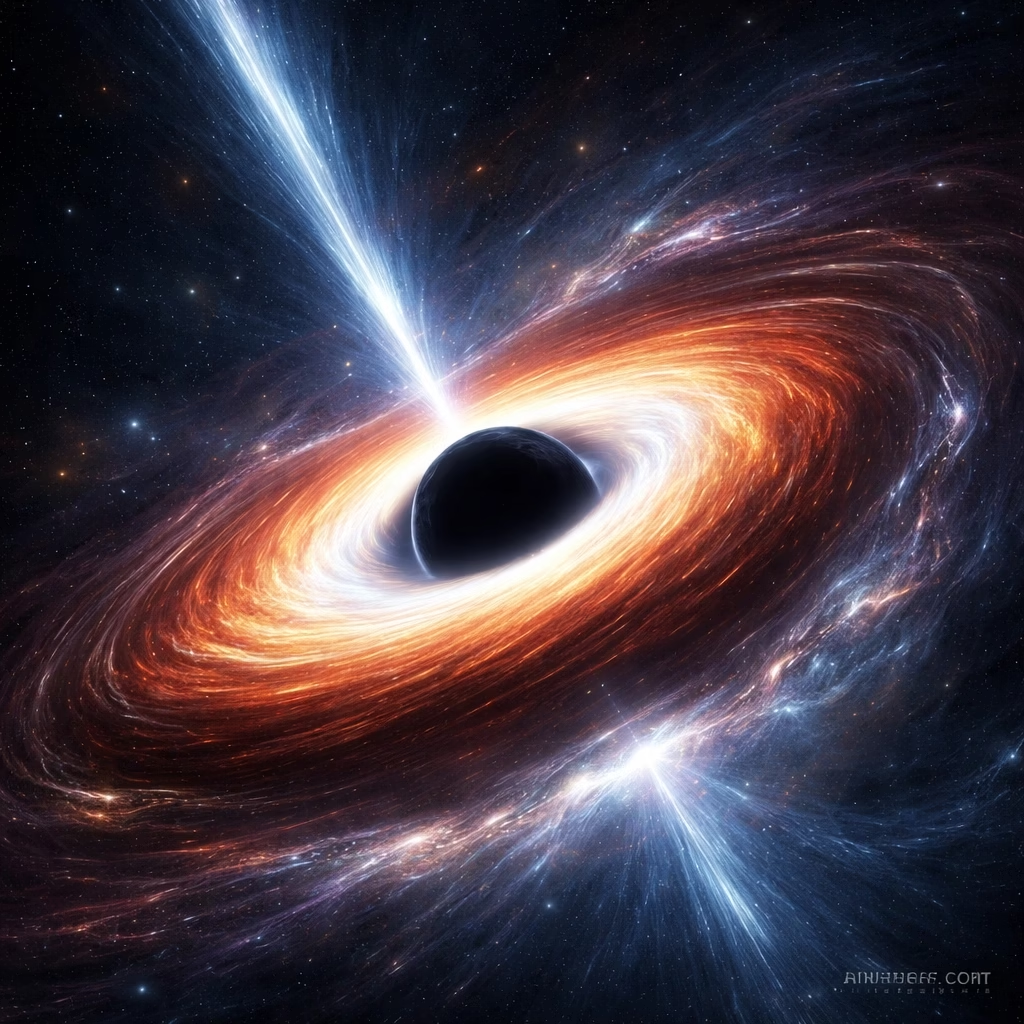
Key Developments: A Catastrophic Birth Revealed
The emerging consensus among astrophysicists points towards a far more violent and rapid formation mechanism than previously envisioned. This “catastrophic” theory suggests that supermassive black holes weren’t grown gradually but were born in extreme, high-energy events that were commonplace in the chaotic early universe.
One prominent aspect of this new understanding involves the rapid assembly of matter in dense knots of the cosmic web. In these regions, immense quantities of primordial gas, along with young, massive stars, would have been funneled into compact volumes. Instead of orderly accretion, simulations now suggest scenarios where entire gas clouds, perhaps millions of solar masses, could undergo a runaway collapse. This is not merely direct collapse, but an accelerated, highly efficient process driven by gravitational instabilities in extremely dense environments.
Furthermore, the early universe was a maelstrom of galactic mergers. Recent simulations, leveraging increased computational power, illustrate that in the aftermath of these frequent galaxy collisions, vast amounts of gas and stars would be funneled towards the galactic centers. This influx could trigger a rapid and overwhelming growth spurt for any nascent black hole seed, or even initiate the direct collapse of an entire super-dense stellar cluster, forming a black hole of intermediate mass that quickly balloons into a supermassive one.
Dr. Priyamvada Natarajan from Yale University, a leading researcher in this field, has explored models where black holes grow through “runaway mergers” of smaller black holes within dense stellar clusters. In the extreme conditions of the early universe, such clusters would have been far more common and tightly packed, leading to frequent collisions and mergers of stellar remnants, ultimately forming a single, much larger black hole at an accelerated pace.
Another catastrophic pathway involves the collapse of “quasi-stars” – hypothetical supermassive stars, potentially millions of solar masses, that could have formed in the early universe. These objects, stabilized by the intense radiation pressure from an embedded stellar-mass black hole, would eventually collapse entirely once their fuel was exhausted, forming a supermassive black hole directly. While still theoretical, the conditions for their formation align with the dense, pristine gas environments of the early cosmos.

Crucially, new data from the James Webb Space Telescope is providing observational backing for these extreme theories. JWST has identified numerous bright, compact galaxies in the early universe that appear to be undergoing intense star formation and rapid mergers. These environments are precisely where the catastrophic formation mechanisms are predicted to occur, providing the necessary fuel and gravitational dynamics for rapid SMBH growth.
Impact: Reshaping Our Cosmic Narrative
The resolution of the supermassive black hole paradox has profound implications for our understanding of cosmic evolution. It fundamentally alters our models of how galaxies form and evolve, as the central black hole is known to exert significant influence on its host galaxy through processes like “feedback,” where energy released by the black hole can regulate star formation.
If SMBHs formed catastrophically and rapidly, it suggests that their influence on early galaxy formation was immediate and pervasive, rather than a gradual process that caught up later. This changes how scientists interpret the observed properties of distant, young galaxies and their star formation rates.
Furthermore, this new paradigm could refine our understanding of the early universe’s physical conditions, including the density fluctuations that led to the formation of the first structures. It also opens new avenues for exploring the interplay between dark matter halos, gas dynamics, and the birth of the first stars and black holes.
For the broader scientific community and the public, it provides a more coherent and dramatic narrative for the universe’s most enigmatic objects, connecting their origins to the most violent and energetic events imaginable in the cosmos.
What Next: Probing the Violent Past
The journey to fully confirm and characterize these catastrophic birth scenarios is ongoing. Future observations with the James Webb Space Telescope will be critical. Astronomers plan to conduct deeper surveys of the early universe, searching for the tell-tale signatures of these extreme formation events, such as unusually bright quasars or galaxies with exceptionally high black hole-to-galaxy mass ratios at early epochs.
Sophisticated cosmological simulations will continue to play a vital role. Researchers are developing models with even higher resolution and incorporating more complex physics, including detailed gas dynamics, radiative feedback, and relativistic effects, to precisely map the conditions under which these catastrophic collapses and mergers could occur.
Upcoming observatories are also poised to contribute significantly. The European Space Agency’s Athena X-ray Observatory, planned for launch in the 2030s, will be able to detect fainter and more distant X-ray emissions from accreting black holes, providing a clearer census of SMBHs in the early universe. Similarly, the Nancy Grace Roman Space Telescope will conduct wide-field infrared surveys, identifying more distant galaxies and quasars that could harbor these early giants.
Scientists will also continue the search for “intermediate-mass black holes” (IMBHs), objects between stellar-mass and supermassive black holes. These IMBHs could represent the direct products of some catastrophic formation channels or serve as important building blocks in the rapid assembly of their supermassive cousins, offering crucial clues to the full evolutionary pathway.
The mystery of supermassive black holes, while seemingly closer to a solution, continues to drive cutting-edge research, promising further revelations about the universe’s most extreme phenomena.