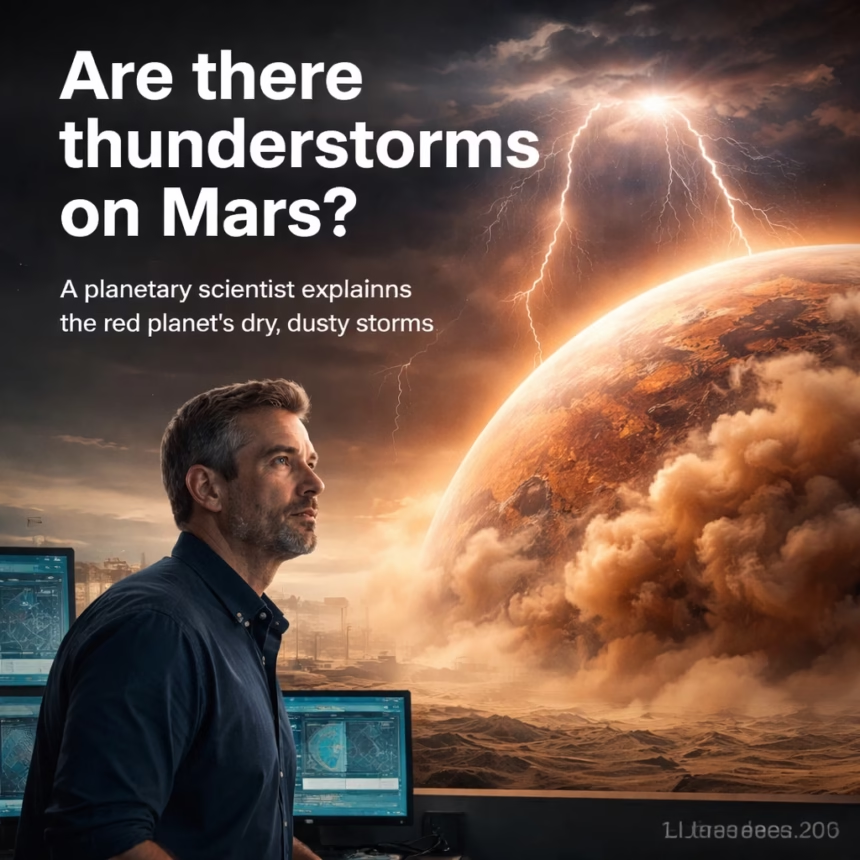
Planetary scientists continue to unravel the complex atmospheric dynamics of Mars, shedding light on its unique weather phenomena. A persistent question has been whether the Red Planet's infamous dust storms generate lightning and thunder similar to Earth's powerful electrical storms. Recent insights clarify that while Mars experiences immense atmospheric turbulence, its dry, thin atmosphere fundamentally precludes traditional thunderstorms.
Background: A World Without Water-Ice Thunderstorms
Earth's dramatic thunderstorms are a product of specific atmospheric conditions: abundant water vapor, strong convective updrafts, and the formation of ice crystals within towering cumulonimbus clouds. As ice particles collide in these turbulent environments, they generate static electricity, leading to massive lightning discharges and the subsequent sonic boom of thunder.
Mars, by stark contrast, presents an entirely different atmospheric reality. Its atmosphere is incredibly thin, roughly 1% the density of Earth's, and composed primarily of carbon dioxide. This arid environment lacks the significant water vapor and robust convection necessary for terrestrial-style lightning and thunder. Early missions to Mars, such as Mariner 4 in 1965, began to reveal a cold, dry world, challenging earlier speculations of a more Earth-like past. Subsequent landers and rovers, including the Viking missions in the 1970s and the Spirit and Opportunity rovers in the 2000s, consistently provided data confirming Mars' extreme aridity.
Earthly Thunderstorm Mechanics
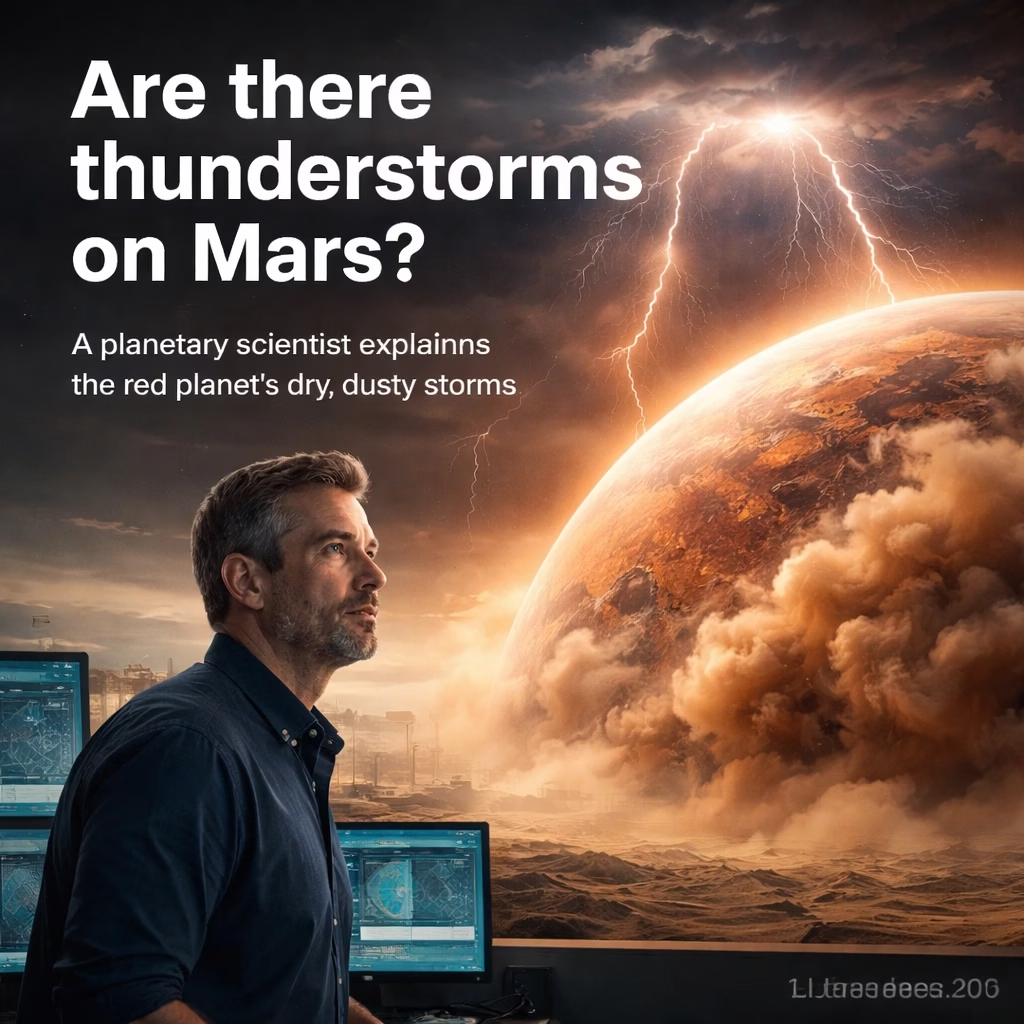
On Earth, lightning forms when rapidly rising air carries water droplets and ice crystals aloft. Collisions between these particles cause charge separation, with positive charges accumulating at the top of the cloud and negative charges at the bottom. When the electrical potential difference becomes too great, a rapid discharge of electricity occurs, creating a lightning bolt.

Mars’ Arid Reality
The Martian atmosphere simply does not support this process. There is insufficient water vapor to form substantial water-ice clouds, and the low atmospheric pressure limits the vertical development of any clouds that do form. Consequently, the fundamental ingredients for generating the powerful electrical fields required for lightning are absent.
Key Developments: Electrified Dust, Not Thunder
While lacking water-ice thunderstorms, Mars experiences massive, planet-encircling dust storms that are anything but calm. Recent observations from NASA's Curiosity and Perseverance rovers have significantly advanced our understanding of these phenomena. Dr. Aris Thorne, a planetary atmospheric scientist at the Institute for Martian Climate Studies, explains, "The fundamental ingredients for terrestrial thunderstorms – specifically abundant water vapor and the vigorous updrafts that carry it high into the atmosphere to form ice crystals – are simply absent on Mars."
Instead, Martian dust storms generate their own unique electrical phenomena. As fine dust particles are lofted by strong winds, they collide and rub against each other. This friction, known as the triboelectric effect, causes the particles to acquire an electrostatic charge. Smaller, lighter particles tend to gain a positive charge, while larger, heavier particles become negatively charged, creating localized electric fields within the dust clouds.
More Read
Electrostatic Charging in Dust
This process is akin to rubbing a balloon on your hair, where friction causes a transfer of electrons and a static charge builds up. On Mars, this happens on a massive scale within dust storms. While these electrostatic fields are not typically strong enough to generate planet-spanning lightning bolts visible from orbit, they can lead to small-scale electrical discharges. These "dust lightning" events, if they occur, would likely be much weaker and localized than Earth's lightning, possibly manifesting as faint glows or micro-discharges within the densest parts of dust storms.
No Lightning, But Potential for Discharges
Current scientific consensus indicates that the conditions for large-scale, powerful lightning strikes, like those seen on Earth, do not exist on Mars. The electrical fields generated by triboelectric charging in Martian dust storms are generally insufficient to overcome the insulating properties of the thin atmosphere to produce macroscopic lightning. However, the presence of localized electrostatic charges and potential small-scale discharges remains an active area of research, particularly as it relates to the behavior of dust particles themselves.
Impact: Challenges for Exploration
The absence of lightning-generating thunderstorms has significant implications for both current robotic missions and future human exploration. For rovers like Curiosity and Perseverance, the primary electrical concern from storms is not direct lightning strikes but the pervasive dust itself. Dust accumulation on solar panels, as famously impacted the Opportunity rover, significantly reduces power generation. The electrostatic charging of dust particles can also pose risks to sensitive electronic equipment, potentially leading to static discharge events that could damage components.
Robotic Mission Challenges
Martian dust, which can be electrostatically charged, adheres to surfaces, including rover solar panels and scientific instruments. This accumulation reduces efficiency and can necessitate "dust-clearing" events, either by wind or mechanical means. Additionally, electrostatic discharges could interfere with communication systems or damage delicate sensors if not properly shielded.
Human Exploration Considerations
For future human missions to Mars, understanding the electrical environment is crucial. While astronauts would not face the direct threat of lightning strikes, the challenges posed by electrically charged dust are substantial. Inhalation of fine dust particles could pose health risks, and dust clinging to spacesuits and habitats could lead to equipment wear and tear, as well as contamination. Mitigating the effects of charged dust will be a key engineering challenge for long-duration human missions.
What Next: Deeper Insights and Future Missions
Future missions are poised to delve even deeper into Mars' atmospheric mysteries. NASA's upcoming Mars Sample Return campaign, in conjunction with ESA, will bring Martian samples to Earth, potentially offering new insights into the planet's geological and atmospheric history, including past climate conditions. JAXA's Martian Moons eXploration (MMX) mission, set to launch in 2024, will also contribute to understanding the Martian environment by studying its moons and their interaction with the planet's atmosphere.

Advanced Atmospheric Modeling
Scientists are continually refining atmospheric models to better predict and understand Martian weather, including the dynamics of dust storms. These models, increasingly incorporating artificial intelligence and machine learning, aim to forecast dust storm initiation and propagation, which is vital for mission planning and safety.
Looking for Past Evidence
An intriguing area of ongoing research involves searching for evidence of past atmospheric conditions on Mars. Billions of years ago, Mars is believed to have had a thicker atmosphere and potentially liquid water on its surface. If such conditions existed, it raises the speculative question of whether ancient Mars could have supported water-ice thunderstorms. Future geological and atmospheric studies will continue to probe the Red Planet's deep past for clues about its evolving climate and potential for more Earth-like weather phenomena. The current reality, however, firmly establishes Mars as a world of dry, electrically charged dust storms, devoid of the thunderous skies we know on Earth.