
On January 24, 1961, the quiet farming community near Goldsboro, North Carolina, stood unknowingly on the precipice of an unimaginable catastrophe. A routine Cold War mission turned into a nightmare when a B-52 bomber carrying two thermonuclear weapons disintegrated mid-air, bringing the United States within a hair's breadth of an accidental nuclear detonation on its own soil. This harrowing incident, kept secret for decades, highlights the perilous stakes of the Cold War and the fragile line between safety and disaster.
Background: The Cold War’s Silent Threat
The early 1960s represented a zenith of Cold War tensions, with the United States and the Soviet Union locked in a precarious nuclear arms race. Both superpowers maintained constant vigilance, deploying strategic bombers on airborne alert missions designed to ensure a rapid retaliatory strike capability. Operation Chrome Dome, as these US Air Force patrols were known, involved B-52 Stratofortresses carrying fully armed nuclear weapons, circling near enemy airspace or over friendly territory, ready to proceed to their targets at a moment's notice. This strategy, while intended to deter aggression, also introduced inherent risks.
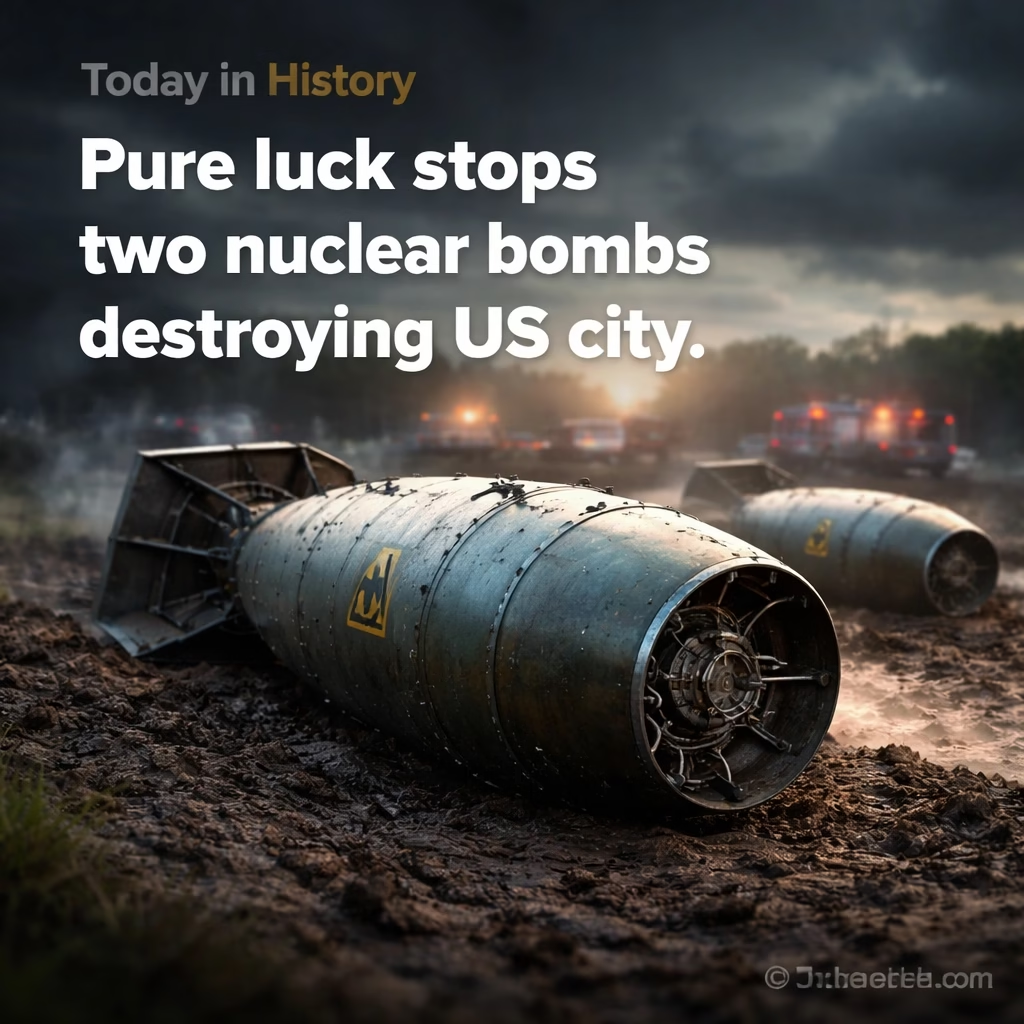
On the fateful day of January 24, 1961, a B-52G bomber, tail number 58-0245, codenamed "Broken Arrow," departed Seymour Johnson Air Force Base in Goldsboro, North Carolina. It was part of an airborne alert mission over the East Coast. Aboard were eight crew members and two Mark 39 hydrogen bombs, each with a yield of 3.8 megatons – approximately 250 times more powerful than the bomb dropped on Hiroshima. During its patrol, the aircraft developed a catastrophic fuel leak in its right wing. As the crew attempted to return to base, the leak worsened, leading to an uncontrollable fire. At an altitude of 10,000 feet, the bomber became unstable, and the pilot, Major Walter S. Scott, ordered the crew to bail out. Five crew members parachuted to safety, one died on impact, and two were killed in the crash. The disintegrating aircraft then released its deadly cargo.
Key Developments: Unveiling the Near Catastrophe
For decades, the full extent of the danger posed by the Goldsboro crash remained largely obscured by military secrecy. While the incident was known, the details surrounding the near-detonation of the nuclear bombs were classified. It wasn't until 2013, following a Freedom of Information Act (FOIA) request by investigative journalist Eric Schlosser, that a declassified document from the Atomic Energy Commission (AEC) finally revealed the chilling reality: one of the two Mark 39 bombs came within a single, low-voltage switch of detonating.
More Read

The document, a 1969 memo titled "Goldsboro Revisited" written by Parker F. Jones, a supervisor of nuclear safety at Sandia National Laboratories, detailed the terrifying sequence of events. The first bomb plummeted into a muddy field, burying itself deep underground. Its parachute had deployed, and four of its six safety mechanisms had activated, preventing detonation. The second bomb, however, presented a far more perilous scenario. As it fell, its parachute also deployed, but critically, five of its six safety mechanisms failed. These failures included a high-voltage switch, a barometric switch, and a timer switch, all designed to prevent accidental detonation. The only thing preventing the 3.8-megaton weapon from unleashing its destructive power was a single, low-voltage switch – a simple, mechanical switch designed to complete the firing circuit. This switch was found in a "safe" position, but its failure to activate was described by Jones as "pure luck." Had this final switch closed, Goldsboro and a significant portion of the Eastern Seaboard would have faced an unimaginable nuclear disaster.
This revelation profoundly shifted the understanding of Cold War risks, demonstrating that the threat of accidental nuclear war was not merely theoretical but a tangible, ever-present danger. Experts immediately highlighted the implications, underscoring the inherent fallibility of complex systems and the immense destructive potential contained within these weapons, even when not intentionally deployed.
Impact: Averted Disaster and Lingering Legacy
Had the second Mark 39 bomb detonated, the impact would have been catastrophic beyond comprehension. The 3.8-megaton explosion would have created a fireball several miles wide, vaporizing everything within a radius of several miles. The immediate blast zone would have extended for tens of miles, causing widespread destruction to infrastructure and immense loss of life in Goldsboro and surrounding communities like Kinston, Fayetteville, and even parts of Raleigh. Furthermore, the resulting radioactive fallout would have spread for hundreds of miles, carried by prevailing winds, contaminating vast agricultural areas and rendering them uninhabitable for generations. Millions of people across North Carolina and beyond would have been exposed to lethal levels of radiation, leading to widespread illness, death, and long-term environmental devastation.

Beyond the immediate human and environmental toll, the political ramifications would have been immense. An accidental nuclear detonation on American soil during the height of the Cold War could have been misinterpreted by the Soviet Union as a deliberate act, potentially triggering a retaliatory strike and escalating into a full-scale nuclear war. The incident would have shattered global trust in nuclear safety protocols and intensified fears of nuclear proliferation.
The Goldsboro near-miss, along with other "Broken Arrow" incidents, spurred significant changes in nuclear weapons design and safety protocols. The military intensified efforts to develop "fail-safe" mechanisms, including Permissive Action Links (PALs), which require a specific code to arm a weapon, making accidental or unauthorized detonation virtually impossible. The incident also underscored the need for stricter handling procedures for nuclear materials and a re-evaluation of airborne alert strategies. While one bomb was recovered largely intact, the core of the second bomb, containing uranium, remains buried deep beneath a farmer's field near Faro, North Carolina. The Air Force purchased a 400-foot circular easement around the buried section, acknowledging the ongoing presence of radioactive material. The memory of the Goldsboro incident serves as a stark reminder of the immense power and inherent risks associated with nuclear weapons.
What Next: Lessons for a Nuclear Age
The Goldsboro incident remains a critical case study in nuclear safety and the enduring challenges of managing weapons of mass destruction. While significant advancements have been made in nuclear weapon design and safety protocols since 1961, the fundamental lesson of Goldsboro — that "pure luck" can be the final arbiter between safety and catastrophe — continues to resonate. The incident underscores the imperative for continuous vigilance, robust international treaties, and stringent national policies to prevent future accidents.
For the United States, the buried bomb near Goldsboro represents a tangible, if contained, legacy of the Cold War. The site is monitored, ensuring its stability and preventing environmental contamination. However, the long-term implications of such buried materials and the costs associated with their eventual, safe disposal remain a concern. Globally, the lessons from Goldsboro are pertinent to the ongoing debates surrounding nuclear non-proliferation and disarmament. As more nations acquire or seek nuclear capabilities, the risks of accidental detonation, whether due to technical malfunction, human error, or miscalculation, multiply.
The historical memory of near-misses like Goldsboro serves as a powerful deterrent against complacency. It reinforces the argument for reducing global nuclear arsenals and strengthening international cooperation to manage and ultimately eliminate these weapons. The incident highlights that even in the most sophisticated systems, the margin for error can be terrifyingly thin, making the pursuit of a world free from nuclear weapons not just an idealistic goal, but a pragmatic necessity for global security. The day Goldsboro almost vanished remains a chilling testament to humanity's capacity for both technological prowess and self-destruction, a story that continues to inform our understanding of the nuclear age.