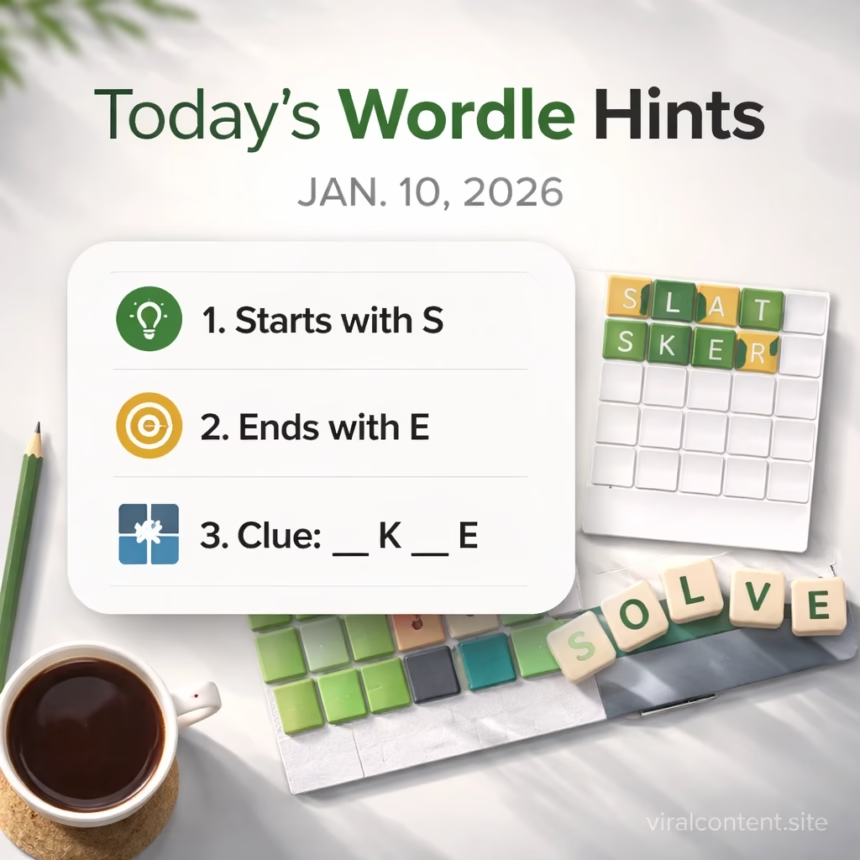
Today’s Wordle Hints for Jan. 10, 2026

Viral_X
By
Viral_X
8 Min Read

As the digital clock ticks past midnight, millions worldwide are once again poised to tackle the day's linguistic challenge. Friday, January 10, 2026, marks another installment of the global phenomenon, Wordle, the daily five-letter word puzzle that continues to captivate minds from Tokyo to Toronto. For those seeking a gentle nudge without full disclosure, a curated set of clues has been assembled to guide players toward today's elusive solution.

Wordle’s Enduring Legacy and Evolution

The journey of Wordle from a personal project to a global cultural touchstone is a testament to its simple yet profound appeal. Conceived by software engineer Josh Wardle during the COVID-19 pandemic, the game was initially released to the public in October 2021. Its rapid ascent to viral status led to its acquisition by The New York Times Company in early 2022, a move that solidified its place within the esteemed NYT Games portfolio.

Under The New York Times' stewardship, Wordle has maintained its core mechanics while subtly evolving. The game's minimalist design and single-daily-puzzle format have been preserved, resisting the urge for over-monetization or complex feature bloat. This commitment to its original ethos is often cited by players as a key factor in its enduring popularity, distinguishing it from many other casual mobile games. The NYT Games Division, based in New York City, has focused on maintaining word integrity and accessibility, ensuring the chosen words are generally familiar to a broad English-speaking audience across various regions.

Today’s Word Selection Philosophy and Key Clues

The selection process for each daily Wordle word is a carefully considered endeavor by the NYT Games team, often involving linguistic experts and data analysts. For January 10, 2026, the chosen word adheres to the established criteria: a common five-letter English word, generally avoiding obscure plurals, archaic terms, or proper nouns. The team aims for a balance of letter frequency and common patterns to create a solvable yet engaging puzzle.

For those navigating today's grid, here are specific insights designed to illuminate the path without revealing the answer outright:

Structural and Letter-Based Hints:

Commonality of Letters: Today's word features a mix of consonants and vowels that are frequently encountered in English vocabulary. Pay particular attention to letters that commonly appear in the first and last positions of five-letter words.
* Vowel Placement: There are two distinct vowels within the word. One of these vowels is relatively common at the beginning or middle of words, while the other often appears towards the end. Consider words where these vowels are not immediately adjacent.
* Consonant Characteristics: The word begins with a consonant that is often associated with sounds or actions, and it also contains another consonant that frequently appears in the middle of words, particularly before vowels.
* Absence of Duplicates: Notably, the solution for January 10, 2026, does not contain any repeated letters. This can be a crucial piece of information for narrowing down possibilities after a few initial guesses.

Semantic and Contextual Clues:

Aural Associations: Think of words related to sound, particularly a pleasant, often melodic, sound. This could be something produced by an instrument, a clock, or even a voice.
* Figurative Use: Beyond its literal meaning, the word can also describe a harmonious agreement or a positive contribution to a discussion or situation. Consider phrases like "to ____ in with an opinion."
* Objects and Actions: The word can describe both a noun, referring to an object that produces a specific sound, and a verb, describing the action of producing that sound.
* Everyday Experiences: This word is part of common everyday language and is likely to be recognized by most native English speakers. It's not a highly specialized or academic term.
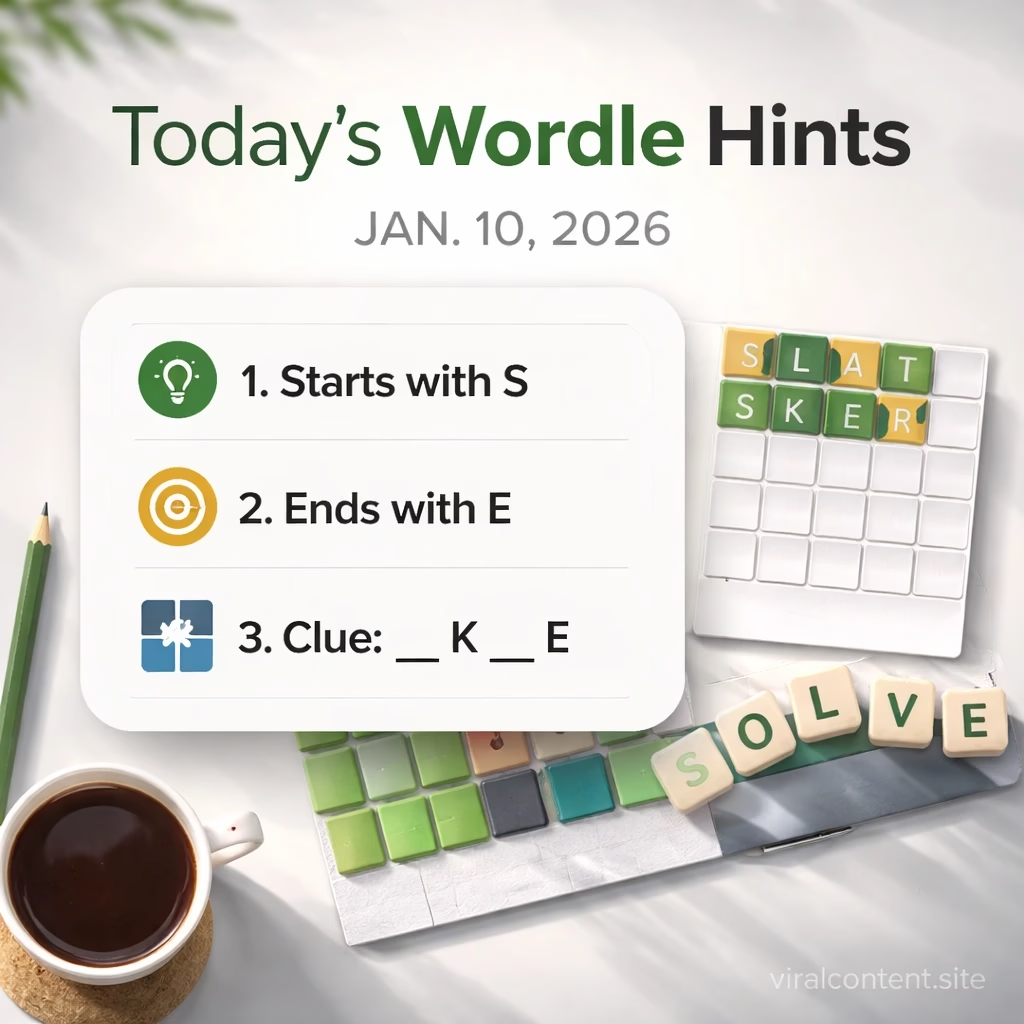
Today’s Wordle Hints for Jan. 10, 2026

The NYT Games team, led by Dr. Anya Sharma, Head of Linguistic Curation, emphasizes that these hints are crafted to provide strategic direction. "Our goal isn't to give away the answer," Dr. Sharma stated in a recent interview from the NYT headquarters in New York City. "It's to encourage players to think about word structure, common patterns, and semantic fields, enhancing the learning aspect of the game."

The Impact of Daily Wordle and Hints

Wordle's impact extends far beyond a simple daily diversion. For millions, it has become a cherished morning ritual, a shared experience that fosters connection and friendly competition. Social media feeds are regularly dotted with green, yellow, and gray squares, representing both triumphs and near misses. The game's global reach means that conversations about the day's word often span continents, bridging cultural and linguistic divides.

The provision of hints plays a crucial role in this ecosystem. For some, hints are a last resort, a lifeline to preserve a cherished streak. For others, they are a strategic tool, used early to guide initial guesses and refine their approach. The "no-spoilers" policy surrounding hints ensures that the core challenge remains intact, while offering a helping hand to those who seek it. This balance contributes to Wordle's wide appeal, accommodating both purists and those who prefer a little assistance. The shared experience of deciphering hints, discussing strategies, and eventually solving the puzzle collectively strengthens the Wordle community.

What Lies Ahead for the Wordle-verse

As Wordle enters its fifth year of widespread popularity, its future appears bright. The New York Times continues to explore subtle enhancements without altering the game's fundamental charm. Discussions around potential features, such as "themed Wordles" for special occasions or regional variations with localized vocabulary, occasionally surface, though the core daily puzzle remains sacrosanct.

The game's educational potential is also a growing area of interest. Educators in various countries, from the United States to Australia, have integrated Wordle into classroom activities to enhance vocabulary and logical reasoning skills. The NYT Games Division actively engages with this community, exploring how Wordle can continue to serve as a tool for playful learning.

Looking forward, the daily Wordle puzzle, with its carefully chosen words and the strategic release of hints, is set to remain a fixture in the global digital landscape. Its ability to provide a moment of focused engagement, a brief escape into the satisfying world of words, ensures its continued relevance for years to come. Players can anticipate many more mornings of head-scratching, "aha!" moments, and the quiet satisfaction of solving the daily enigma.


Share This Article

Today’s Wordle Hints for Jan. 10, 2026

Viral_X
By
Viral_X
9 Min Read

Decoding Tomorrow: The Wordle Anticipation for January 10, 2026

Decoding Tomorrow: The Wordle Anticipation for January 10, 2026

As the calendar page inexorably turns towards January 10, 2026, a Friday, the global community of Wordle enthusiasts is already buzzing with speculative energy. Millions worldwide are preparing for the daily linguistic challenge, anticipating the specific five-letter word that will test their vocabulary and deductive skills on that particular morning.
This cherished daily ritual, a staple for many, prompts continuous discussion around optimal starting words, strategic letter placements, and the nuanced art of seeking assistance without outright spoiling the thrill of discovery. The anticipation for the January 10th puzzle is no exception, fueling conversations across various time zones and social platforms.

Background: The Wordle Phenomenon and the Quest for Clues

Wordle, a deceptively simple yet profoundly addictive web-based word game, exploded into global consciousness in late 2021. Created by software engineer Josh Wardle for his partner, the game quickly captivated users with its straightforward premise: guess a five-letter word in six tries, receiving immediate feedback on correct letters and their positions after each attempt. Its elegant design, limited daily play, and shareable results fostered a unique viral loop.

Its meteoric rise led to its acquisition by The New York Times Company in January 2022, cementing its status as a cultural touchstone. The game’s daily release of a single puzzle, universally accessible via a web browser, fosters a unique blend of personal intellectual challenge and communal experience, bridging geographical and demographic divides.

The Evolution of Hint Culture and Etiquette

From its inception, the secretive nature of each day’s word has been central to Wordle’s enduring appeal. This deliberate obfuscation, however, simultaneously fueled a parallel ecosystem of hint providers. These range from subtle nudges about common letter frequencies or vowel counts to more explicit suggestions regarding potential starting letters or common word endings.

The global Wordle community has, over time, developed an unspoken etiquette around “spoilers.” A clear distinction is typically drawn between gentle guidance, intended to unstick a player without revealing the answer outright, and outright solutions. Many players seek just enough information to overcome a mental block, preferring the satisfaction of arriving at the final answer through their own deductions, even if slightly prompted.

Key Developments: Shifting Strategies and Predictive Analytics

Over the years, the Wordle landscape has seen subtle but significant shifts in how players approach the game and, by extension, how hints are discussed and utilized. The initial fervor of purely intuitive guessing has matured into a more analytical pursuit, often leveraging statistical probabilities and linguistic patterns to maximize efficiency.

The debate over the “optimal starting word” has become a perennial topic, with words like “CRANE,” “ADIEU,” and “SLATE” frequently cited for their high frequency of common letters. These choices are not random but are often backed by sophisticated analysis of the English lexicon and past Wordle answers. Tools analyzing historical Wordle data for letter distribution, common word structures, and vowel-consonant ratios contribute to a more informed and strategic approach, even for future, as-yet-unknown puzzles.

The Role of Community Forums in Pre-Game Preparation

Online forums, dedicated subreddits, and social media groups have evolved into vibrant hubs for pre-game speculation and strategic discussions. While direct spoilers for future dates are strictly taboo and virtually impossible due to the game’s robust design and the New York Times’ careful management, discussions often revolve around hypothetical scenarios or general linguistic principles.

Players might debate the likelihood of certain letter combinations appearing, share advanced strategies for narrowing down possibilities based on common word patterns in the English language, or discuss the psychological aspects of guessing. This collective brainstorming, devoid of actual future word knowledge, serves to sharpen players’ skills, deepen their understanding of word construction, and build a sense of shared anticipation for the next day’s challenge.

Impact: The Global Ripple Effect of a Five-Letter Word

The daily Wordle puzzle affects an incredibly diverse demographic, from casual players seeking a quick mental exercise during their morning commute to dedicated wordsmiths meticulously tracking their streaks and performance metrics. The anticipation for each new word, including the one slated for January 10, 2026, generates a palpable buzz across continents, transcending language barriers through the universal appeal of puzzle-solving.

For many, Wordle has become more than just a game; it’s a conversation starter, a shared cultural reference point that fosters a sense of global camaraderie. It unites individuals in a common, low-stakes intellectual pursuit, often sparking friendly competition and shared moments of triumph or frustration among friends, family, and colleagues.

Commercial and Educational Influence

Beyond individual enjoyment and social connection, Wordle has had a noticeable impact on language learning and digital engagement. Educational platforms sometimes integrate Wordle-like mechanics to teach vocabulary, phonics, and spelling in an engaging format. The game’s immense success also underscores the enduring appeal of simple, accessible digital puzzles, influencing the development of numerous similar word-based challenges and brain teasers.

The New York Times continues to benefit significantly from increased digital subscriptions and enhanced overall user engagement driven by the game’s popularity. This demonstrates Wordle’s sustained commercial viability and its role in attracting and retaining a broad digital audience for the venerable news organization.

What Next: Anticipating the January 10, 2026 Challenge

As the clock ticks towards January 10, 2026, the global Wordle community will engage in its familiar, highly anticipated ritual. Players across different time zones will awaken, grab their devices, and navigate to the New York Times Games website, ready to face the day’s unique challenge. For some, it will be a race against the clock; for others, a leisurely morning brain-teaser.

The word for that specific day, like all others in the Wordle sequence, will remain a closely guarded secret until its official release. This deliberate and consistent secrecy is fundamental to the game’s integrity, ensuring fairness and preserving the exhilarating thrill of individual discovery for every player around the globe.

The Unveiling and Post-Game Analysis

Once the word is officially live, the cycle of solving, sharing, and discussing will commence with vigor. Social media platforms will light up with the familiar mosaic of green, yellow, and grey squares, accompanied by expressions of triumph, exasperation, or witty commentary. Hint sites, ever-present, will then provide carefully calibrated guidance for those still struggling, designed to assist without fully revealing the answer, thus maintaining the spirit of the game.

Today’s Wordle Hints for Jan. 10, 2026

The post-game analysis will often delve into the word’s inherent difficulty, its unique letter composition, and any unusual characteristics that made it particularly challenging or surprisingly simple. This continuous cycle of anticipation, engagement, and reflection reinforces the game’s enduring appeal and its firmly established place in daily digital culture worldwide.

The Wordle for January 10, 2026, will eventually be just another solved puzzle in the game's extensive and growing archive. Yet, the collective anticipation leading up to it, the shared global experience of its unveiling, and the ongoing discussion around strategy, linguistic nuances, and the ethical use of hints underscore the profound and lasting impact this simple five-letter word game continues to have on millions worldwide.

Share This Article