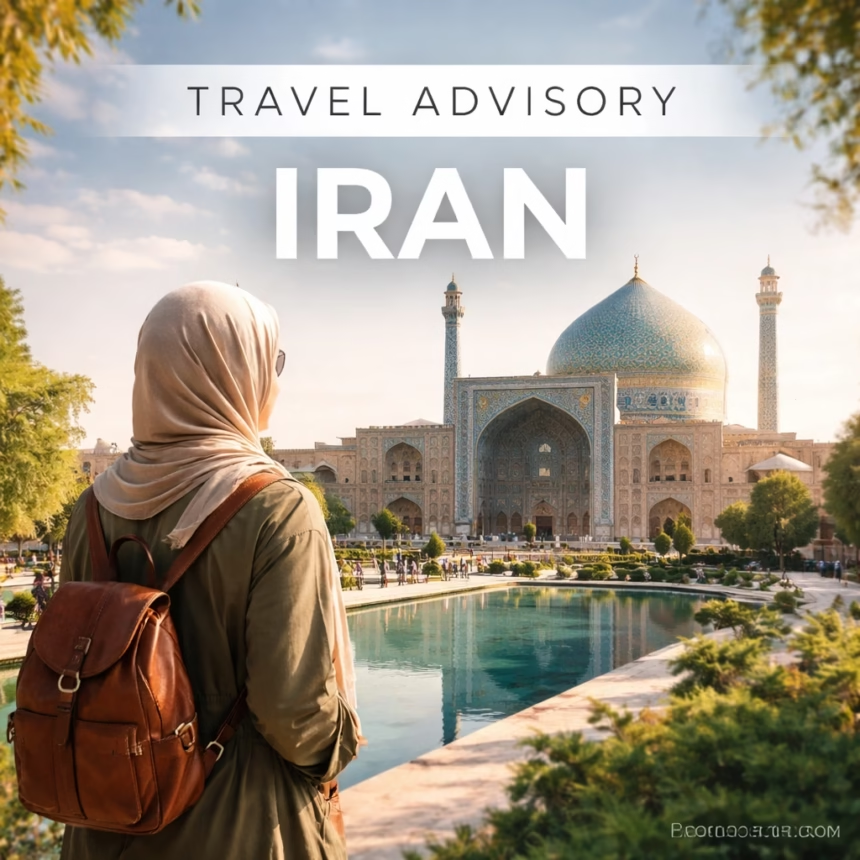
Governments worldwide have recently updated their travel advisories for Iran, urging citizens to reconsider or entirely avoid travel due to escalating regional tensions and the heightened risk of arbitrary detention. These advisories, issued by nations including the United States, the United Kingdom, Canada, and Australia, reflect a deteriorating security landscape and significant risks to foreign nationals. The updated guidance, which took effect in late 2023 and early 2024, specifically highlights concerns over security conditions across the Islamic Republic.
Background: A History of Caution
Travel advisories concerning Iran are not new, reflecting decades of complex geopolitical relations and internal security dynamics. Since the 1979 revolution, relations between Iran and many Western nations have been fraught with tension, often translating into elevated risks for foreign visitors. The United States, for instance, has maintained a "Do Not Travel" advisory for Iran for many years, citing the risk of kidnapping, arrest, and detention of U.S. citizens. This long-standing caution stems from a pattern of incidents involving foreign nationals.
Throughout the 2000s and 2010s, numerous cases of dual nationals and Western citizens being detained on charges such as espionage or threatening national security have consistently fueled these warnings. Key events like the collapse of the Joint Comprehensive Plan of Action (JCPOA) in 2018 and subsequent re-imposition of U.S. sanctions significantly heightened tensions. This period saw an increase in rhetoric and a more pronounced warning from various governments, advising against all but essential travel. The UK Foreign, Commonwealth & Development Office (FCDO) and Global Affairs Canada have also routinely advised their citizens against non-essential travel or, in some cases, all travel, particularly for individuals with Iranian heritage or those involved in sensitive fields like journalism or academia. The European Union has also expressed deep concerns regarding human rights and the safety of its citizens.
The timeline of advisories often correlates with specific geopolitical flashpoints. Periods of heightened regional instability, such as conflicts in Iraq and Syria, or direct confrontations involving Iranian-backed groups, have invariably led to more stringent travel warnings. Internal political unrest, including widespread protests in 2019, 2022, and early 2024, has further contributed to the unpredictable security environment, leading to additional layers of caution from international bodies. These historical patterns underscore a consistent message: travel to Iran carries inherent and evolving risks.
Key Developments: Recent Escalations
The most recent updates to travel advisories for Iran reflect a significant deterioration in regional stability and an increased threat perception. In late 2023 and early 2024, the U.S. Department of State reiterated its "Do Not Travel" advisory, specifically citing the risk of arbitrary arrest and detention of U.S. citizens, particularly dual U.S.-Iranian nationals. The advisory highlighted the Iranian government's practice of detaining individuals for political leverage, often without due process or access to consular services.

Similarly, the UK FCDO updated its guidance in January 2024, advising against all travel to Iran. This stringent update was prompted by the escalating conflict in the Middle East, particularly concerns about potential spillover effects and increased regional volatility. The FCDO specifically warned that the risk of arbitrary detention and harassment of British nationals remains high, emphasizing that British citizens, especially those with connections to Iran, could be targeted. They also noted the limited ability of the British Embassy in Tehran to provide consular assistance in such circumstances.
Global Affairs Canada also escalated its advisory in early 2024, urging Canadians to "avoid all travel to Iran due to the volatile security situation, the regional threat of terrorism, and the risk of arbitrary detention." The Canadian government highlighted that its ability to provide consular services in Iran is severely limited. Australia’s Department of Foreign Affairs and Trade (DFAT) issued similar warnings, categorizing Iran as a "Do Not Travel" destination and pointing to the high risk of detention and the unpredictable security environment.
These recent changes are not merely incremental adjustments; they represent a heightened level of concern from multiple Western governments. The advisories specifically mention increased military activity in the region, including actions in the Red Sea and broader Middle East, which contribute to an unpredictable and dangerous operational environment within Iran. The potential for miscalculation or escalation of conflicts involving Iran and its proxies is a central theme in these updated warnings, signaling a more acute and immediate threat to foreign nationals.
More Read

Impact: Who is Affected?
The updated travel advisories have far-reaching implications, affecting various groups of individuals and entities. The impact extends beyond immediate safety concerns for travelers to broader considerations for the travel industry and international relations.
Dual Nationals and Individuals with Iranian Heritage
Perhaps the most vulnerable group are dual nationals, particularly those holding both Iranian and a Western citizenship. Iran does not recognize dual nationality, treating such individuals solely as Iranian citizens. This means they are not entitled to consular protection from their other country of citizenship. Many cases of arbitrary detention have involved dual nationals, often accused of espionage or security offenses, with limited access to legal counsel or family. The advisories explicitly warn these individuals that their risk profile is significantly higher.
Journalists, Academics, and Researchers
Professionals in sensitive fields, including journalism, academia, and research, face elevated risks. The Iranian authorities have a documented history of scrutinizing and detaining individuals involved in these professions, viewing their activities with suspicion. Even seemingly innocuous research or reporting can be misconstrued as hostile intelligence gathering. Many advisories specifically caution these groups against travel.
General Tourists and Business Travelers
While general tourists might perceive themselves as less targeted, the pervasive risk of arbitrary detention and the volatile security situation still pose significant threats. The unpredictability of the legal system and the potential for being caught in broader geopolitical tensions make leisure travel highly risky. Business travelers also face challenges, as the risk to personnel can outweigh potential commercial benefits, leading many companies to restrict or prohibit travel for their employees.
Travel Industry and Insurance Providers
The travel advisories directly impact airlines, tour operators, and travel agencies. Many airlines may reduce or suspend flights to Iran in response to heightened risks, affecting connectivity. Tour operators often cancel scheduled tours, leading to financial losses and reputational damage. Travel insurance policies typically contain clauses that invalidate coverage if a traveler goes against government advisories, particularly "Do Not Travel" warnings. This means individuals who choose to travel despite the warnings may find themselves without medical coverage, evacuation assistance, or other critical support in an emergency.
Iranian Diaspora
The advisories also profoundly affect members of the Iranian diaspora who wish to visit family in Iran. The emotional and cultural imperative to maintain ties often conflicts with the severe safety warnings. Many individuals are forced to weigh the risks to their personal safety against the desire to connect with relatives, creating significant personal dilemmas.

What Next: Expected Milestones
The trajectory of travel advisories for Iran is intrinsically linked to broader geopolitical developments and internal stability. Predicting specific milestones is challenging, given the region's volatility, but several factors will likely influence future updates.
Regional De-escalation Efforts
A significant reduction in tensions across the wider Middle East would be a primary driver for any potential easing of travel warnings. Diplomatic efforts to de-escalate conflicts in the Red Sea, Syria, Iraq, and Yemen, particularly those involving Iranian-backed groups, could create a more stable environment. Any successful negotiation or cessation of hostilities that directly or indirectly involves Iran would be a positive indicator. However, current trends suggest continued, if not increased, regional friction.
Iranian Internal Stability
The internal political and social landscape within Iran will also play a crucial role. Widespread protests, government crackdowns, or significant shifts in internal policy can either exacerbate or alleviate security concerns. Future elections or changes in leadership could usher in periods of either increased stability or renewed unrest. Governments issuing advisories closely monitor human rights records and the treatment of foreign nationals within the country.
Consular Access and Legal Reforms
Any improvements in Iran's adherence to international norms regarding consular access for detained foreign nationals or reforms to its judicial processes could influence advisory levels. Greater transparency and due process in cases involving foreigners would signal a reduced risk of arbitrary detention. However, there are no immediate indications of such reforms being implemented.
Regular Review Periods
Governments like the U.S., UK, Canada, and Australia typically review their travel advisories on a regular basis, often every few months or as significant events unfold. These reviews are comprehensive, taking into account intelligence assessments, diplomatic reports, and on-the-ground conditions. Travelers should expect these advisories to remain stringent in the near term, given the current geopolitical climate. Any future easing would likely be gradual and contingent on sustained improvements across multiple fronts. Conversely, further escalation of regional conflicts or an increase in the detention of foreign nationals could lead to even more severe restrictions.
For individuals contemplating travel to Iran, continuous monitoring of official government advisories remains paramount. The current guidance strongly suggests that the risks involved are substantial and unlikely to diminish in the immediate future.