The AI Reckoning: Trillions Erased Amid Growing Fears of Unchecked Innovation
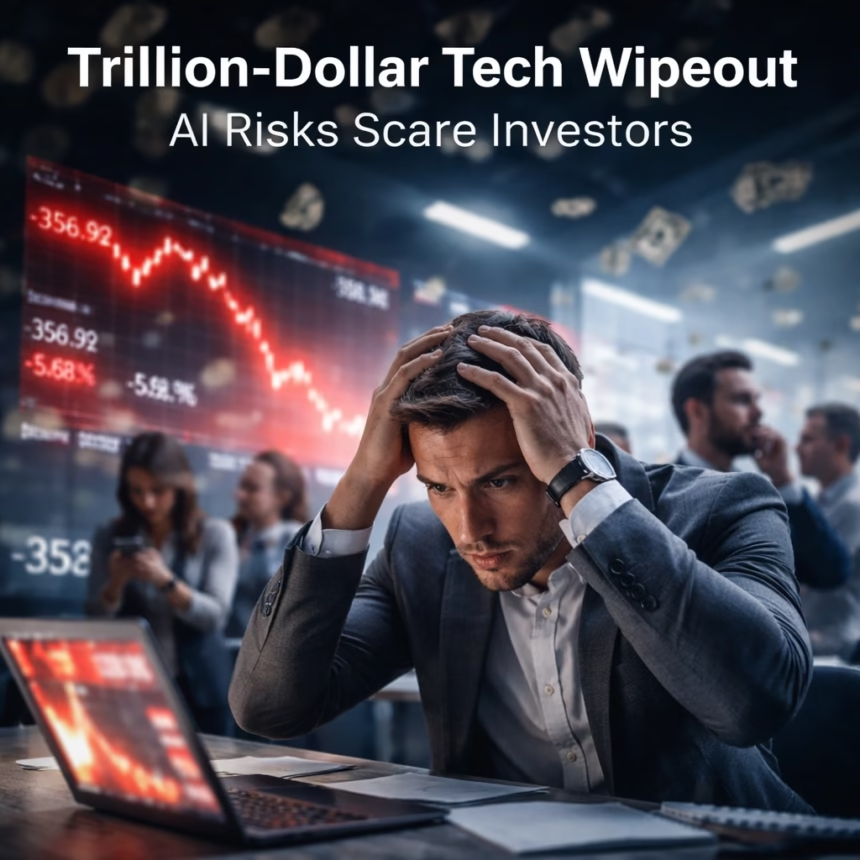
Global technology markets have witnessed an unprecedented downturn, with an estimated $3 trillion in market capitalization evaporating over the past six months. This significant correction, primarily impacting Silicon Valley's tech giants, is largely attributed to escalating investor concerns surrounding the rapid, largely unregulated advancement of artificial intelligence, particularly from late 2023 through early 2024.
Background: The AI Hype Cycle and Its Genesis
The current market instability follows a period of intense enthusiasm and speculative investment in artificial intelligence. The launch of OpenAI's ChatGPT in November 2022 ignited a global frenzy, showcasing generative AI's transformative potential to millions. This moment catalyzed a massive influx of capital into the sector.
Throughout 2023, companies like Microsoft, Google, and Amazon poured billions into AI research and development, acquiring startups and integrating AI capabilities across their product portfolios. Nvidia, a key enabler of AI computing, saw its stock price surge by over 200% in the first half of 2023, reaching a market valuation exceeding $1 trillion by June.

Venture capital funding for AI startups also hit record highs, with firms like Anthropic and Inflection AI securing multi-billion-dollar rounds. Investors, driven by a fear of missing out (FOMO), embraced ambitious valuations, often overlooking profitability metrics in favor of projected future growth.
Early Warning Signs Emerge
Despite the euphoria, whispers of caution began to surface in late 2023. Prominent AI researchers, including Geoffrey Hinton and Yoshua Bengio, publicly voiced concerns about existential risks, job displacement, and the potential for misuse. Regulatory bodies in the European Union initiated discussions on comprehensive AI legislation, signaling a potential shift towards tighter controls.
By October 2023, the White House issued an executive order on AI safety and security, acknowledging the technology's profound societal implications. These developments, initially dismissed by some as fringe anxieties, gradually began to chip away at investor confidence, particularly as the sheer speed of AI development outpaced ethical frameworks and governance.
More Read

Key Developments: Regulatory Scrutiny and Ethical Dilemmas
The turning point arrived in late Q4 2023 and accelerated into Q1 2024. A series of interconnected events triggered a sharp market correction.
In December 2023, the European Union provisionally agreed on the landmark EU AI Act, setting stringent rules for high-risk AI applications. This move, expected to be fully implemented by 2025, introduced significant compliance costs and potential legal liabilities for tech companies operating within the bloc, dampening revenue projections.
Simultaneously, a report from the United Nations Human Rights Office in January 2024 highlighted the "unprecedented risks" of unchecked AI, citing concerns over privacy, discrimination, and autonomous weapons systems. This global spotlight on AI's darker potentials further solidified investor apprehension.
Tech Leaders Address Concerns
Even within Silicon Valley, a more sober discourse emerged. During the World Economic Forum in Davos in January 2024, several tech CEOs, including Google's Sundar Pichai and Microsoft's Satya Nadella, emphasized the critical need for responsible AI development and international cooperation on governance. Their statements, while reassuring in tone, inadvertently underscored the magnitude of the risks involved, prompting investors to re-evaluate the sector's long-term stability.
Major tech stocks experienced significant declines. Alphabet (Google's parent company) saw its shares drop by 18% from their Q3 2023 peak, while Microsoft dipped 15%. Even Nvidia, once the darling of the AI boom, experienced a 22% correction from its December 2023 high as concerns about future chip demand in a more regulated environment grew. The collective market capitalization loss across the NASDAQ 100 index alone exceeded $1.5 trillion in this period.
Impact: Who is Affected by the AI Correction?
The market downturn has cast a wide net, affecting a diverse range of stakeholders from institutional investors to individual consumers.

Giants Feel the Pinch
Large technology companies, particularly those heavily invested in AI, are experiencing direct financial impacts. Reduced market valuations translate to diminished shareholder wealth and increased scrutiny from boards. Some firms have begun to scale back ambitious AI projects or reallocate resources towards AI safety and ethics research, potentially slowing innovation in certain areas.
Recruitment in the AI sector, which had been red-hot, has started to cool. While demand for specialized AI talent remains high, the pace of hiring has moderated, and some companies have initiated targeted layoffs in non-critical AI divisions.
Startup Landscape Shifts
The ripple effect is particularly pronounced in the AI startup ecosystem. Venture capital firms, now more risk-averse, are demanding clearer paths to profitability and robust ethical frameworks from prospective investments. This shift has led to down rounds for some startups, while others struggle to secure follow-on funding, potentially leading to consolidation or closures.
Pension funds and mutual funds, heavily invested in the tech sector, have seen the value of their holdings decrease, impacting retirement savings for millions. Individual retail investors who jumped into AI stocks during the peak of the hype cycle are also facing significant losses.
Broader Economic Implications
Beyond the tech sector, industries reliant on AI for future growth, such as autonomous vehicles, biotechnology, and personalized medicine, face increased uncertainty. The slowdown in AI investment could delay the deployment of groundbreaking technologies, potentially affecting productivity growth and global economic expansion.
What Next: The Path to Responsible AI and Market Rebalancing
The current market correction is widely viewed not as the end of AI innovation, but rather a rebalancing towards more sustainable and responsible development. Several key milestones and trends are expected in the coming months and years.
Evolving Regulatory Landscape
The EU AI Act's full implementation by 2025 will serve as a global benchmark, likely influencing legislation in other major economies. The United States Congress is expected to intensify its efforts to craft comprehensive AI legislation throughout 2024, focusing on areas like data privacy, bias detection, and accountability. International bodies, including the G7 and the UN, will continue to convene summits and working groups aimed at harmonizing global AI governance frameworks.
This regulatory push is anticipated to shift corporate strategies, prioritizing safety, transparency, and ethical considerations alongside technological advancement. Companies that proactively embrace these principles may regain investor trust and market leadership.
Strategic Shifts in Investment and Innovation
Investment in AI is unlikely to cease but will become more discerning. Venture capital will increasingly favor startups demonstrating clear business models, strong governance, and a commitment to responsible AI. Areas like AI security, explainable AI, and privacy-preserving AI technologies are expected to see continued growth.
Major tech companies will likely double down on internal AI safety research and external collaborations with academic institutions and non-profits. The focus will shift from "move fast and break things" to "innovate responsibly."
Potential for Market Stabilization
Analysts predict that the market will eventually stabilize as the regulatory landscape becomes clearer and companies adapt to the new environment. While the era of unchecked hype may be over, the fundamental potential of AI remains. The current downturn could be a necessary recalibration, paving the way for a more mature, resilient, and ethically grounded AI industry in the long term.
The coming months will be critical in shaping the future trajectory of artificial intelligence, determining whether this period of reckoning leads to sustainable progress or prolonged stagnation.