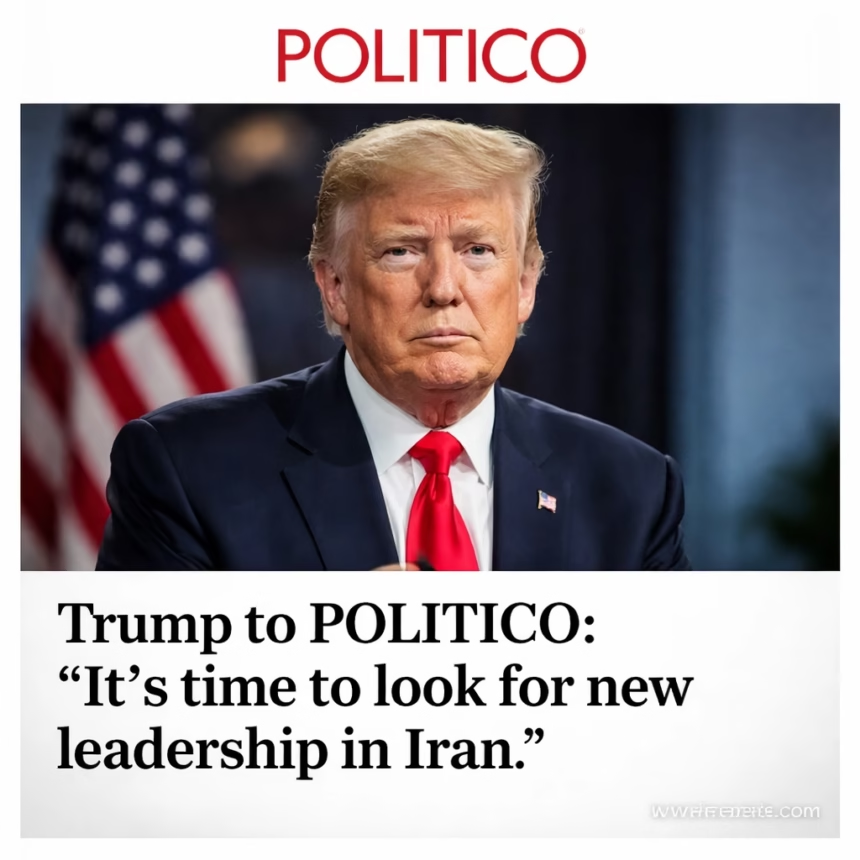
Former President Donald Trump recently articulated a significant shift in his approach to Iran, stating in an interview with POLITICO that “it’s time to look for new leadership” in the Islamic Republic. This declaration, made public on November 15, 2023, signals a potentially dramatic reorientation of U.S. foreign policy towards Tehran should he return to office, intensifying the ongoing debate about the future of a volatile region.
Background: Decades of Tension and Shifting US Policy
The relationship between the United States and Iran has been fraught with tension for over four decades, fundamentally altered by the 1979 Islamic Revolution and the subsequent hostage crisis. Since then, successive U.S. administrations have grappled with Iran's nuclear ambitions, its support for regional proxy groups, and its internal human rights record.
The Obama Administration and the JCPOA
The Obama administration pursued a diplomatic path, culminating in the 2015 Joint Comprehensive Plan of Action (JCPOA), commonly known as the Iran nuclear deal. This agreement, signed by Iran, the P5+1 nations (China, France, Germany, Russia, the United Kingdom, and the United States), and the European Union, aimed to limit Iran’s nuclear program in exchange for sanctions relief. Proponents argued it was the most effective way to prevent Iran from developing nuclear weapons, while critics contended it did not adequately address Iran’s ballistic missile program or its regional destabilizing activities.
Trump’s “Maximum Pressure” Campaign
Upon entering office in 2017, Donald Trump criticized the JCPOA as a flawed agreement. In May 2018, his administration unilaterally withdrew the U.S. from the deal and reimposed a wide array of sanctions, initiating a “maximum pressure” campaign designed to cripple Iran’s economy and force it to negotiate a new, more comprehensive agreement. This strategy led to a significant escalation of tensions, including attacks on oil tankers in the Persian Gulf, the downing of a U.S. drone, and the January 2020 U.S. drone strike that killed Iranian General Qasem Soleimani in Baghdad, Iraq. Despite the economic pressure, Iran largely resisted renegotiating the nuclear deal on U.S. terms and continued to advance its nuclear program beyond JCPOA limits.
Current Iranian Political Landscape
Iran is currently led by Supreme Leader Ali Khamenei, the highest authority in the country, and President Ebrahim Raisi, who took office in August 2021. The nation has faced significant internal unrest, notably the widespread protests that erupted in September 2022 following the death of Mahsa Amini in morality police custody. These protests, which saw women and youth at the forefront, highlighted deep-seated discontent over economic hardship, political repression, and social freedoms across major cities like Tehran, Isfahan, and Shiraz. Regionally, Iran continues to exert influence through various proxy groups in Iraq, Syria, Lebanon, and Yemen, often clashing with the interests of the United States and its allies, particularly Israel and Saudi Arabia.
More Read

Key Developments: A Direct Call for Change
Former President Trump's recent statement to POLITICO represents a more direct and explicit call for a fundamental change in Iran's governance than his previous "maximum pressure" rhetoric. While his earlier policy aimed to alter the Iranian regime's behavior, this new language explicitly targets the leadership itself.
The Specifics of Trump’s Statement
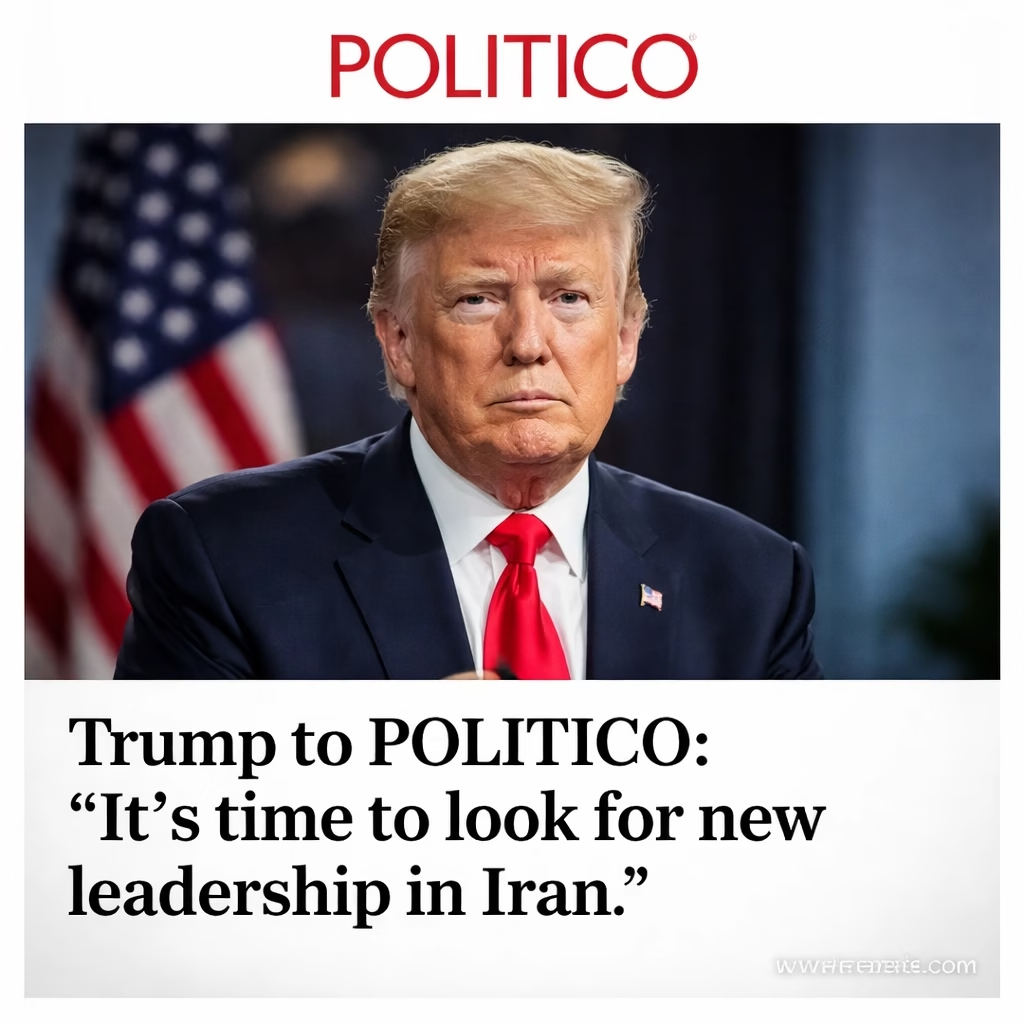
During the interview, Trump reportedly stated, “It’s time to look for new leadership in Iran. They’re a failed state, they’re a failed country, they’re a failed economy, and they’re failing at everything.” This pronouncement goes beyond merely seeking a new nuclear deal or curtailing regional aggression; it suggests a desire for an overhaul of the ruling establishment in Tehran. The statement was made within the context of discussions about global stability and the ongoing challenges posed by states perceived as adversaries to U.S. interests.
Contrast with Current Biden Administration Policy
The Biden administration, upon taking office in January 2021, expressed a willingness to return to the JCPOA, provided Iran also returned to full compliance. While indirect talks in Vienna aimed at reviving the deal have stalled, the Biden administration’s policy has generally focused on de-escalation and diplomatic engagement, albeit with continued sanctions and pressure related to human rights abuses and regional destabilization. This approach contrasts sharply with Trump’s more confrontational stance and his recent call for leadership change, which could be interpreted as a step toward regime change advocacy. The current administration has largely avoided such explicit public declarations regarding Iran’s internal leadership, emphasizing stability and non-proliferation through diplomatic channels.
Geopolitical Timing and U.S. Election Cycle
Trump’s statement comes at a critical juncture, both internationally and domestically. The Middle East remains highly volatile, with ongoing conflicts and shifting alliances. Domestically, the United States is heading into a presidential election year, and foreign policy stances often become key differentiators for candidates. Trump, as a leading Republican contender, is likely using such pronouncements to signal a decisive foreign policy vision to his base and to contrast with the current administration’s approach. His remarks could also be seen as an attempt to appeal to constituencies in the U.S. and among regional allies who advocate for a tougher stance against the Iranian regime.
Impact: A Ripple Effect Across Regions
The former president's call for new leadership in Iran carries significant implications, potentially influencing geopolitical dynamics, domestic U.S. foreign policy debates, and internal Iranian affairs.
Regional Geopolitical Repercussions
Trump’s statement is likely to resonate strongly across the Middle East. U.S. allies such as Israel and Saudi Arabia, which view the current Iranian regime as a significant threat to their security, may interpret this as a positive signal of renewed U.S. commitment to confronting Tehran. These nations have historically expressed frustration with diplomatic overtures to Iran and often advocate for more assertive measures. Conversely, Iran’s regional adversaries might see this as an endorsement for more aggressive proxy actions or a green light for heightened covert operations. For Iran itself, such a statement from a prominent U.S. political figure could solidify the perception of external threats, potentially leading the current leadership to further entrench its position and increase its anti-Western rhetoric. This could also intensify its support for regional proxy forces as a deterrent against perceived foreign intervention.
Domestic U.S. Foreign Policy Debates
Within the United States, Trump’s remarks will likely fuel ongoing debates about the most effective strategy toward Iran. Proponents of a hardline approach may laud the statement as a necessary articulation of intent, arguing that only a change in leadership can genuinely address Iran’s problematic behavior. Conversely, critics might warn that such explicit calls for regime change could destabilize the region further, alienate international allies who favor diplomatic solutions, and potentially provoke a more aggressive response from Tehran. They might also argue that it complicates efforts to manage the nuclear program and other regional issues by removing any incentive for the current regime to negotiate. The statement will undoubtedly become a point of contention in the upcoming presidential election, forcing other candidates to articulate their own positions on Iran’s future.
Potential Influence on Iranian Internal Dynamics
While it is unlikely to trigger immediate internal change, Trump’s statement could have subtle impacts within Iran. For the ruling establishment, it reinforces their narrative of external interference and hostility, potentially allowing them to rally nationalist sentiment and suppress dissent more forcefully under the guise of national security. For the Iranian populace, particularly those who have participated in recent anti-government protests, the statement might be viewed with mixed emotions. Some dissidents might see it as a hopeful sign of international support for their cause, while others might be wary of foreign intervention, fearing it could lead to further instability or unintended consequences, drawing parallels to past U.S. interventions in the region. The statement could also empower hardline factions within the Iranian government who advocate for a more isolationist and confrontational stance against the West.
More Read

What Next: Scenarios and Expected Milestones
The long-term implications of former President Trump's declaration will largely depend on future political developments in the United States and Iran. Several scenarios could unfold, each with distinct potential milestones.
If Trump Returns to Office
Should Donald Trump win the 2024 U.S. presidential election, his administration would likely pursue a highly confrontational policy toward Iran, potentially escalating the “maximum pressure” campaign beyond its previous scope. This could involve:
* Increased Sanctions: A renewed focus on crippling Iran’s oil exports, banking sector, and other vital industries, potentially targeting new sectors or individuals.
* Support for Opposition: While direct intervention is less likely, a Trump administration might explore overt or covert support for opposition movements within Iran, or amplify rhetoric that encourages internal dissent.
* Heightened Military Posturing: Increased naval presence in the Persian Gulf, more frequent military exercises, and a readiness to respond forcefully to perceived Iranian provocations.
* Abandonment of JCPOA Revival: Any remaining hope for a return to the Iran nuclear deal would likely be extinguished, possibly leading to Iran accelerating its nuclear program further.
* Diplomatic Isolation: Efforts to isolate Iran on the international stage, potentially pressuring U.S. allies to adopt a similarly tough stance.
Current Administration’s Response and Future Policy
The Biden administration, while unlikely to adopt Trump’s explicit call for regime change, may face pressure to adjust its own strategy. It might:
* Reiterate Commitment to Diplomacy: Emphasize the importance of diplomatic channels to manage tensions and prevent nuclear proliferation, contrasting its approach with more aggressive alternatives.
* Targeted Sanctions: Continue to impose sanctions related to human rights abuses and regional destabilization, maintaining pressure without explicitly calling for leadership change.
* Reinforce Regional Alliances: Work closely with partners like Saudi Arabia and Israel to address shared concerns about Iran, potentially bolstering regional defense capabilities.
* Strategic Communication: Counter narratives of U.S. intent to avoid further escalating tensions with Tehran, particularly concerning the nuclear program.
Internal Iranian Dynamics and International Reactions
Internally, the Iranian regime will likely continue its efforts to consolidate power and suppress dissent, especially if external pressure mounts. Any explicit calls for regime change from a U.S. president could be used by hardliners to justify further crackdowns and to rally nationalist support. International reactions would also be varied:
* European Allies: Nations like France, Germany, and the UK, who remain signatories to the JCPOA, would likely express concern over a more confrontational U.S. stance, advocating for continued diplomacy.
* Russia and China: These nations, often at odds with U.S. foreign policy, might deepen their economic and political ties with Iran, potentially offering a lifeline against U.S. sanctions and complicating international efforts to pressure Tehran.
* Regional Powers: Countries like Turkey and Qatar might seek to maintain a delicate balance, engaging with both the U.S. and Iran to protect their own interests.
The coming months, particularly leading up to the U.S. presidential election, will be crucial in shaping the discourse around Iran. While Trump's statement is a significant rhetorical shift, its practical implications remain contingent on future political outcomes and the complex interplay of regional and international forces.