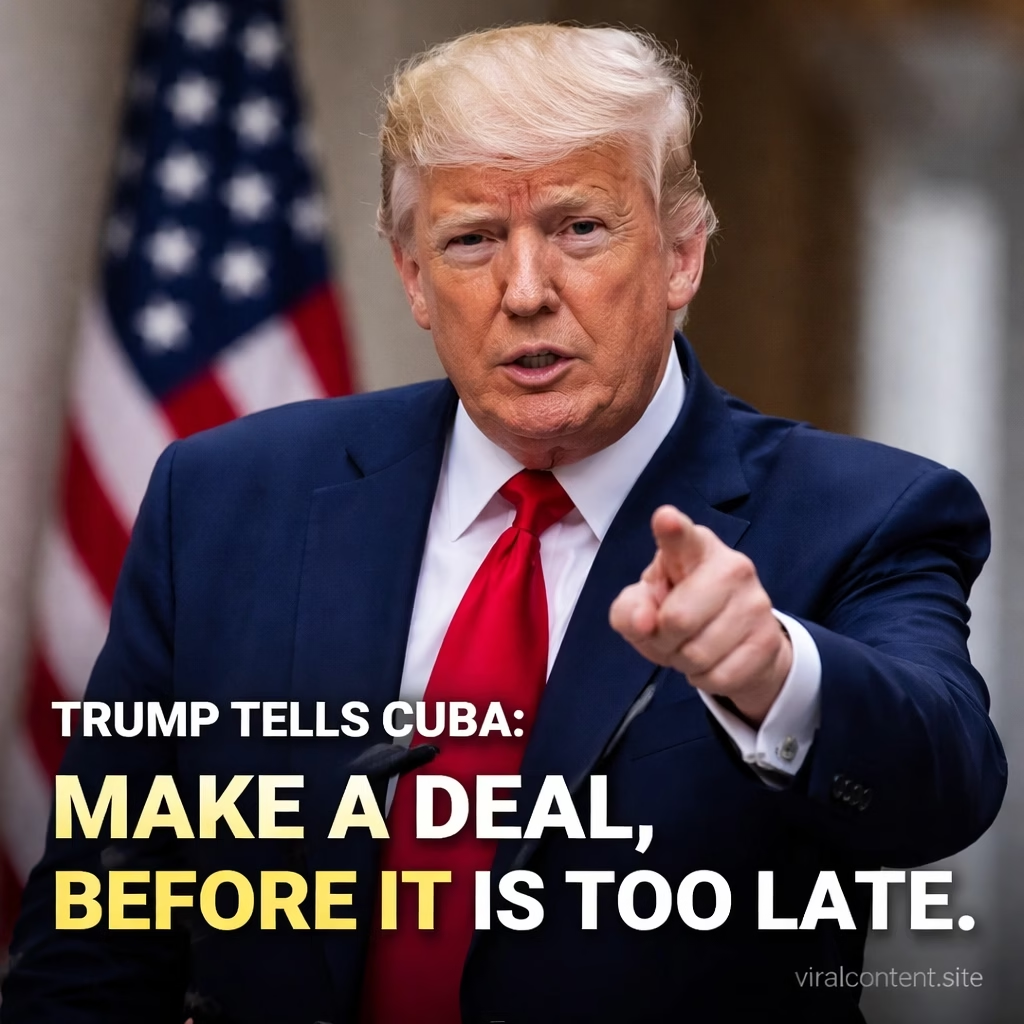
President Donald Trump has issued a direct ultimatum to Cuba, urging the communist nation to "make a deal, before it is too late." The stark warning, delivered from Washington D.C., signals a renewed hardening of U.S. policy towards the island nation and puts Havana on notice regarding its future relationship with the United States. This declaration underscores the Trump administration's intent to dismantle the diplomatic openings initiated by the previous administration.
Background: A Century of Shifting Sands
The relationship between the United States and Cuba has been historically fraught, marked by periods of intense hostility and fleeting moments of engagement. Following the 1959 Cuban Revolution, Fidel Castro's embrace of communism and alignment with the Soviet Union led to a complete breakdown of diplomatic ties. In 1961, the U.S. severed relations, followed by the imposition of a comprehensive economic embargo in 1962, a policy that has largely remained in place for decades.
For over 50 years, the embargo aimed to pressure the Cuban government into democratic reforms and respect for human rights, though its effectiveness remained a subject of fierce debate. Travel restrictions, trade prohibitions, and financial sanctions created a deep chasm between the two neighboring countries, isolating Cuba economically and politically from its powerful northern neighbor.
A significant shift occurred in December 2014, when President Barack Obama and Cuban President Raúl Castro announced a historic rapprochement. This breakthrough led to the restoration of diplomatic relations in July 2015, the reopening of embassies in Washington D.C. and Havana, and a series of measures easing travel and trade restrictions. The Obama administration argued that engagement, rather than isolation, was the most effective path to encouraging change in Cuba.
However, this diplomatic thaw was met with considerable skepticism and opposition from various quarters, particularly within the Cuban-American community and conservative political factions in the United States. Critics argued that the Obama administration had offered too many concessions without securing sufficient human rights improvements or democratic reforms from the Cuban government. They contended that the deal primarily benefited the Cuban regime, not its people.
More Read

Upon entering office in January 2017, President Donald Trump swiftly signaled his intention to reverse what he termed the "terrible and misguided deal" with Cuba. He promised to renegotiate a better agreement or scrap the existing one entirely. His administration began a comprehensive review of U.S. policy towards Cuba, emphasizing concerns over human rights abuses, political repression, and Cuba's support for Venezuela's socialist government. This review laid the groundwork for a more confrontational approach.
Key Developments: The Warning and Its Context
President Trump's directive for Cuba to "make a deal, before it is too late" emerged amidst a series of policy adjustments designed to roll back the Obama-era openings. While the exact timing and venue of the specific phrasing varied across reports, the sentiment became a consistent theme in his administration's rhetoric concerning Havana. This was not a sudden pronouncement but rather an intensified reiteration of his campaign promise.
More Read

In June 2017, President Trump delivered a major policy speech in Miami, Florida, outlining a stricter approach. He announced new restrictions on American travel to Cuba, prohibiting individual "people-to-people" educational travel and instead requiring such trips to be conducted through licensed organizations. He also banned U.S. business transactions with entities tied to the Cuban military, intelligence, or security services, specifically targeting the Grupo de Administración Empresarial S.A. (GAESA), a powerful Cuban military conglomerate that controls large sectors of the island's economy, including tourism.
The administration’s stated demands for a "deal" centered on several key areas. Foremost among these were significant improvements in human rights, including the release of political prisoners, respect for freedom of speech and assembly, and the legalization of independent political parties. The U.S. also pressed for democratic reforms, urging Cuba to move towards free and fair elections. Economically, the Trump administration sought to ensure that any benefits from engagement directly reached the Cuban people, rather than bolstering the state-run economy and its military apparatus. The return of U.S. fugitives harbored in Cuba, including Joanne Chesimard (Assata Shakur), also remained a persistent point of contention.
Cuban officials, including Foreign Minister Bruno Rodríguez Parrilla, initially responded with a mix of defiance and cautious openness to dialogue. While condemning the new U.S. policies as a "setback" and an "archaic" return to Cold War tactics, they reiterated Cuba's willingness to engage in respectful dialogue on issues of mutual interest, provided it was on a basis of equality and without preconditions or interference in Cuba's internal affairs. However, Havana consistently rejected any demands that it viewed as infringing on its sovereignty.
Within the United States, the announcement garnered varied reactions. Hardline Cuban-American lawmakers, such as Senator Marco Rubio of Florida, strongly supported the new measures, hailing them as a necessary correction to the perceived leniency of the previous administration. They argued that the pressure was essential to force the Cuban government to change. Conversely, many U.S. businesses, particularly those in the travel and agricultural sectors that had begun to explore opportunities in Cuba, expressed disappointment and concern about the potential loss of market access and the chilling effect on future investment. Human rights organizations were divided, with some supporting pressure for reforms and others fearing that renewed isolation would worsen conditions for ordinary Cubans.
Impact: Ripple Effects Across Sectors
The Trump administration's tougher stance and the explicit warning to "make a deal" have sent significant ripple effects across various sectors, both in Cuba and the United States. The most immediate impact has been on Cuba's nascent private sector and its burgeoning tourism industry.
Economically, the restrictions on U.S. travel and transactions with military-controlled entities directly targeted the most profitable segments of Cuba's economy. The decline in American visitors, coupled with reduced remittances from Cuban-Americans due to new financial regulations, placed considerable strain on the island's already fragile economy. Small private businesses, or *cuentapropistas*, which had flourished under the Obama-era openings, found themselves struggling as their primary source of foreign currency and clientele diminished. This economic pressure was intended to compel the Cuban government to reconsider its policies, but it also directly affected the livelihoods of ordinary Cuban citizens.
More Read

Politically, the renewed U.S. pressure reinforced a narrative within Cuba of external aggression, allowing the government to rally nationalist sentiment and deflect criticism of its internal policies. It also strengthened the hand of hardliners within the Cuban Communist Party who had been skeptical of the rapprochement. Domestically in the U.S., the policy shift solidified President Trump's support among a key demographic of Cuban-American voters, particularly in Florida, a crucial swing state. It also aligned with the broader "America First" foreign policy agenda, prioritizing U.S. interests and demanding concessions from perceived adversaries.
Humanitarian and social impacts were also notable. The restrictions on individual travel complicated family visits for many Cuban-Americans and made it harder for ordinary Americans to engage directly with Cuban society, limiting cultural and educational exchanges. The tightening of the embargo also exacerbated shortages of essential goods, impacting the daily lives of Cubans already facing economic hardship. The diplomatic environment grew colder, leading to a reduction in cooperation on issues such as environmental protection, counter-narcotics, and maritime security that had seen progress during the Obama years.
Regionally, the shift in U.S. policy towards Cuba reverberated across Latin America. Many regional allies and partners of the U.S. had supported the Obama-era engagement, viewing it as a positive step towards regional stability. The return to a more confrontational approach was met with concern by some, who feared it could destabilize the region and undermine efforts to address shared challenges through multilateral cooperation. Cuba also leveraged the U.S. stance to strengthen its alliances with other anti-U.S. governments in the region, particularly Venezuela and Nicaragua, further complicating regional dynamics.
What Next: An Uncertain Path Forward
The future trajectory of U.S.-Cuba relations remains highly uncertain following President Trump's ultimatum. The demand to "make a deal" implies a willingness to negotiate, but the conditions set by the U.S. administration are stringent and fundamentally challenge the Cuban government's long-held principles of sovereignty and socialist governance.
One potential scenario involves Cuba, under continued economic duress, eventually signaling a willingness to make certain concessions. However, given Havana's historical resilience to external pressure and its consistent rejection of U.S.-imposed conditions, a full capitulation on core political demands appears unlikely. Any engagement from Cuba would likely focus on economic liberalization within its existing political framework, rather than fundamental democratic reforms.
Conversely, should Cuba refuse to engage on the U.S.'s terms, the Trump administration had the capacity and demonstrated willingness to further tighten sanctions. This could include additional restrictions on remittances, further limitations on travel, and potentially the full activation of Title III of the Helms-Burton Act, which allows U.S. citizens to sue foreign companies benefiting from confiscated property in Cuba. Such measures would aim to increase economic pressure, but also risk further isolating Cuba and potentially strengthening its resolve.
The role of third-party mediation or international bodies in de-escalating tensions remains limited, as both nations have historically preferred direct, albeit often contentious, bilateral engagement. However, countries like Canada, Mexico, or European Union members, who maintain diplomatic and economic ties with Cuba, could play a quiet role in encouraging dialogue.
Expected milestones, if any, are difficult to predict. Without a clear framework for negotiation or a defined set of mutual interests that both sides are willing to compromise on, the path forward appears fraught with obstacles. Any significant shift would likely depend on changes in leadership in either country, evolving geopolitical circumstances, or a dramatic re-evaluation of strategies by both Washington and Havana. For now, the "make a deal" ultimatum leaves U.S.-Cuba relations in a state of prolonged tension and unpredictability.