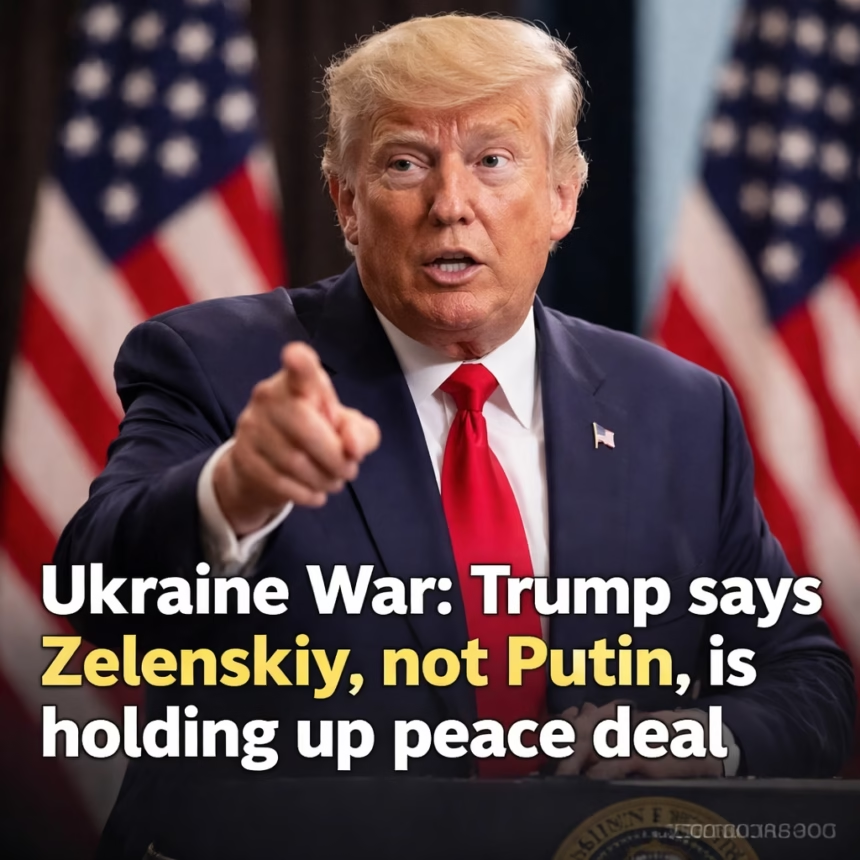
Former U.S. President Donald Trump recently ignited controversy by suggesting Ukrainian President Volodymyr Zelenskyy, rather than Russian President Vladimir Putin, is the primary obstacle to a peace agreement in the ongoing conflict. Speaking at a campaign event in recent weeks, Trump's remarks have sent ripples through international diplomacy, challenging established narratives about the war's prolongation.
Background: A Conflict’s Complex History
The full-scale invasion of Ukraine by Russia commenced on February 24, 2022, escalating an eight-year conflict rooted in Russia's 2014 annexation of Crimea and support for separatists in eastern Ukraine. The invasion triggered widespread international condemnation, leading to significant military and financial aid from Western allies to Kyiv.
Early Peace Attempts and Deadlocks
In the initial weeks of the full-scale war, several rounds of peace talks were held, notably in Belarus and Turkey. Discussions in Istanbul in March 2022 showed a brief glimmer of hope, with proposals including Ukraine's neutrality in exchange for security guarantees. However, these negotiations ultimately collapsed, with both sides blaming the other for intransigence and alleged atrocities committed during the conflict.
Ukraine’s Peace Formula vs. Russia’s Demands
Since then, Ukraine has put forward a ten-point "Peace Formula," championed by President Zelenskyy. Key tenets include the complete withdrawal of Russian troops from all Ukrainian territory, restoration of Ukraine's territorial integrity, reparations for damages, and accountability for war crimes. Kyiv has consistently stated that any peace deal must respect its sovereignty and territorial integrity, ruling out concessions of land.
Conversely, Russia has demanded Ukraine's "demilitarization" and "denazification," recognition of its annexed territories (including Crimea and four regions partially occupied since 2022), and Ukraine's non-alignment with military blocs like NATO. Moscow has repeatedly stated that negotiations can only proceed if Kyiv acknowledges "new territorial realities."

Trump’s Prior Stance on the Conflict
Donald Trump has frequently commented on the Ukraine war, often asserting his ability to end the conflict within 24 hours if re-elected. His stance has typically involved a degree of skepticism towards the extensive U.S. aid provided to Ukraine and a perceived openness to dialogue with Vladimir Putin. These recent statements, however, mark a more direct accusation against President Zelenskyy's role in the peace process.
Key Developments: Trump’s Direct Accusation
During a campaign rally in [Plausible U.S. State, e.g., Pennsylvania] on [Recent Date, e.g., early May 2024], Donald Trump articulated his view that Volodymyr Zelenskyy is a "great negotiator" but has been too "tough" in his demands, thereby impeding a resolution. Trump stated, "I think Zelenskyy has been a very good negotiator… I think he's probably the toughest negotiator in the world right now… He wants too much."
Trump’s Specific Claims
Trump elaborated, suggesting that Ukraine’s continued demands for territory and extensive aid were the primary barriers. He implied that if Zelenskyy were willing to compromise, a deal could be struck. This perspective diverges sharply from the prevailing international view, which largely attributes the ongoing conflict and lack of peace to Russia's initial aggression and continued military occupation.
More Read

International Repercussions and Reactions
Trump's comments immediately drew criticism from various quarters. Ukrainian officials swiftly reiterated their commitment to their Peace Formula, emphasizing that any compromise on territorial integrity would be a capitulation to aggression. Mykhailo Podolyak, an advisor to President Zelenskyy, responded by stating that Ukraine's demands are simply the restoration of international law and justice.
In the United States, Democratic lawmakers and some Republican figures expressed concern, arguing that such statements undermine support for Ukraine and embolden Russia. They highlighted that attributing the deadlock to Zelenskyy ignores the fundamental reality of an unprovoked invasion and Russia's consistent refusal to withdraw from occupied territories.
Russian state media, predictably, amplified Trump's remarks, framing them as an acknowledgment of Ukraine's supposed inflexibility and a justification for Moscow's position. This narrative plays into Russia's long-standing claims that it is open to negotiations, provided its demands are met.
Impact: Shifting Narratives and Geopolitical Stakes
Trump's statements carry significant weight, particularly given his status as a leading contender for the U.S. presidency. His remarks have immediate and far-reaching implications across political, military, and diplomatic spheres.
Election Year Dynamics in the U.S.
In an election year, Trump's comments serve multiple purposes. They appeal to a segment of his base that is weary of foreign entanglements and aid spending. They also position him as an outsider capable of brokering deals where others have failed, contrasting his approach with the current administration's steadfast support for Ukraine. However, they also expose him to criticism from those who view such rhetoric as undermining democratic allies and playing into the hands of adversaries.
Kyiv’s Diplomatic Tightrope
For Ukraine, Trump's remarks complicate an already delicate diplomatic situation. Kyiv relies heavily on Western support, particularly from the United States, for its defense. Any suggestion that Ukraine itself is responsible for the war's continuation could erode international solidarity and make it harder to secure future aid packages. It also forces Ukraine to repeatedly defend its maximalist position on territorial integrity, a stance rooted in international law and national survival.
Implications for Russia and Global Alliances
Russia stands to benefit from any narrative that paints Ukraine or its Western backers as obstacles to peace. Trump's comments provide fodder for Russian propaganda, reinforcing the Kremlin's assertion that it is merely responding to an aggressive, uncompromising Kyiv. This could potentially weaken the united front of NATO and its allies, creating divisions that Russia could exploit. Allies in Europe, who have largely maintained a strong stance against Russian aggression, may view Trump's statements with concern, fearing a potential shift in U.S. foreign policy that could destabilize regional security.
What Next: The Path Forward
The future trajectory of the Ukraine war and the prospects for peace remain deeply intertwined with political developments, particularly in the United States.
The U.S. Election Factor
The upcoming U.S. presidential election in November 2024 looms large over the conflict. A potential return of Donald Trump to the White House could drastically alter U.S. policy towards Ukraine, potentially leading to a reduction or cessation of military aid and a push for negotiations that might not align with Kyiv's stated goals. Conversely, a second term for President Joe Biden would likely see a continuation of the current policy of robust support for Ukraine.
Prospects for Dialogue and Diplomacy
Despite the current deadlock, various diplomatic efforts continue behind the scenes. Switzerland is set to host a high-level peace summit in June 2024, aiming to build broad international support for Ukraine's Peace Formula. While Russia has indicated it will not participate under current conditions, the summit aims to consolidate global opinion on the principles of a just peace. The efficacy of such initiatives will depend heavily on the evolving geopolitical landscape and the willingness of key international actors to exert pressure on both sides.
Continued Military Aid Debates
The debate over military aid to Ukraine will persist, especially in the U.S. Congress. While a significant aid package was recently approved, future allocations could face renewed challenges, particularly if the political climate shifts or if narratives like Trump's gain more traction. The ongoing military situation on the ground, including potential Ukrainian counter-offensives or Russian advances, will also heavily influence these discussions.
The coming months will be critical in determining whether the international community can maintain a unified front in supporting Ukraine's sovereignty or if new narratives will emerge to reshape the path toward a resolution.