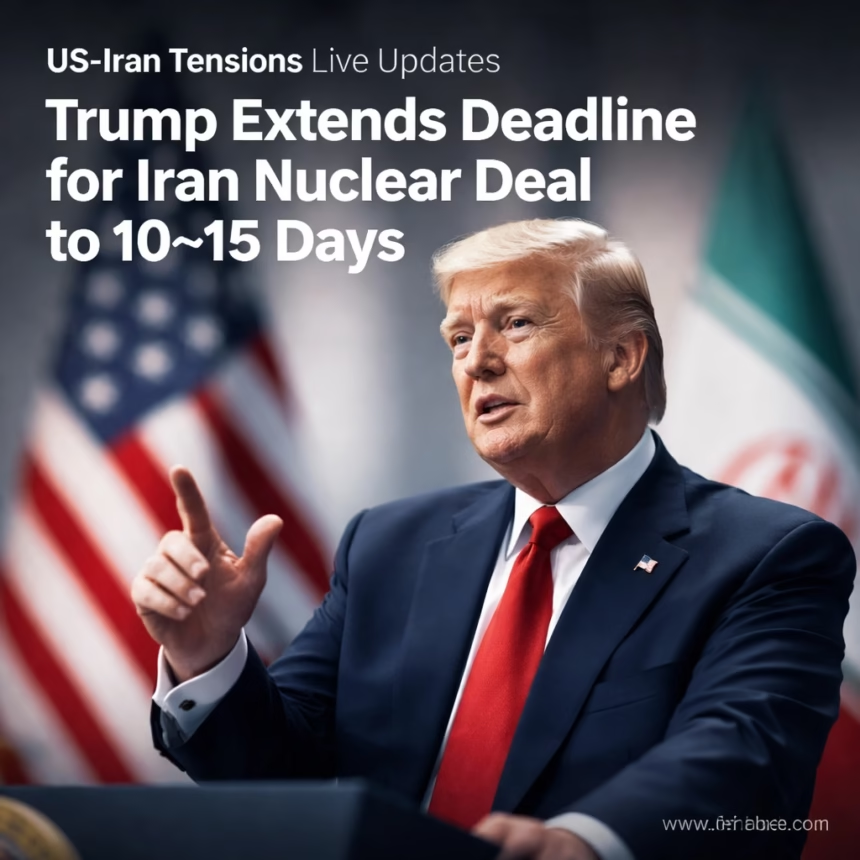
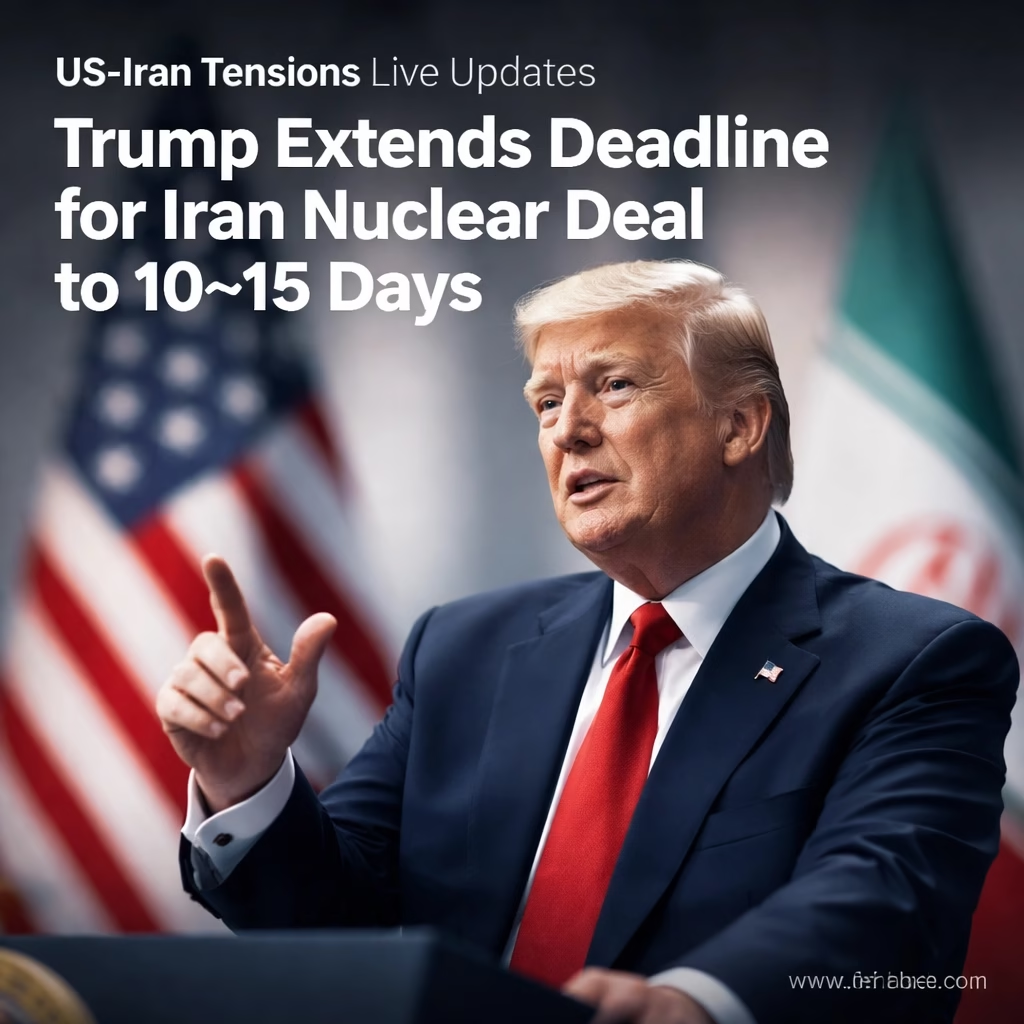
President Donald Trump has granted a critical, albeit brief, extension to the waiver of sanctions on Iran, pushing the deadline for a decision on the landmark nuclear deal by an additional 10 to 15 days. This eleventh-hour reprieve intensifies global diplomatic efforts surrounding the Joint Comprehensive Plan of Action (JCPOA), placing the future of the 2015 agreement on a precarious edge. The move, announced from Washington D.C., signals a heightened period of uncertainty for international relations and the stability of the Middle East.
Background: A Deal Under Scrutiny
The Joint Comprehensive Plan of Action, commonly known as the Iran nuclear deal, was forged in July 2015 between Iran and the P5+1 group of world powers—the United States, United Kingdom, France, China, Russia, plus Germany. The agreement aimed to prevent Iran from developing nuclear weapons by significantly curtailing its nuclear program in exchange for the lifting of international economic sanctions. Under the deal, Iran agreed to reduce its centrifuges, limit uranium enrichment levels, and allow extensive international inspections by the International Atomic Energy Agency (IAEA).
From its inception, the JCPOA was hailed by proponents as a triumph of diplomacy, averting a potential military confrontation. Former President Barack Obama’s administration championed the deal, emphasizing its robust verification mechanisms. However, the agreement faced fierce opposition from critics, notably Israel and Saudi Arabia, who argued it did not adequately address Iran's ballistic missile program or its regional destabilizing activities.
Upon assuming office, President Trump consistently lambasted the JCPOA, labeling it "the worst deal ever negotiated." His administration argued that the deal was too lenient, particularly concerning its "sunset clauses," which would gradually lift restrictions on Iran's nuclear activities after a specified period. Trump also criticized the deal's failure to address Iran's ballistic missile development and its support for proxy groups across the Middle East, including in Syria, Yemen, and Lebanon. Throughout his presidency, Trump has repeatedly threatened to withdraw the United States from the agreement unless its "flaws" were rectified, placing the onus on European allies to negotiate a stronger supplementary agreement.
Several deadlines for renewing sanction waivers have passed since Trump took office, each met with a temporary extension while the administration sought concessions or a renegotiated framework. This consistent pressure has kept the deal in a state of perpetual limbo, forcing European signatories to engage in complex diplomatic efforts to both appease Washington and preserve the original agreement. The current extension represents the latest chapter in this ongoing saga, providing a narrow window for a resolution.
More Read
Key Developments: The Crunch Time Extension
The recent announcement by President Trump to extend the sanction waivers by a mere 10 to 15 days marks a pivotal moment in the ongoing US-Iran standoff. This short timeframe underscores the urgency and the high stakes involved, signaling that the administration is nearing a definitive decision regarding the JCPOA.
The decision was reportedly influenced by intense diplomatic overtures from European allies, particularly France, Germany, and the United Kingdom. French President Emmanuel Macron had been particularly active in attempting to bridge the gap between Washington and Tehran, proposing a "grand bargain" that could address some of Trump's concerns without fully abandoning the existing deal. Macron's visit to Washington D.C. just prior to the deadline was a high-profile effort to persuade President Trump to maintain the agreement while seeking avenues for a stronger, broader framework.
Sources close to the negotiations indicated that the European leaders presented a package of proposals aimed at satisfying Trump's demands. These proposals reportedly included strengthening the monitoring provisions of the JCPOA, extending the duration of its restrictions beyond the original sunset clauses, and initiating separate negotiations to curb Iran's ballistic missile program and its regional activities. The goal was to demonstrate a willingness to address the perceived shortcomings of the original deal, thereby providing President Trump with a reason to keep the United States within the agreement.

However, Iran has vehemently rejected any notion of renegotiating the JCPOA. Iranian President Hassan Rouhani and Foreign Minister Mohammad Javad Zarif have consistently stated that the deal is a multilateral international agreement and is not open for revision. They argue that Iran has fully complied with its obligations under the agreement, as repeatedly verified by the IAEA, and that any attempt to alter it would be a violation of international law and a breach of trust. Tehran has warned that if the United States withdraws from the deal and reimposes sanctions, Iran would likely resume its full nuclear program, potentially enriching uranium to higher levels.
The 10-15 day extension is widely seen as a final window for these diplomatic efforts to yield a tangible outcome that satisfies President Trump's demands. It places immense pressure on all parties to find a common ground, or face the potential collapse of the deal altogether.
Impact: A Ripple Effect Across Geopolitics
The potential collapse or renegotiation of the Iran nuclear deal carries significant implications, reverberating across global politics, economics, and security. The immediate beneficiaries or casualties of any decision will be Iran, the United States, and the European signatories, but the ripple effects will be felt much wider.
Geopolitical Ramifications
A US withdrawal from the JCPOA would severely strain transatlantic relations, particularly with France, Germany, and the UK, who have invested heavily in preserving the deal. It would also undermine the principle of multilateral diplomacy and the credibility of international agreements, potentially making it harder to negotiate future arms control or non-proliferation treaties. In the Middle East, the situation could escalate tensions. Israel, which has consistently opposed the deal, might view a US withdrawal as an opportunity to exert more pressure on Iran, while Saudi Arabia and its allies could feel emboldened in their regional rivalry with Tehran. This could lead to increased proxy conflicts and instability across the region, from Yemen to Syria.
Economic Consequences
If the US re-imposes sanctions on Iran, the economic impact on the Islamic Republic would be severe. Sanctions targeting Iran's oil exports, banking sector, and other key industries would cripple its economy, which has already been struggling with high unemployment and inflation. This could lead to social unrest within Iran and potentially strengthen hardline elements who advocate for a more confrontational stance against the West. For the global economy, a significant disruption to Iran's oil supply could lead to a spike in crude oil prices, affecting consumers and industries worldwide. European companies that have resumed trade and investment in Iran since the lifting of sanctions would face difficult choices, potentially having to withdraw to avoid US secondary sanctions.
Nuclear Proliferation Concerns
Perhaps the most critical concern is the future of Iran's nuclear program. If the deal collapses, Iran has indicated it would likely restart its uranium enrichment activities beyond the limits set by the JCPOA. This would drastically shorten its "breakout time"—the period it would take to produce enough fissile material for a nuclear weapon—and could trigger a new nuclear crisis. Such a development would not only raise proliferation risks in the Middle East but also challenge the global non-proliferation regime, potentially encouraging other nations to pursue nuclear weapons. The IAEA's crucial monitoring capabilities, which have provided transparency into Iran's program, would also be severely hampered or cease entirely.
More Read

What Next: A High-Stakes Countdown
The next 10 to 15 days represent a critical period of intense diplomatic maneuvering, with the future of the Iran nuclear deal hanging in the balance. All eyes will be on Washington D.C., Tehran, and the European capitals as leaders engage in a frantic push for a resolution.
Potential Outcomes
There are several possible scenarios that could unfold within this narrow timeframe:
US Withdrawal and Sanctions Re-imposition: This is the most drastic outcome. If President Trump determines that his demands have not been met, he could refuse to issue the next round of sanctions waivers, effectively withdrawing the United States from the JCPOA. This would trigger the re-imposition of US sanctions on Iran, including secondary sanctions on foreign entities doing business with Tehran.
* A "Fix" or Supplementary Agreement: While unlikely given Iran's firm stance against renegotiation, intense European diplomacy could theoretically yield a framework that satisfies President Trump's concerns without formally reopening the original JCPOA. This might involve a separate agreement addressing ballistic missiles or extending sunset clauses, potentially endorsed by the European signatories. However, Iran's participation and acceptance of such a deal remain highly doubtful.
* Another Temporary Extension: Though less likely given the definitive tone of the current extension, President Trump could, under immense pressure, grant another short-term waiver, effectively punting the decision further down the road. This would only prolong the uncertainty but might be chosen if a viable path forward emerges but requires more time.
* European Efforts to Salvage the Deal: If the US withdraws, European nations could attempt to keep the deal alive with Iran, perhaps by devising mechanisms to circumvent US sanctions and continue trade. However, the global dominance of the US dollar and financial system makes such an endeavor extremely challenging and potentially ineffective in providing Iran with the promised economic relief.
Congressional Role
The US Congress also plays a role in this unfolding drama. There have been bipartisan efforts to draft legislation that could address some of President Trump's concerns, such as extending the sunset clauses or strengthening inspection provisions, while keeping the US in the deal. However, the timing and political will to pass such legislation within the short window are uncertain.
Iran’s Response
Should the US withdraw, Iran's response will be crucial. Tehran has repeatedly warned it would abandon its commitments under the JCPOA and accelerate its nuclear program. This could involve increasing uranium enrichment levels, installing more advanced centrifuges, and potentially withdrawing from the Nuclear Non-Proliferation Treaty (NPT), further escalating the crisis.
The next few days promise to be a high-stakes countdown, shaping not only the future of the Iran nuclear deal but also the broader trajectory of US foreign policy, transatlantic relations, and regional stability in the Middle East. The global community watches closely as the deadline approaches, hoping for a diplomatic resolution that averts a deeper crisis.