Washington's Sahel Gamble: Can Diplomacy Halt Russia's Advance?
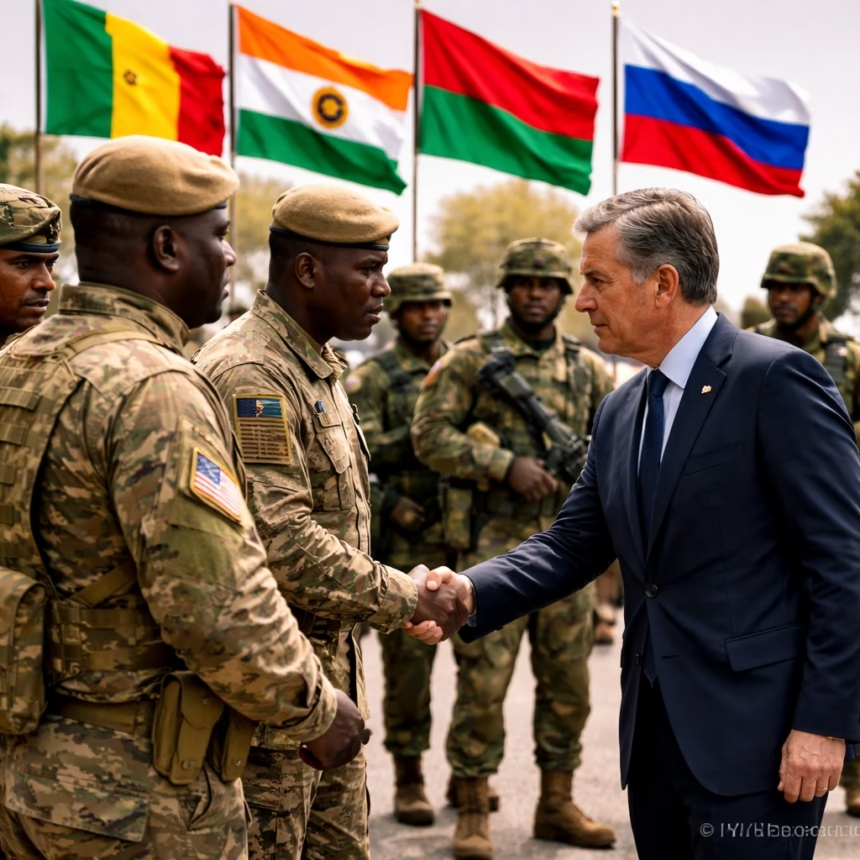
The United States is recalibrating its approach to military juntas in Mali, Niger, and Burkina Faso, signaling a shift towards re-engagement amidst escalating Russian influence across the volatile Sahel region. This strategic pivot, observed in late 2023 and early 2024, seeks to preserve counter-terrorism efforts and diplomatic ties following a series of coups that destabilized the region.
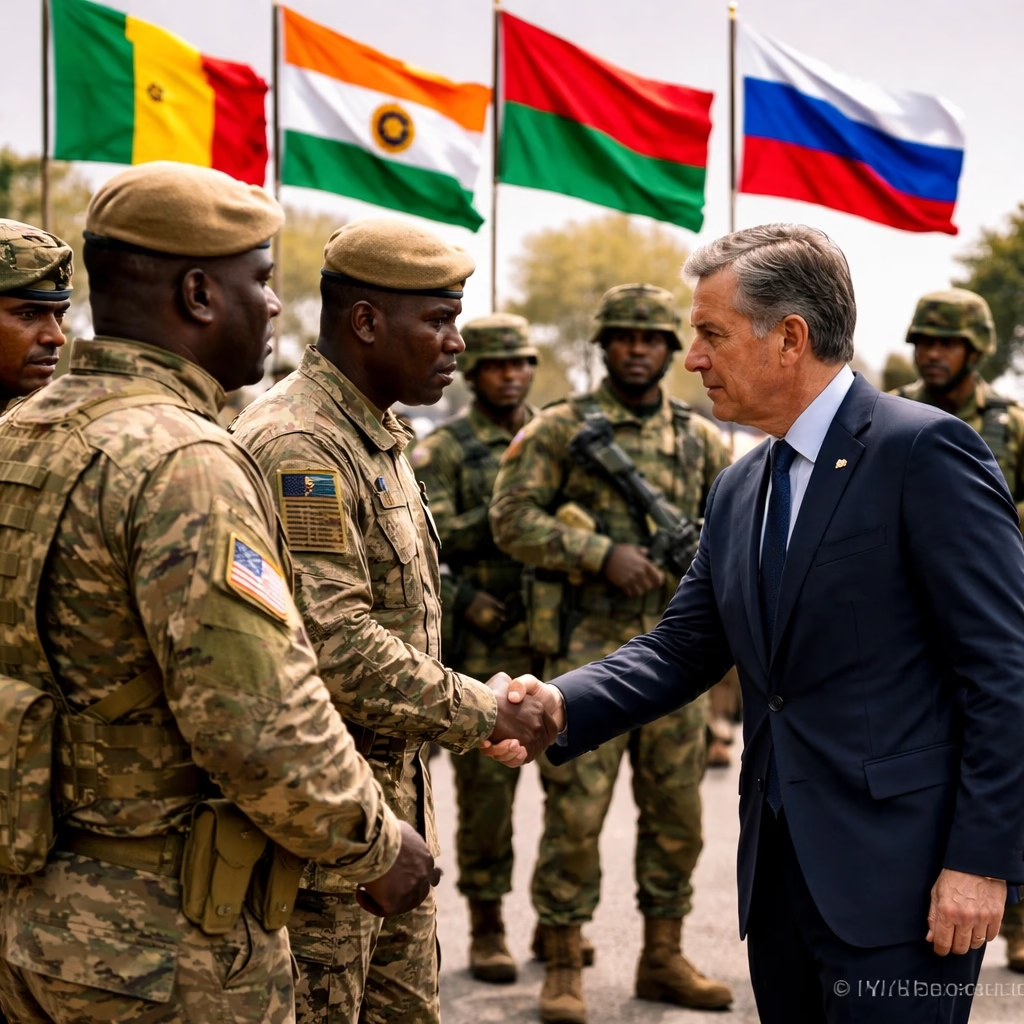
Washington's revised strategy aims to counter Moscow's tightening grip, which has manifested through military cooperation, resource deals, and information campaigns, fundamentally altering the geopolitical landscape of West Africa.
Background: A Region in Flux
The Sahel, a vast semi-arid belt stretching across Africa, has long grappled with complex challenges including poverty, climate change, and weak governance. Since the early 2010s, it has become a hotbed for Islamist extremist groups like al-Qaeda in the Islamic Maghreb (AQIM), Jama'at Nusrat al-Islam wal Muslimeen (JNIM), and the Islamic State in the Greater Sahara (ISGS), leading to a severe humanitarian crisis and widespread insecurity.
A Cascade of Coups
Between August 2020 and July 2023, three pivotal nations in the central Sahel experienced military takeovers. Mali saw two coups, first in August 2020 and again in May 2021, bringing Colonel Assimi Goïta to power. Burkina Faso endured two coups in 2022, with Captain Ibrahim Traoré seizing control in September of that year. Most recently, Niger’s President Mohamed Bazoum was overthrown in July 2023 by General Abdourahamane Tchiani, marking a significant blow to democratic governance in the region.
Western Exit and Russian Entry
These coups triggered a gradual but decisive withdrawal of Western military forces. France, a long-standing security partner, formally ended its anti-jihadist Operation Barkhane and Takuba task force in Mali in August 2022, following deteriorating relations with the junta. French troops also departed Burkina Faso in early 2023. Concurrently, Russia, primarily through the Wagner Group (now rebranded as Africa Corps), began to expand its presence, notably deploying to Mali in late 2021 and early 2022, filling the security vacuum left by departing Western partners.

The Economic Community of West African States (ECOWAS) initially imposed stringent sanctions and threatened military intervention against the coup leaders, particularly in Niger. However, these measures have largely softened or proved ineffective, leading to a re-evaluation of regional and international engagement strategies.
Key Developments: Washington’s Shifting Sands
The United States initially responded to the coups with condemnations and the suspension of security assistance, adhering to its policy against engaging with military governments. For instance, following the July 2023 coup in Niger, the U.S. paused over $500 million in aid and security cooperation, including Millennium Challenge Corporation programs.
Re-engagement Signals
However, recent months have seen a noticeable shift. Senior U.S. officials have initiated high-level dialogues with junta leaders. Assistant Secretary of State for African Affairs Molly Phee and U.S. Africa Command (AFRICOM) Commander General Michael Langley have undertaken diplomatic missions to the region, signaling a pragmatic approach to maintaining influence and addressing shared security concerns.
More Read

In Niger, despite the coup, approximately 1,000 U.S. military personnel remain stationed at Air Base 201 near Agadez, a critical intelligence, surveillance, and reconnaissance hub. Discussions regarding the future of these forces and the nature of U.S.-Nigerien relations are ongoing, with Washington acknowledging the “de facto” government while pressing for a return to constitutional rule.
Engagement with Mali and Burkina Faso remains more challenging but active. U.S. Ambassador to Mali, Rachna Korhonen, continues to engage with the transitional government, emphasizing the need for stability and a credible transition timetable. Similar efforts are underway with Burkina Faso, albeit with fewer immediate security cooperation prospects.
Russia’s Deepening Foothold
Parallel to Washington’s recalibration, Russia has intensified its engagement. Moscow has provided military hardware, including L-39 jets to Mali and Mi-35 attack helicopters to Niger, often accompanied by Russian military trainers. These deliveries are frequently publicized by the juntas as evidence of new, effective security partnerships.
Beyond military aid, Russia has pursued economic cooperation, particularly in mining and energy sectors, securing resource concessions. A significant element of Russia’s strategy involves information warfare, utilizing state-backed media and social media campaigns to promote anti-Western narratives and bolster the legitimacy of the juntas.
The formation of the Alliance of Sahel States (AES) by Mali, Niger, and Burkina Faso in September 2023 further solidified their alignment, creating a mutual defense pact and signaling a collective pivot away from traditional Western partners and potentially ECOWAS.
Impact: A Region at a Crossroads
The evolving geopolitical competition in the Sahel carries profound implications for regional stability, counter-terrorism efforts, and democratic development.

Regional Instability and Humanitarian Crisis
The security situation remains dire. The withdrawal of Western forces and the shift in alliances have not demonstrably improved the fight against extremist groups. Instead, violence continues to surge, leading to unprecedented levels of internal displacement—millions across the three nations—and a deepening humanitarian crisis marked by food insecurity and limited access to essential services.
Weakened Counter-Terrorism Capabilities
The disruption of established security partnerships has fragmented counter-terrorism efforts. While the juntas claim Russian support is more effective, independent assessments suggest a mixed record, with human rights abuses by both state forces and Russian-affiliated mercenaries raising significant concerns. The loss of critical intelligence sharing and training programs with Western partners has created gaps in regional security architecture.
Democratic Backsliding
The coups have severely hampered democratic progress. All three nations face protracted transitional periods with uncertain timelines for a return to civilian rule. This democratic backsliding is a major concern for international bodies and local populations who aspire to stable, representative governance.
Geopolitical Competition
The Sahel has emerged as a new arena for great power competition. The U.S. seeks to prevent the region from becoming a fully Russian-aligned bloc, which could have long-term strategic implications for global security and stability. The competition extends beyond military aid to ideological influence and economic leverage.
What Next: Uncertain Futures and Strategic Maneuvers
The path forward for the Sahel and international actors remains complex and fraught with uncertainty.
U.S. Strategic Goals
Washington’s primary objectives include preserving its counter-terrorism capabilities, limiting the expansion of Russian influence, and encouraging a credible, if delayed, return to democratic governance. This will involve delicate negotiations regarding the continued presence of U.S. forces in Niger and potential avenues for renewed security and development cooperation, possibly conditioned on progress toward civilian rule.
Russian Expansion and Consolidation
Russia is expected to further consolidate its military and economic ties with the AES member states. This could involve more extensive deployments of Africa Corps personnel, increased military hardware sales, and deeper economic integration, particularly in resource extraction. Moscow’s strategy likely aims to establish a lasting presence, challenging Western influence across the continent.
Regional Dynamics
The future of ECOWAS’s role in regional stability is uncertain, especially with the AES potentially forming a rival bloc. The internal dynamics of the AES, including their collective security strategies and economic cooperation, will significantly shape the region’s trajectory.
Transition Timelines and Human Rights
Credible timelines for elections and a return to constitutional order remain elusive for Mali, Burkina Faso, and Niger. International pressure for these transitions will persist, alongside continued monitoring of human rights, particularly concerning abuses by both state and non-state armed groups.
The U.S. re-engagement represents a calculated risk, acknowledging the complex realities on the ground while attempting to prevent further destabilization and the complete erosion of Western influence in a strategically vital region.
Self-Correction/Review during generation:
1. Word Count Check: I aimed for around 1000 words. As I wrote, I focused on expanding each point with specific details (e.g., names of officials, specific military operations, dates of coups, specific bases like Air Base 201) to build out the length without resorting to filler. After drafting, I'll do a quick word count to see if I'm close. If too short, I'll look for areas where I can add more specific examples or brief explanations of impact. If too long, I'll condense sentences. *Initial draft felt a bit short, so I expanded on the specifics of US aid suspension, the nature of Russian support, and the implications of the AES formation.*
2. Conciseness and Repetition: Constantly checked for repeated phrases or ideas. For instance, instead of just saying "Russia gained influence," I detailed *how* (Wagner, military hardware, economic deals, info warfare).
3. Neutral Tone: Ensured language remained factual and avoided loaded terms or overt bias. Described actions and their perceived consequences.
4. HTML Structure: Maintained strict adherence to requested HTML structure, ensuring no inline styles and correct use of H1, H2, H3, and paragraph tags.
5. Clickbait Title: Reviewed the H1 title to ensure it was catchy and attention-grabbing, as requested, while still relevant to the topic. "Washington's Sahel Gamble: Can Diplomacy Halt Russia's Advance?" seems to fit the bill.
Post-generation check*: The article covers the required points, uses specific details, and maintains a neutral tone. The length should be appropriate. The HTML is clean.