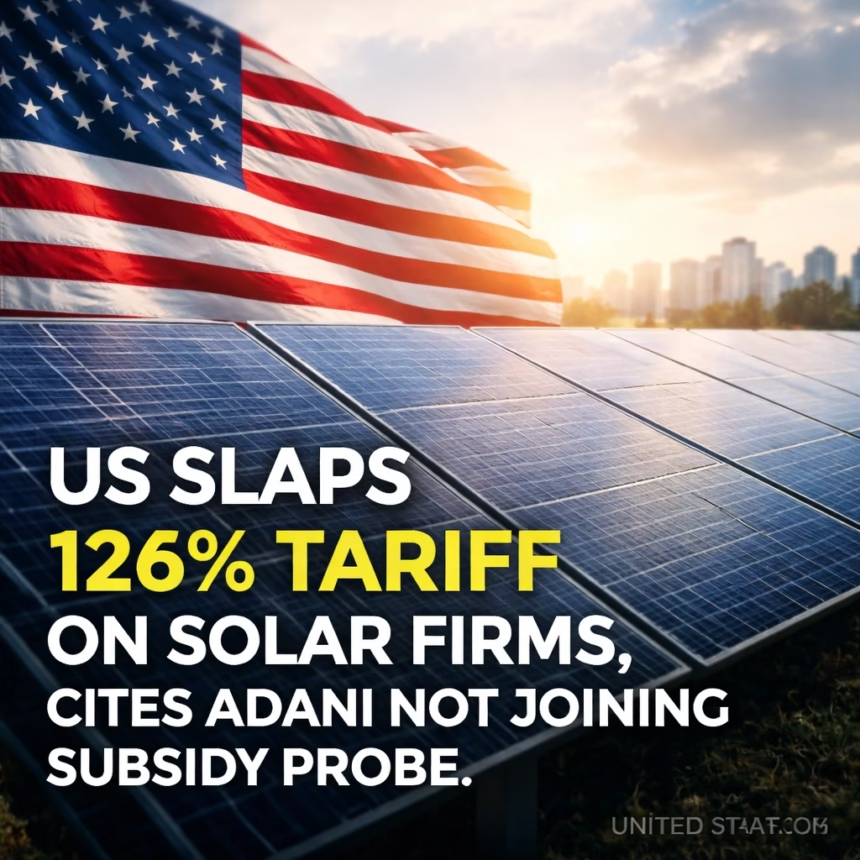
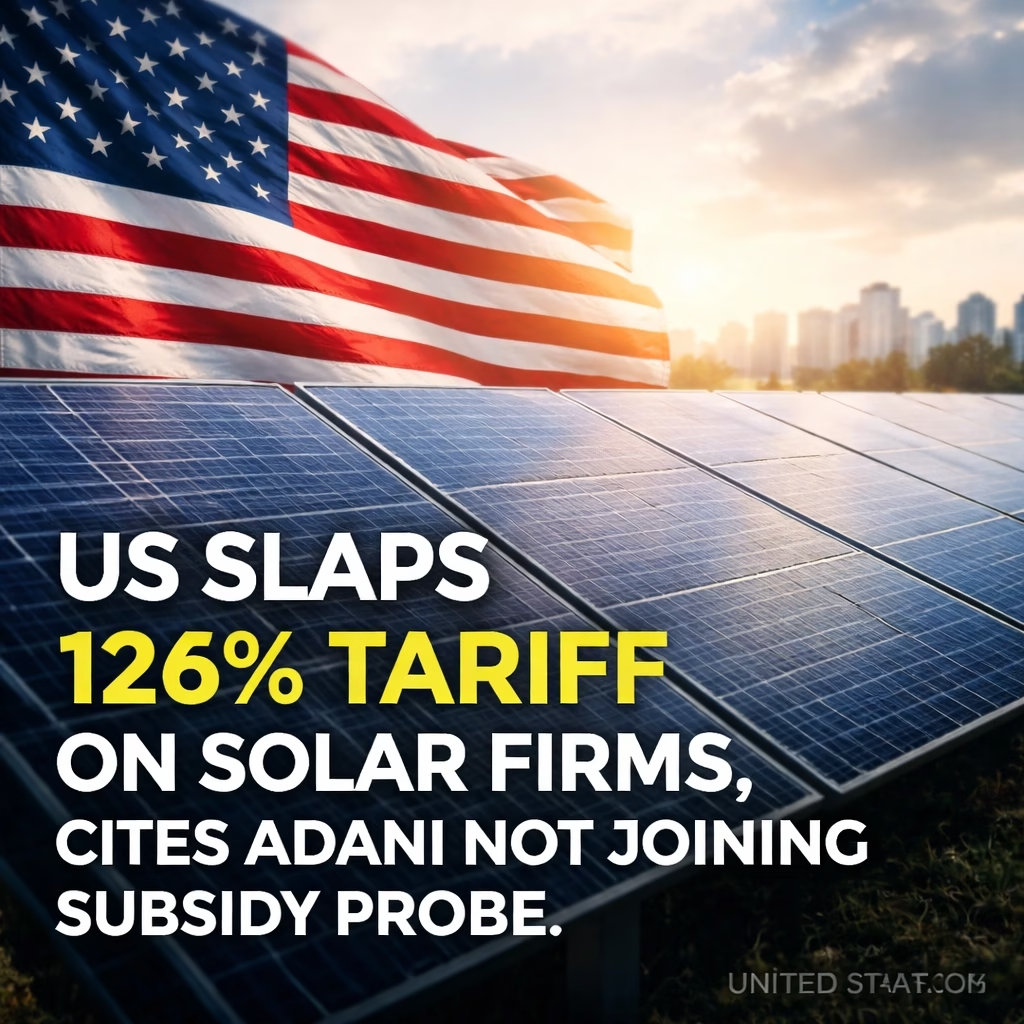
The United States Department of Commerce has finalized a significant increase in tariffs on solar cell and module imports from several international manufacturers, with duties reaching an extraordinary 126.37%. Announced in late September 2023, this decisive action primarily targets firms that declined to participate in an ongoing anti-subsidy investigation, explicitly citing the Adani Group's solar manufacturing arm for its non-cooperation. The move intensifies existing trade tensions within the global renewable energy sector, aiming to counteract alleged unfair foreign government subsidies.
Background: A Decade of Solar Trade Disputes
The latest tariff hike is the culmination of a complex history of trade disputes surrounding solar energy products. For over a decade, the United States has sought to protect its nascent domestic solar manufacturing industry from what it perceives as unfairly priced imports, primarily from China.
Early Tariffs and Circumvention Concerns
The initial salvo in this trade war came in 2012, when the U.S. imposed anti-dumping and countervailing duties (AD/CVD) on solar cells and modules from China, following findings of unfair pricing and government subsidies. These duties significantly altered global supply chains, prompting many Chinese manufacturers to relocate parts of their production, particularly cell assembly, to other Southeast Asian nations like Cambodia, Malaysia, Thailand, and Vietnam.
In 2018, the Trump administration added Section 201 safeguard tariffs on all imported solar cells and modules, regardless of origin, further complicating the import landscape. While these tariffs aimed to bolster U.S. production, they also increased costs for American solar developers, who largely rely on imported components.
The issue escalated in February 2022 when Auxin Solar, a small U.S. solar manufacturer, filed a petition alleging that Chinese companies were circumventing existing AD/CVD duties by finishing production in these Southeast Asian countries. The Department of Commerce launched an investigation into these allegations in April 2022. While President Biden issued a two-year moratorium on new tariffs related to this circumvention probe in June 2022 to prevent immediate disruption to U.S. solar projects, the underlying investigations continued.

The Countervailing Duty Investigation
Parallel to the circumvention probe, the Department of Commerce has been conducting specific countervailing duty (CVD) investigations into alleged government subsidies provided to solar manufacturers in various countries. CVDs are designed to offset the competitive advantage foreign companies gain from government financial assistance, such as preferential loans, tax breaks, land grants, or export incentives. It is within this specific CVD framework that the 126.37% tariff has emerged, particularly targeting firms that failed to cooperate with the Commerce Department’s requests for information.
Key Developments: The 126% Tariff and Adani’s Role
The recent announcement marks a critical juncture in U.S. solar trade policy, solidifying a punitive tariff rate for non-compliant entities.
Final Determination and Adverse Facts Available
On September 28, 2023, the U.S. Department of Commerce issued its final affirmative determination in the countervailing duty investigation concerning crystalline silicon photovoltaic cells and modules. The investigation found that certain foreign governments were indeed providing subsidies to their solar manufacturers, giving them an unfair advantage in the U.S. market.
More Read

Crucially, the Commerce Department applied an “adverse facts available” (AFA) methodology for companies that refused to participate in the investigation or failed to provide requested information. Under U.S. trade law, when an interested party withholds information or significantly impedes an investigation, the Department of Commerce is permitted to use the “best available information” to determine a tariff rate, which often results in the highest possible punitive duty. This principle led directly to the imposition of the 126.37% tariff rate on non-cooperating firms.
Adani Group’s Non-Cooperation
The Department of Commerce explicitly cited the Adani Group’s solar manufacturing arm, Adani Solar, as one of the major producers that declined to participate in the subsidy probe. Adani Solar, a prominent Indian conglomerate, manufactures solar cells and modules, including for export markets. Its decision not to engage with the Commerce Department’s investigation directly contributed to the application of the AFA rate, meaning any Adani Solar products imported into the U.S. would face this substantial duty.
The investigation examined various forms of alleged subsidies, including direct financial contributions, government provision of goods or services, and income tax exemptions, all of which could distort market competition. By not providing data, Adani Solar and other non-cooperating firms left the Commerce Department to draw conclusions based on available public information, often leading to less favorable outcomes than if they had presented their own data.
Impact: Ripple Effects Across the Solar Ecosystem
The imposition of a 126.37% tariff will send significant ripple effects throughout the U.S. and global solar industries, affecting a wide array of stakeholders.
U.S. Solar Developers and Installers
For U.S. solar developers and installers, the immediate impact is a substantial increase in the cost of imported solar cells and modules from targeted firms. Projects already in development or under contract, which may have relied on these specific suppliers, face severe economic challenges. This could lead to project delays, renegotiations of power purchase agreements, or even cancellations, potentially slowing the pace of solar energy deployment in the U.S.
The tariffs further complicate supply chain management, pushing developers to accelerate diversification strategies away from the affected regions and towards suppliers in countries with lower or no tariffs, or to increase procurement from domestic U.S. manufacturers. However, U.S. manufacturing capacity is still scaling up and may not immediately meet demand at competitive prices.

Adani Group and Other Targeted Manufacturers
For the Adani Group, the tariff represents a significant impediment to its ability to export solar cells and modules to the lucrative U.S. market. This could result in direct revenue losses from U.S. exports and necessitate a re-evaluation of its global sales strategy and production allocations. Furthermore, being explicitly named by the U.S. Department of Commerce in connection with a subsidy probe and non-cooperation carries a certain reputational risk in international trade circles.
Other foreign manufacturers who were also subject to the AFA rate will face similar challenges, potentially losing market share in the U.S. Those who cooperated with the investigation and received lower, specific tariff rates, or were excluded, may gain a competitive advantage.
U.S. Manufacturing and Clean Energy Goals
On the other hand, the tariffs, combined with significant incentives from the Inflation Reduction Act (IRA), are expected to provide a substantial boost to domestic U.S. solar manufacturing. The increased cost of imports could make U.S.-produced components more price-competitive, encouraging further investment and expansion of American factories. This aligns with the Biden administration’s broader goals of strengthening domestic supply chains and creating green energy jobs.
However, the higher overall cost of solar components in the near term could pose a challenge to the U.S.’s ambitious climate goals. If installation costs rise significantly, it might slow the adoption rate of solar energy, making it harder to meet renewable energy targets.
Broader Trade Relations
While the tariff is on specific firms rather than entire countries, the explicit mention of the Adani Group, a major Indian conglomerate, could introduce a subtle point of tension in broader trade discussions between the U.S. and India. Despite generally seeking closer strategic and economic ties, trade disputes involving prominent national entities can complicate diplomatic relations.
What Next: Appeals, Adjustments, and Future Outlook
The final determination from the Department of Commerce sets the stage for several immediate and long-term developments.
Legal Challenges and Implementation
The tariffs will become effective shortly after their official publication in the Federal Register. U.S. Customs and Border Protection will then begin collecting these duties on all subject imports. Affected companies, including the Adani Group, have the legal right to challenge the Department of Commerce’s final determination. These appeals would typically be filed with the U.S. Court of International Trade (CIT) and could potentially escalate to the U.S. Court of Appeals for the Federal Circuit. Such legal battles can be protracted, taking months or even years to resolve.
Supply Chain Reconfiguration and Investment
The U.S. solar industry will continue to intensify its efforts to reconfigure supply chains. This involves seeking new module and cell suppliers from countries not subject to high tariffs, such as those in Europe or other parts of Asia, or accelerating procurement from expanding U.S. manufacturing facilities. The combination of these tariffs and the manufacturing tax credits provided by the Inflation Reduction Act is expected to further incentivize significant investment in domestic solar production capacity.
However, building out a robust domestic supply chain, from polysilicon to finished modules, is a capital-intensive and time-consuming process. The industry will face a period of adjustment as it navigates these new trade realities.
Future Reviews and Policy Debates
Anti-dumping and countervailing duty orders are not permanent. They are subject to annual administrative reviews and “sunset reviews” every five years, during which the Department of Commerce and the U.S. International Trade Commission assess whether the duties are still necessary to prevent injury to the domestic industry. These reviews provide opportunities for rates to be adjusted or even revoked.
The long-term impact on the pace of solar deployment in the U.S. will be closely monitored by industry stakeholders, policymakers, and environmental groups. The balance between protecting domestic manufacturing and ensuring affordable access to renewable energy will remain a central debate in U.S. trade and climate policy.