Trump's 'Final Offer': Iran Confronts Ultimatum as Peace Talks Loom
Trump's 'Final Offer': Iran Confronts Ultimatum as Peace Talks Loom
President Donald Trump has delivered a stark ultimatum to Iran, outlining what his administration terms a "final offer" for a comprehensive deal. This significant declaration, made from the White House, precedes anticipated international peace negotiations aimed at de-escalating long-standing tensions in the Middle East. The move signals a critical juncture in U.S.-Iran relations, forcing Tehran to consider its response before diplomatic pathways solidify.
Background: A Decade of Diplomatic Strife and Escalation
The current standoff between Washington and Tehran is rooted in decades of complex geopolitical dynamics, fundamentally reshaped by the 2015 Joint Comprehensive Plan of Action (JCPOA), widely known as the Iran nuclear deal. This landmark agreement, brokered by the P5+1 nations (United States, United Kingdom, France, China, Russia, plus Germany) and Iran, sought to curb Iran’s nuclear program in exchange for significant sanctions relief.
Under the JCPOA, Iran agreed to drastic reductions in its uranium enrichment capacity, limitations on centrifuges, and stringent international inspections by the International Atomic Energy Agency (IAEA). In return, the global community lifted a range of multilateral and unilateral sanctions that had crippled Iran’s economy for years. The deal was hailed by its proponents as a crucial step towards preventing nuclear proliferation in the volatile Middle East.

However, the agreement faced consistent criticism from then-candidate Donald Trump, who labeled it “the worst deal ever negotiated.” Upon assuming office, President Trump initiated a review of the JCPOA, ultimately withdrawing the United States from the accord on May 8, 2018. He argued that the deal was fundamentally flawed, citing its temporary “sunset clauses” that would allow Iran to resume certain nuclear activities after a specified period, and its failure to address Iran’s ballistic missile program or its support for regional proxy groups.
Following the U.S. withdrawal, the Trump administration reimposed and expanded a sweeping “maximum pressure” campaign of sanctions targeting Iran’s vital oil exports, banking sector, and key industries. This economic pressure aimed to force Iran back to the negotiating table for a new, more comprehensive agreement that would address all U.S. concerns, not just the nuclear program.
More Read
Iran, in response to the U.S. sanctions and the perceived failure of European signatories to uphold their commitments under the JCPOA, began to incrementally scale back its compliance with the nuclear deal’s restrictions. Starting in May 2019, Tehran announced a series of steps reducing its commitments, including exceeding limits on enriched uranium stockpiles and enriching uranium to higher purities than allowed by the agreement. These actions were described by Iran as reversible if sanctions were lifted.
The period also saw a significant escalation of regional tensions. Incidents included attacks on oil tankers in the Gulf of Oman, the downing of a U.S. surveillance drone by Iran, and a major drone and missile attack on Saudi Aramco oil facilities at Abqaiq and Khurais in September 2019, which the U.S. and Saudi Arabia blamed on Iran. The killing of Iranian General Qassem Soleimani in a U.S. drone strike in Baghdad in January 2020, followed by Iranian missile strikes on U.S. bases in Iraq, brought the two nations to the brink of open conflict, underscoring the precarious state of regional stability.
Key Developments: The Ultimatum’s Unveiling
President Trump’s latest declaration marks a significant pivot in the administration’s strategy, moving from an open-ended “maximum pressure” campaign to a defined “final offer” before scheduled peace talks. While the precise details of this “final offer” have not been fully disclosed to the public, White House officials have indicated it encompasses a broader range of demands than the original JCPOA, reflecting longstanding U.S. concerns.
Sources close to the administration suggest the core tenets of the ultimatum include permanent and verifiable restrictions on Iran’s nuclear program, going beyond the sunset clauses of the JCPOA. Critically, it also demands substantial limitations on Iran’s ballistic missile development and proliferation, a contentious issue not covered by the 2015 agreement. Furthermore, the offer likely calls for an end to Iran’s support for regional proxy groups and a cessation of its destabilizing activities across the Middle East, from Yemen to Lebanon.
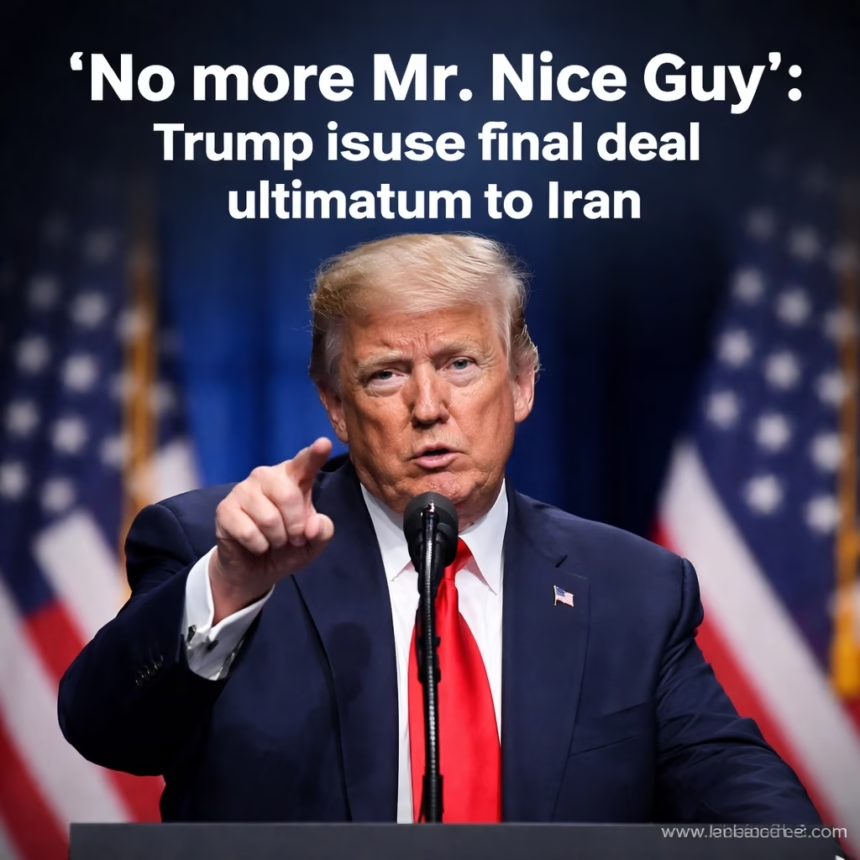
The rhetoric accompanying this ultimatum has been notably firm. President Trump’s statements have echoed a “no more Mr. Nice Guy” approach, emphasizing that this is Iran’s “last chance” to engage constructively before the window for a diplomatic resolution potentially closes. This strong language is designed to convey a sense of urgency and to pressure the Iranian leadership into making significant concessions ahead of any formal negotiations.
Initial reactions from international allies have been mixed. European signatories to the JCPOA – France, Germany, and the United Kingdom (E3) – have consistently advocated for preserving the original deal while also expressing growing concern over Iran’s breaches. While they welcome any genuine attempt at de-escalation, the E3 nations have also voiced caution regarding unilateral ultimatums that could undermine multilateral efforts. They are likely to assess whether this “final offer” provides a viable pathway to a broader, more stable agreement or risks further isolating Iran.
More Read

From Tehran, the immediate response has been predictably defiant. Senior Iranian officials have publicly rejected the notion of an ultimatum, calling it “unacceptable” and a violation of national sovereignty. Foreign Minister Javad Zarif and other prominent figures have reiterated Iran’s stance that it will not negotiate under duress or abandon its defensive missile program. However, despite the strong public rebukes, there remains a delicate balancing act within Iran’s political establishment, with some factions potentially open to exploring diplomatic avenues if their core interests are guaranteed.
China and Russia, both P5+1 members and traditional allies of Iran, have largely criticized the U.S. withdrawal from the JCPOA and its “maximum pressure” campaign. They are likely to view the “final offer” with skepticism, advocating for a return to the original deal and multilateral diplomacy, rather than what they might perceive as unilateral demands. Their influence could be crucial in shaping Iran’s eventual response and the dynamics of any future negotiations.
Impact: Repercussions Across the Globe
The implications of President Trump’s ultimatum reverberate far beyond Washington and Tehran, influencing geopolitical stability, economic markets, and the future of international diplomacy.
For Iran, the immediate impact is a deepening of economic hardship. The intensified sanctions have already crippled its oil exports, devalued its currency, and fueled high inflation and unemployment. A failure to engage with the “final offer” could lead to further isolation and economic strangulation, potentially exacerbating internal unrest and challenging the legitimacy of the ruling establishment. The ultimatum also forces a critical internal debate between hardliners, who advocate for resistance, and pragmatists, who might seek a diplomatic off-ramp.
The United States faces scrutiny regarding its diplomatic credibility. While the administration aims to demonstrate strength and resolve, critics argue that abandoning existing agreements and issuing ultimatums can undermine the trust required for future international negotiations. The success or failure of this strategy will significantly shape America’s standing as a global arbiter and its ability to forge consensus on critical security issues.
Regional allies, particularly Saudi Arabia, Israel, and the United Arab Emirates, are closely watching the developments. These nations have long advocated for a tougher stance against Iran and generally support U.S. efforts to curb Tehran’s regional influence and missile program. However, they also face the direct consequences of any miscalculation, including potential military escalation or disruption of vital shipping lanes in the Persian Gulf, which could destabilize the entire region and impact global oil supplies.
European powers, already struggling to maintain the JCPOA, find themselves in a precarious position. While they share some U.S. concerns about Iran’s regional activities, they prioritize diplomatic engagement and the preservation of the non-proliferation framework established by the original deal. The ultimatum challenges their capacity to act as independent mediators and could further strain transatlantic relations if the U.S. approach is perceived as too aggressive or counterproductive.
Globally, the situation carries significant economic risks. Disruptions to oil production or shipping in the Strait of Hormuz, a critical choke point for a fifth of the world’s oil supply, could trigger a sharp rise in crude prices, impacting economies worldwide. Beyond energy, the broader implications for the global non-proliferation regime are profound. The collapse of the JCPOA and the failure to replace it with a viable alternative could set a dangerous precedent, potentially encouraging other nations to pursue nuclear capabilities outside international frameworks.
What Next: Navigating the Path to Peace Negotiations
All eyes are now on the upcoming peace negotiations, which are expected to convene in a neutral location, possibly with European facilitation. The precise date and list of participants remain subject to intense diplomatic maneuvering, but the stage is set for a high-stakes encounter that could redefine the future of the Middle East.
The most immediate milestone will be Iran’s formal response to the “final offer.” While public rhetoric suggests outright rejection, diplomatic channels often allow for more nuanced engagement. Iran could choose to reject the ultimatum outright, leading to a continuation or even intensification of the “maximum pressure” campaign. Alternatively, it might present a counter-proposal, signaling a willingness to negotiate on some terms while firmly resisting others, particularly those concerning its ballistic missile program or regional influence.
Mediating efforts from European nations, alongside countries like Oman and Qatar, will be crucial. These states have historically played a role in bridging divides between Washington and Tehran and may seek to soften the edges of the ultimatum to create a more palatable framework for dialogue. Their success hinges on their ability to convince both sides that a diplomatic resolution, however challenging, is preferable to continued escalation.
Several potential outcomes loom on the horizon. The most optimistic scenario involves a breakthrough where both sides find common ground on a new, more comprehensive agreement that addresses U.S. security concerns while providing Iran with verifiable economic benefits and security assurances. However, given the deep mistrust and maximalist positions, this outcome appears challenging.
A more likely near-term outcome might be a partial agreement or a de-escalation framework that temporarily eases tensions without resolving all core issues. This could involve a mutual return to some JCPOA commitments in exchange for limited sanctions relief, buying time for more extensive negotiations. The least desirable outcome would be a complete breakdown of talks, leading to a prolonged standoff, further economic hardship for Iran, and an increased risk of regional conflict, potentially drawing in other global powers.
Adding another layer of complexity is the upcoming U.S. presidential election cycle. The outcome of the election could significantly alter U.S. foreign policy towards Iran, potentially leading to a renewed emphasis on diplomacy under a different administration or a continuation of the current “maximum pressure” strategy. This electoral uncertainty may influence Iran’s calculus, potentially leading them to either delay significant concessions or seek a swift resolution before a potential change in U.S. leadership.
Ultimately, the coming weeks and months will be critical. The “final offer” has set a clear deadline and framework for engagement. Whether this bold move paves the way for a lasting peace or pushes the region further into instability remains to be seen, hinging on the diplomatic dexterity and political will of all parties involved.