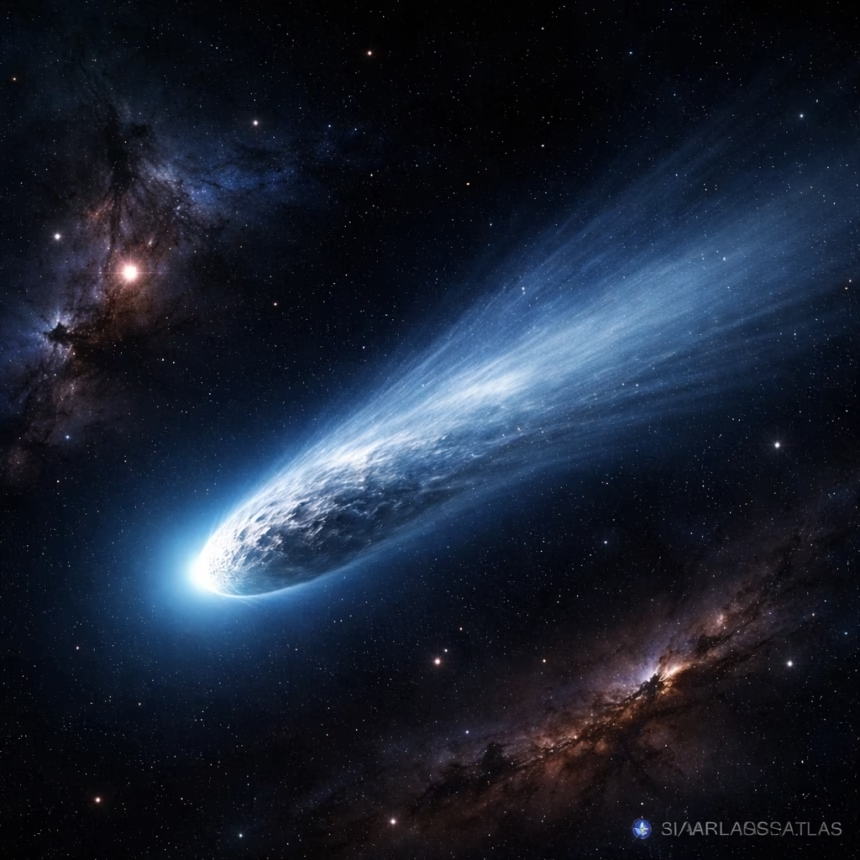
Astronomers have recently unveiled groundbreaking insights into Interstellar Comet 3I/ATLAS, suggesting this cosmic wanderer formed an astounding 12 billion years ago. These new observations, gathered from advanced telescopes, position the comet as one of the oldest known objects in the universe, predating our own solar system by billions of years. Its remarkable journey through interstellar space now offers a unique and tangible window into the early epochs of cosmic evolution.
Background: A Visitor from the Deep Past
Comet 3I/ATLAS, formally designated C/2019 Q4 (ATLAS) before its interstellar nature was confirmed, was first discovered in December 2019 by the Asteroid Terrestrial-impact Last Alert System (ATLAS) in Hawaii. Its trajectory, a distinctly hyperbolic orbit, immediately signaled its origin from beyond the Sun's gravitational influence, making it only the third confirmed interstellar object ever observed. This designation, "3I," places it in an exclusive club alongside 1I/'Oumuamua (discovered in 2017) and 2I/Borisov (2019).
Unlike its predecessors, 3I/ATLAS offered a more sustained viewing opportunity, allowing for unprecedented detailed analysis. Initial observations revealed a relatively pristine, icy composition, characteristic of a comet that had spent eons in the frigid vacuum of space, far from any star. However, the revelation of its extreme age – up to 12 billion years – is what truly sets it apart. To put this into perspective, our own solar system, including Earth, formed approximately 4.6 billion years ago.
This implies 3I/ATLAS originated in a different stellar nursery, potentially within a much older galaxy or a very early star cluster that existed only a billion to two billion years after the Big Bang. Scientists deduced this extraordinary age from the comet's specific volatile content and its structural integrity, which together point to formation in an extremely cold, undisturbed environment characteristic of the universe's infancy.
Key Developments: Unlocking Ancient Secrets with Telescopic Eyes
The groundbreaking age estimate for 3I/ATLAS stems from a meticulous analysis conducted by a team of international astronomers utilizing state-of-the-art observatories. Principal among these was the Atacama Large Millimeter/submillimeter Array (ALMA) in Chile, a powerful facility capable of detecting the faint molecular signatures within celestial bodies. Through advanced spectroscopic analysis, researchers were able to probe the chemical makeup of 3I/ATLAS's coma, the gaseous envelope surrounding its nucleus as it warmed near the Sun.
More Read

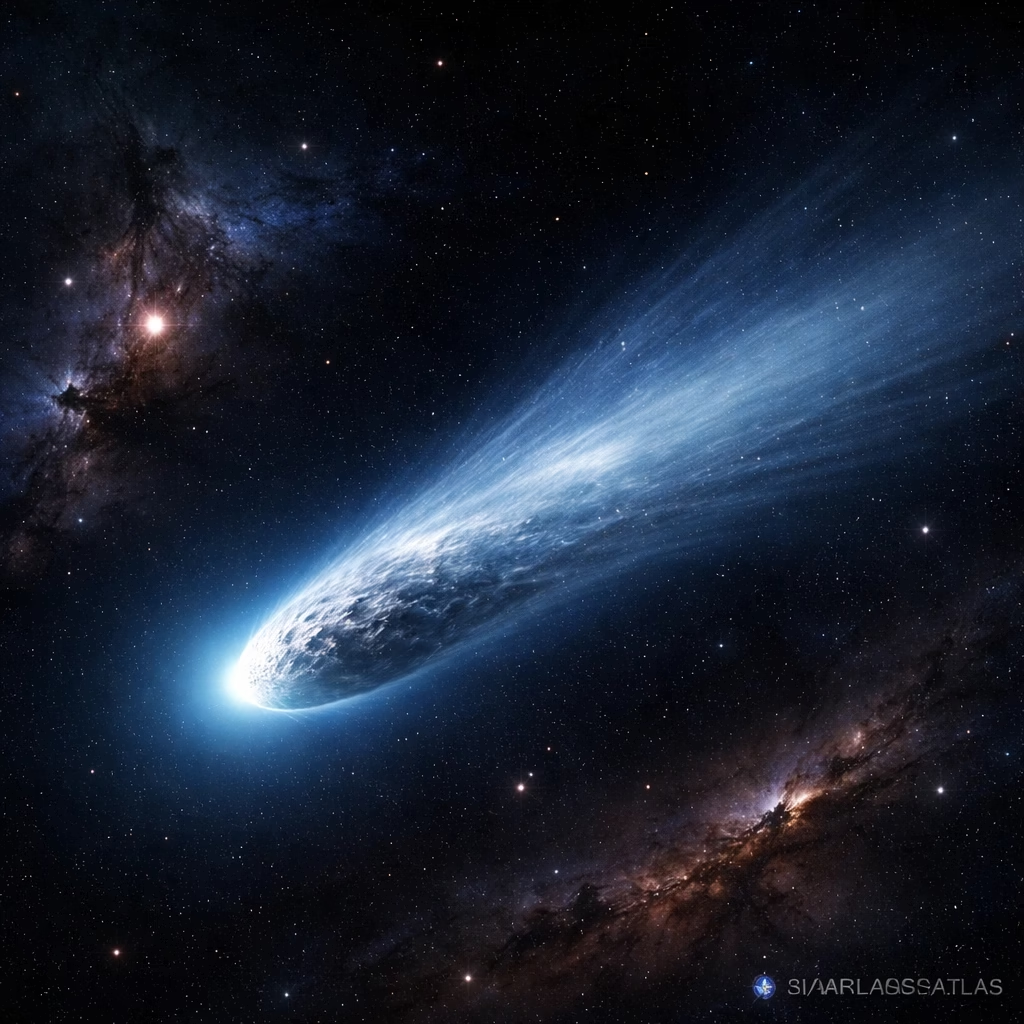
The findings were striking: the comet exhibited unusually high levels of carbon monoxide (CO) and, conversely, surprisingly low levels of water (H2O) compared to typical comets originating from within our own solar system. This distinct volatile ratio, coupled with observations of its dust properties, strongly suggests that 3I/ATLAS formed under extremely cold and dense conditions. Such primordial conditions were widespread in the interstellar medium during the universe's infancy, long before the proliferation of heavier elements created by subsequent generations of stars.
The comet's remarkably pristine nature, despite its immense journey across cosmic distances and timescales, indicates it has remained largely undisturbed since its formation. This allows it to function as a veritable "time capsule," preserving the chemical fingerprint of an era when the universe was still in its nascent stages. These recent findings, published by prominent researchers in the field, challenge previous assumptions about the typical formation environments and ages of cometary bodies, pushing the boundaries of what was thought possible for such small, transient objects.
More Read

Profound Impact: Rewriting Cosmic Narratives
The implications of Interstellar Comet 3I/ATLAS's ancient origins are profound, resonating across multiple scientific disciplines from astrophysics and cosmochemistry to planetary science and astrobiology. This cosmic relic offers the scientific community a tangible, direct sample from the universe's early epochs, providing invaluable insights into the chemical composition of primordial star-forming regions. Its very existence challenges prevailing models of comet formation, which predominantly focus on their genesis within the protoplanetary disks of nascent star systems.
3I/ATLAS suggests that a significant population of small, icy bodies might have formed under different, more widespread conditions in the early universe, perhaps even before the full assembly of organized star systems. Furthermore, the distinct chemical signature of 3I/ATLAS could reshape our understanding of how the building blocks for planets and life were distributed throughout the cosmos. If such ancient, chemically unique objects were common, they could have played a crucial role in delivering volatiles and organic molecules to early planetary systems, potentially influencing the conditions for life's emergence.
The discovery expands our appreciation for the diversity, resilience, and longevity of small bodies in the universe, highlighting their capacity to carry ancient cosmic material across immense distances and through billions of years of cosmic evolution. For the public, 3I/ATLAS serves as a powerful reminder of the universe's staggering age and interconnectedness, offering a rare opportunity to contemplate a literal piece of its distant, formative past.
What Next: Glimpsing Future Discoveries
The revelations surrounding 3I/ATLAS have ignited a new fervor within the astronomical community, prompting a concerted effort to deepen our understanding of this extraordinary object and to search for others like it. Researchers are actively conducting further analyses of 3I/ATLAS's archived observational data, refining trajectory models, and seeking even more subtle chemical signatures within its fleeting coma. A primary goal is to narrow down the precise age estimate and to characterize its isotopic ratios, which could offer definitive clues about its specific formation environment and the type of star system—if any—it originated from.
The insights gleaned from 3I/ATLAS will undoubtedly inform the development of next-generation telescopes and observational strategies. Projects like the Vera C. Rubin Observatory, with its vast sky-scanning capabilities, are expected to significantly increase the discovery rate of new interstellar objects, potentially unearthing more ancient wanderers. Scientists hope to model the exact conditions under which such a fragile, primordial object could have survived billions of years of interstellar travel, enduring countless gravitational perturbations and cosmic radiation.
Ultimately, the quest inspired by 3I/ATLAS is to build a more comprehensive and accurate picture of the early universe's chemical landscape, tracing the pathways through which primordial matter evolved into the complex array of stars, planets, and potentially life that we observe today. The universe, it seems, continues to surprise us with its ancient secrets, delivered right to our cosmic doorstep.