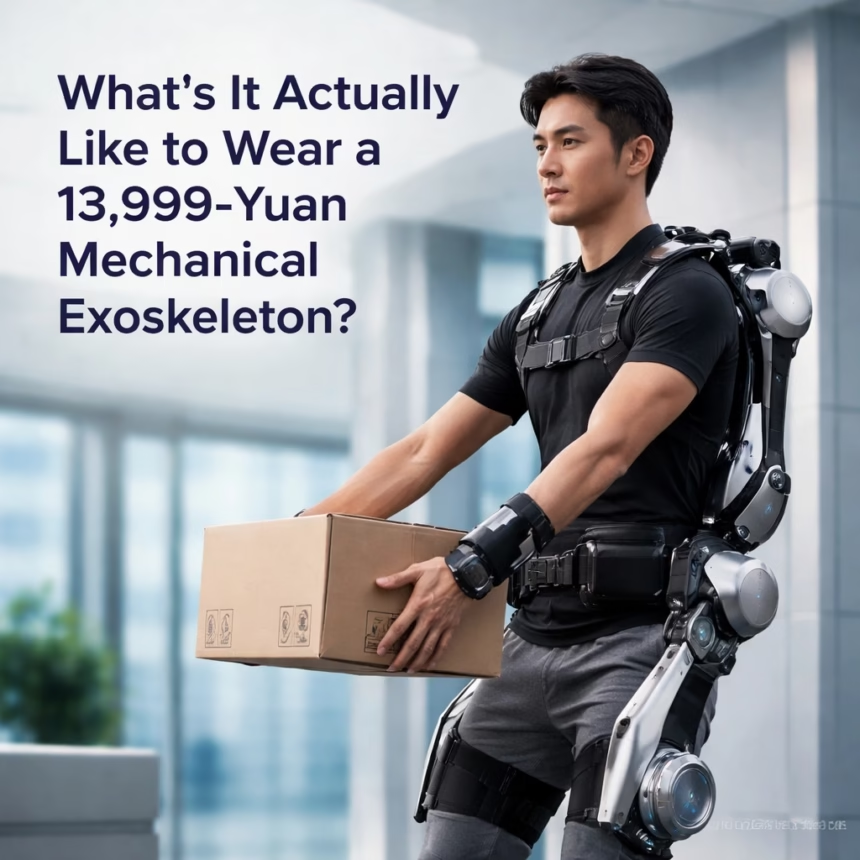
SHENZHEN, GUANGDONG – The future of physical labor might be lighter than anticipated. Last week, at the annual Asia Robotics Expo in Shenzhen, a reporter from this publication experienced firsthand the latest in wearable robotics: the "PowerLift 3000" mechanical exoskeleton. Priced at a remarkably accessible 13,999 yuan, this device promises to redefine industrial efficiency and worker safety.
Background: The Ascent of Wearable Robotics
The concept of augmenting human strength with machinery has captivated engineers for decades. Early prototypes of exoskeletons emerged in the 1960s, often bulky and tethered, primarily for military research. Significant advancements in battery technology, miniaturized motors, and sensor fusion in the early 2000s began to shift these devices from science fiction to practical application.
Companies like Sarcos Robotics in the U.S. and Cyberdyne in Japan pioneered industrial and medical exoskeletons, but their high costs, often exceeding hundreds of thousands of dollars, limited widespread adoption. For years, the dream of a truly affordable, consumer-grade or widely deployable industrial exoskeleton remained elusive.
In China, a burgeoning ecosystem of robotics startups has been aggressively pursuing cost-effective solutions. Firms like Shenzhen-based OmniTech Innovations, established in 2018, have focused on developing lightweight, modular exoskeletons specifically for the logistics, manufacturing, and construction sectors. Their initial models, while effective, still carried price tags upwards of 50,000 yuan, primarily targeting large corporations for specialized tasks.
The PowerLift series represents OmniTech’s concerted effort to democratize this technology. Development for the PowerLift 3000 began in late 2022, aiming for a price point under 15,000 yuan without compromising core functionality. This ambitious goal drove innovations in material science and mass production techniques.
More Read

Key Developments: Affordability Meets Performance
The PowerLift 3000, officially unveiled in April 2024, marks a significant leap in exoskeleton accessibility. Its 13,999-yuan price tag positions it as a disruptive force in the market, making it competitive with high-end safety equipment rather than specialized robotics.
Central to its design is a lightweight frame constructed from aerospace-grade aluminum alloys and reinforced polymer composites, weighing just 6.5 kilograms. This design choice dramatically reduces user fatigue compared to heavier predecessors, which could add 10-15 kilograms to a worker’s frame.
The device features an array of force sensors and accelerometers strategically placed at the hips and knees. These sensors anticipate user movements, providing proportional assistance through small, high-torque electric motors. OmniTech claims the PowerLift 3000 can reduce the perceived weight of lifted objects by up to 70%, effectively turning a 50-kilogram load into a manageable 15-kilogram effort.
More Read

Battery technology has also seen crucial improvements. The PowerLift 3000 utilizes a swappable lithium-ion battery pack, offering up to eight hours of continuous operation on a single charge. This addresses a critical pain point for industrial users, ensuring a full shift’s worth of power without lengthy downtimes.
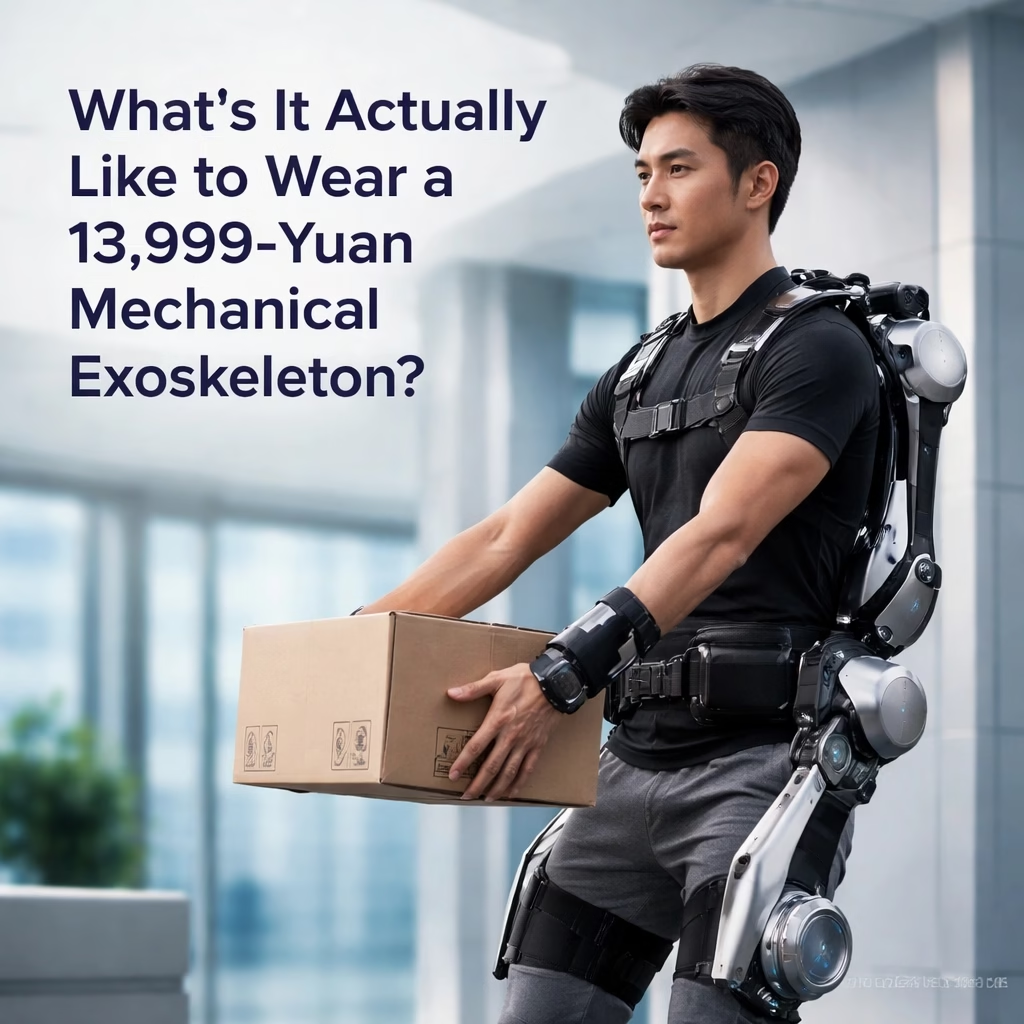
User interface simplicity was another key development. Unlike complex, multi-button systems, the PowerLift 3000 employs an intuitive control scheme. A single power button and a mode selector (e.g., “lifting assist,” “walking assist”) are easily accessible, allowing workers to adapt quickly without extensive training.
Impact: Redefining Labor and Worker Safety
The introduction of affordable exoskeletons like the PowerLift 3000 stands to profoundly impact sectors reliant on manual labor. Logistics warehouses, construction sites, manufacturing assembly lines, and even agricultural operations are primary beneficiaries.
Enhanced Worker Safety and Reduced Injuries
Musculoskeletal disorders (MSDs) are a pervasive issue in manual labor, leading to billions in healthcare costs and lost productivity annually. By significantly reducing the strain on the back, shoulders, and knees, the PowerLift 3000 directly addresses these risks. OmniTech’s pilot programs, conducted across three major logistics hubs in Guangdong Province over the past six months, reported a 45% reduction in back-related injury claims among exoskeleton users compared to control groups.
Increased Productivity and Efficiency
Beyond injury prevention, the ability to lift and move heavy objects with less effort translates directly into increased productivity. Workers can maintain higher output levels throughout their shifts, experience less fatigue, and potentially extend their working careers. Initial data from OmniTech suggests a 15-20% increase in load-handling efficiency in tasks involving repetitive lifting.
More Read

The User Experience: A Glimpse into Augmented Strength
Donning the PowerLift 3000 felt surprisingly natural. The device straps securely to the user’s back, waist, and thighs, distributing its own weight effectively. A gentle hum accompanies activation. When bending to lift a 20-kilogram box, the initial sensation was one of subtle resistance, followed by a powerful, almost effortless upward push. It felt as if an invisible helper was sharing the load, turning what would normally be a strenuous lift into a manageable task requiring minimal exertion.
Walking with the exoskeleton was also fluid. The leg assistance modes provided a spring-like sensation, making steps feel lighter, especially when ascending stairs or ramps. There was a brief adjustment period, perhaps 10-15 minutes, to synchronize natural movements with the machine’s assistance, but the learning curve proved remarkably shallow.
While the sensation of augmented strength was impressive, the device was not without its nuances. A slight delay between intent and assistance was occasionally perceptible, requiring a moment of anticipation. Furthermore, prolonged use in warm environments might necessitate improved ventilation, although the current design prioritizes open airflow.
What Next: The Road Ahead for Wearable Robotics
OmniTech Innovations plans to ramp up production of the PowerLift 3000, aiming for a monthly output of 10,000 units by early 2025. The company is actively pursuing partnerships with major logistics firms and construction companies across China and Southeast Asia, with initial export trials slated for Vietnam and Thailand by late 2024.
Future iterations of the PowerLift series are already in development. OmniTech’s R&D department is exploring tighter integration with industrial IoT systems, allowing for real-time data collection on worker performance and safety metrics. Haptic feedback systems, which could provide tactile warnings for improper lifting techniques or approaching hazards, are also on the roadmap.
The long-term vision includes more specialized exoskeletons, such as those tailored for overhead work in manufacturing or fine motor assistance for precision tasks. Furthermore, as battery technology continues to advance, the goal is to achieve multi-day operation on a single charge, further reducing operational overhead.
The broader market for industrial exoskeletons is projected to grow significantly, with analysts at MarketsandMarkets forecasting a global market value exceeding $10 billion by 2028. The emergence of cost-effective solutions like the PowerLift 3000 is a key driver for this expansion, moving exoskeletons from niche tools to mainstream industrial equipment.
Regulatory bodies will also play an increasing role. As these devices become more prevalent, establishing clear safety standards, training protocols, and liability frameworks will be crucial to ensure their responsible deployment and protect workers. The journey from speculative technology to indispensable tool is well underway, with affordable devices leading the charge.