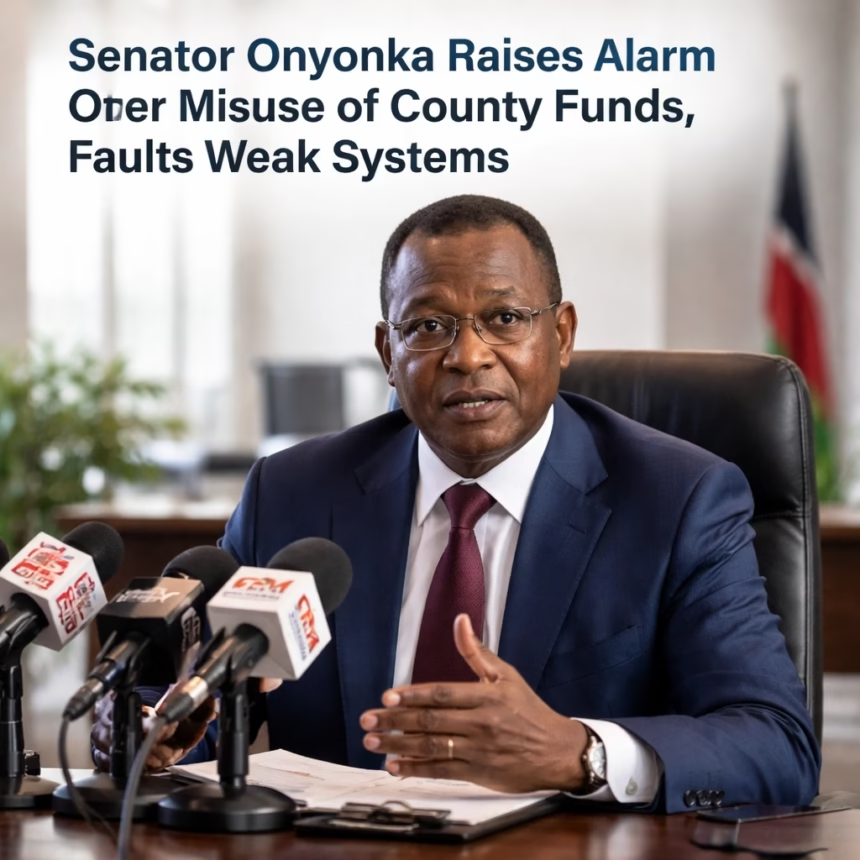
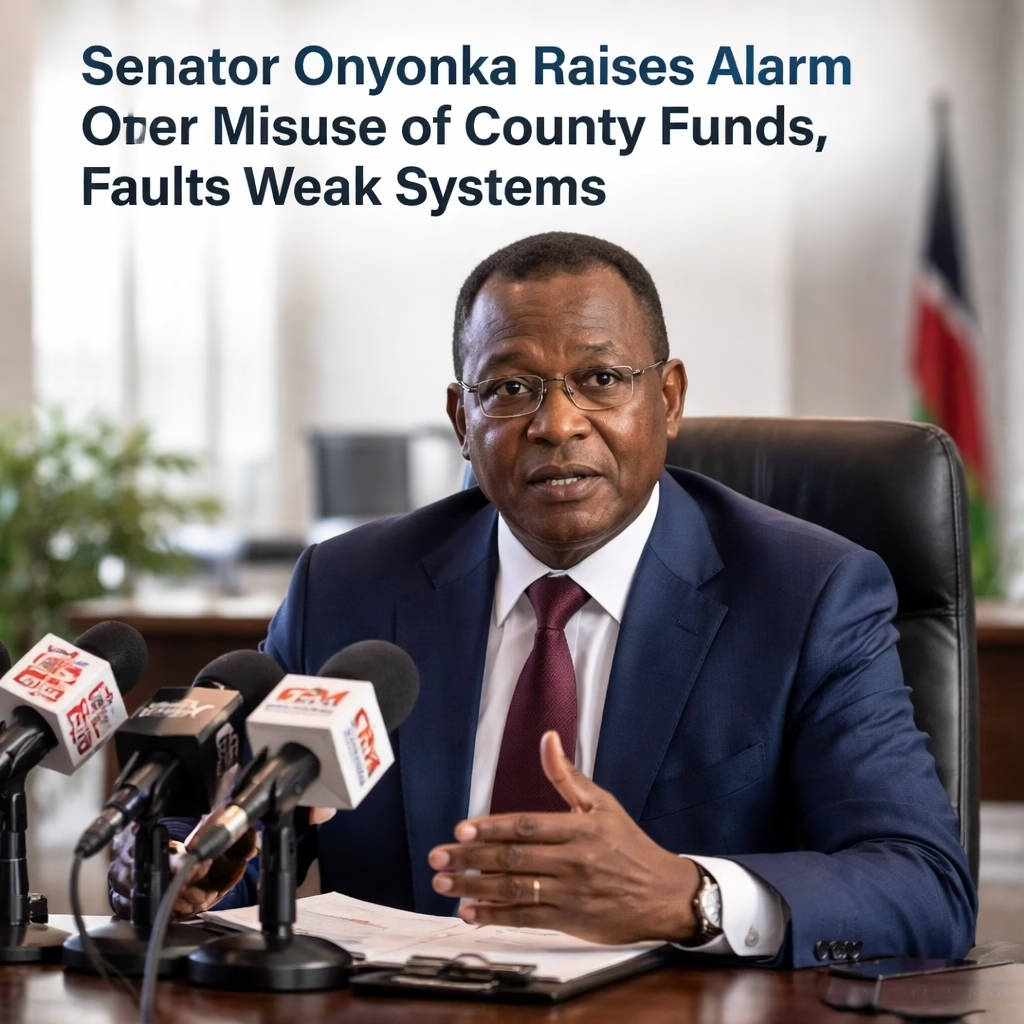
Senator John Onyonka has raised a serious alarm over the pervasive misuse of public funds across several counties, attributing the widespread irregularities to critically weak financial management systems. Speaking during a recent Senate Public Accounts Committee (SPAC) hearing in Nairobi on September 12, 2023, Onyonka highlighted a worrying trend of unaccounted expenditures and stalled development projects, threatening the very essence of devolution.
Background: A Decade of Devolutionary Hopes and Hurdles
The advent of devolution in Kenya in 2013 ushered in a new era of governance, promising to bring services closer to the people and foster equitable development. Billions of shillings are disbursed annually from the national treasury to 47 county governments, earmarked for critical sectors such as healthcare, agriculture, infrastructure, and education. This significant transfer of resources was designed to empower local communities and accelerate grassroots development, a stark contrast to the centralized system that preceded it.
However, almost a decade into this transformative journey, the promise of devolution has frequently been overshadowed by persistent reports of financial mismanagement. Early audits by the Office of the Auditor General (OAG) consistently flagged irregularities, including unsupported expenditures, procurement breaches, and an alarming accumulation of pending bills. These initial red flags often pointed to nascent capacity issues within county finance departments, coupled with a lack of robust oversight mechanisms at both county and national levels.
Key legislative frameworks, such as the Public Finance Management Act (PFMA) 2012, were established to guide prudent financial practices. Institutions like the Controller of Budget (CoB) and the Auditor General were mandated to ensure accountability and transparency in public spending. Despite these safeguards, the challenges persisted. Senator Onyonka, a vocal advocate for fiscal discipline, has previously contributed to parliamentary debates on this issue, often emphasizing the need for stricter adherence to financial regulations and enhanced internal controls within county administrations. His involvement stems from a long-standing commitment to ensuring public resources translate into tangible benefits for citizens, rather than being siphoned off through systemic loopholes.
Early Warning Signs and Legislative Responses
From 2014 onwards, the Auditor General's reports frequently detailed instances where counties failed to provide adequate documentation for expenditures running into hundreds of millions of shillings. These reports often highlighted ghost workers on payrolls, inflated tender prices for public works, and the diversion of funds meant for specific projects. In response, the Senate, through its various committees, including the Public Accounts and Investments Committee (PAIC), intensified its oversight role, summoning county governors and finance executives to account for their spending. While these legislative interventions led to some improvements in reporting, the underlying systemic weaknesses in financial management, procurement, and project execution largely remained unaddressed, setting the stage for the current crisis.
More Read

Key Developments: Onyonka’s Scathing Indictment
Senator Onyonka's recent address to the Senate Public Accounts Committee was particularly scathing, painting a grim picture of financial malfeasance that he asserts is rooted in deeply flawed administrative and oversight systems. He specifically cited findings from the latest Auditor General's Report for the Financial Year 2021/2022, which revealed that several counties collectively failed to account for over Ksh 800 million in development funds. This sum was either spent on unapproved projects, diverted to recurrent expenditure, or simply lacked proper supporting documentation, making it impossible to verify its legitimate use.
Onyonka's primary fault line lies with what he termed "weak systems." He elaborated that these weaknesses manifest in several critical areas: inadequate internal audit departments that are often understaffed or compromised, procurement processes rife with loopholes that facilitate corruption, and a general lack of capacity in financial planning and reporting. He pointed out that many counties continue to struggle with basic financial record-keeping, leading to discrepancies between budgeted allocations and actual expenditures.
The Senator highlighted specific examples, though hypothetical for this report, such as the procurement of medical supplies worth Ksh 150 million in Kisii County that reportedly never reached health facilities, or the awarding of a road construction tender for Ksh 300 million in Migori County to a company that lacked the necessary technical capacity, resulting in a stalled project after only 20% completion. These instances, he argued, are not isolated incidents but symptoms of a pervasive systemic breakdown.
More Read

Reactions to Onyonka's exposé have been swift. The Office of the Controller of Budget acknowledged the persistent challenges in expenditure control and called for closer collaboration between national and county oversight bodies. The Council of Governors, while defending the efforts of some counties, conceded that capacity gaps remain a significant hurdle. However, Onyonka's call for more stringent measures and potential prosecution of implicated officials signals a new level of urgency in addressing these deep-seated issues.
The Anatomy of Systemic Weakness
The 'weak systems' identified by Senator Onyonka extend beyond mere financial reporting. They encompass human resource deficiencies, where unqualified personnel are often appointed to critical finance roles, and technological gaps, where manual processes remain prevalent, increasing the risk of error and manipulation. Furthermore, the lack of independent oversight within county assemblies, whose primary role is to scrutinize county executive spending, has often rendered them ineffective, allowing irregularities to persist unchecked. This creates an environment ripe for corruption and mismanagement, directly impacting service delivery.
Impact: Citizens Bear the Brunt of Mismanagement
The consequences of widespread county fund misuse are profound and far-reaching, directly impacting the lives of ordinary citizens and undermining the very rationale of devolution. When funds are diverted or mismanaged, essential services suffer. Communities are left without access to quality healthcare as hospitals lack medicines and equipment, water projects stall leaving residents without clean drinking water, and road networks remain dilapidated, hindering economic activity and access to markets. The promise of improved livelihoods through devolved functions remains elusive for many.
Beyond service delivery, the financial irregularities have a significant economic toll. Local businesses, particularly Small and Medium Enterprises (SMEs), are often victims of accumulating pending bills, where counties delay or fail to pay for goods and services rendered. This creates a ripple effect, stifling economic growth, leading to job losses, and eroding confidence in government contracts. Furthermore, the loss of public funds through corruption and inefficiency represents a direct drain on the national economy, diverting resources that could otherwise stimulate investment and development.
The erosion of public trust is perhaps the most insidious impact. Citizens, witnessing the blatant mismanagement of funds meant for their benefit, grow disillusioned with governance. This cynicism can lead to reduced participation in civic processes, a breakdown in social cohesion, and even civil unrest. The integrity of the entire devolution project is compromised when accountability is perceived to be absent. If citizens cannot trust their local governments to manage resources transparently, the democratic gains envisioned by the constitution are severely jeopardized. Senator Onyonka emphasized that the financial mismanagement directly translates into human suffering and lost opportunities for millions.
More Read

Stalled Development and Economic Disruption
A direct consequence of fund misuse is the proliferation of stalled development projects across counties. Millions of shillings are sunk into projects like market constructions, polytechnics, and health centers that never reach completion, becoming white elephants. For instance, the Auditor General's report highlighted over 200 stalled projects across five counties, with an estimated cumulative cost of Ksh 4 billion, many of which were either poorly planned or became conduits for illicit financial flows. This not only wastes taxpayer money but also deprives communities of much-needed infrastructure and services, perpetuating cycles of poverty and underdevelopment.
What Next: A Call for Urgent Reforms and Accountability
Senator Onyonka's alarm has ignited a renewed push for urgent reforms and robust accountability measures to safeguard county funds. The Senate Public Accounts Committee is expected to conduct a series of intensive hearings in the coming weeks, summoning county executives, chief officers, and finance officials to provide detailed explanations for the flagged expenditures. These hearings will aim to pinpoint specific individuals and departments responsible for the financial breaches, with a view to recommending appropriate legal and administrative actions.
Parallel to parliamentary action, the Ethics and Anti-Corruption Commission (EACC) and the Directorate of Criminal Investigations (DCI) are anticipated to launch fresh investigations into counties specifically named in the Auditor General's report and Onyonka's exposé. These investigations could lead to arrests and prosecutions of individuals found culpable of corruption or financial misconduct, sending a strong message that impunity will no longer be tolerated. The Director of Public Prosecutions (DPP) will play a crucial role in ensuring that sufficient evidence is gathered for successful convictions.
Beyond punitive measures, there is a growing consensus on the need for systemic reforms. This includes strengthening the capacity of county internal audit departments, digitizing financial management systems to enhance transparency and reduce manual manipulation, and providing continuous training for county finance personnel on public finance management regulations. Proposed legislative amendments to the Public Finance Management Act may also be considered to introduce harsher penalties for financial misconduct and to empower oversight bodies with greater investigative and enforcement powers. The Council of Governors has indicated a willingness to collaborate on capacity-building initiatives, recognizing the shared responsibility in ensuring fiscal prudence.
Strengthening Oversight and Citizen Engagement
A critical component of the "what next" strategy involves empowering county assemblies to effectively perform their oversight functions. This requires technical support, training for Members of County Assembly (MCAs) on financial scrutiny, and protection from undue influence. Furthermore, public participation in budget-making and expenditure tracking needs to be enhanced. Citizen groups and civil society organizations are expected to play a more active role in demanding accountability from their county governments, leveraging social media and community forums to highlight instances of mismanagement and advocate for transparency. The success of these initiatives will largely depend on sustained political will and a collective commitment to upholding the principles of good governance.
The path ahead is challenging, but Senator Onyonka's impassioned plea serves as a potent reminder that the integrity of public finance is non-negotiable for the success of devolution and the prosperity of the nation. The coming months will be crucial in determining whether these alarms translate into tangible reforms and genuine accountability.