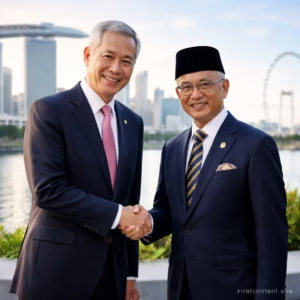
Prime Minister Anthony Albanese is set to fly to Singapore this week for urgent discussions on fuel security, as Australian motorists face a sudden halt in the decline of petrol prices. The high-level talks aim to bolster Australia's energy resilience amidst global volatility and increasing domestic cost-of-living pressures.
Background: Australia’s Fuel Vulnerability
Australia has long grappled with the challenge of fuel security, a critical component of its economic stability and national defence. The nation is a net importer of refined petroleum products, relying heavily on international markets and supply chains to meet its energy needs. This dependency has intensified over decades, with the closure of several domestic oil refineries leaving Australia with limited capacity to process crude oil into petrol, diesel, and jet fuel.
Historically, Australia maintained a more robust domestic refining capability. However, economic pressures, global competition, and the high cost of upgrading aging infrastructure led to a significant reduction in local processing. Today, only two major refineries remain operational: Ampol's Lytton refinery in Queensland and Viva Energy's Geelong refinery in Victoria. These facilities process a fraction of the nation's total fuel requirements, leaving the vast majority to be imported, primarily from Singapore, South Korea, and other Asian refining hubs.
The vulnerability of this import-reliant model became acutely apparent during periods of geopolitical instability and global supply disruptions. The war in Ukraine, for instance, sent shockwaves through international oil markets in early 2022, driving crude oil prices to multi-year highs and consequently pushing Australian petrol prices above $2.20 per litre in many areas. Concerns over China's growing energy demand and OPEC+'s production decisions further underscore the delicate balance of global supply.
In response to these long-standing concerns, previous Australian governments initiated measures to enhance fuel security. A key initiative was the creation of a Strategic Fuel Reserve, established in 2020, with Australia purchasing crude oil and storing it in the United States Strategic Petroleum Reserve. While providing a critical buffer, this offshore reserve does not directly address the immediate supply of refined products or the logistical challenges of transporting them to Australia during a crisis. The current government has continued to explore options for strengthening onshore reserves and supply chain resilience.
More Read

Key Developments: Prices Halt and PM’s Trip
After several months of welcome relief for Australian households and businesses, the downward trend in petrol prices has abruptly stalled across major capital cities and regional centres. Following significant drops from their mid-2022 peaks, average unleaded petrol prices, which had dipped below $1.80 per litre in many areas, have recently stabilised or begun to creep upwards, hovering around the $1.90 to $2.00 mark in late July and early August. This plateauing effect is a cause for concern, particularly given the broader cost-of-living pressures facing Australians.
Several factors are contributing to this shift. Globally, crude oil prices have seen a modest rebound, influenced by a combination of tighter supply from OPEC+ production cuts and an uptick in demand expectations, particularly from China as its economy reopens. The Australian dollar's recent depreciation against the US dollar also plays a significant role. Since crude oil is traded in US dollars, a weaker AUD means Australian importers pay more for the same volume of oil, directly impacting pump prices.
Against this backdrop, Prime Minister Anthony Albanese announced his imminent trip to Singapore. The visit, scheduled for the first week of August, will see the Prime Minister engage in high-level discussions with his Singaporean counterpart, Prime Minister Lee Hsien Loong, along with other senior Singaporean officials and industry leaders. The primary agenda item is robustifying Australia's fuel security arrangements.
More Read

Singapore is a strategic choice for these discussions. It is one of the world's largest refining and trading hubs for petroleum products, serving as a critical node in the global energy supply chain and a primary source of Australia's imported fuel. The talks are expected to focus on enhancing regional cooperation, exploring options for diversified supply routes, and strengthening the resilience of the supply chain between the two nations. This includes potential collaborations on strategic fuel stockpiling, information sharing, and coordinated responses to future supply disruptions.
Impact: Who Is Affected
The halt in falling petrol prices, and the potential for future increases, has wide-ranging implications across the Australian economy and society.
Households and Cost of Living
For Australian households, fuel costs represent a significant component of their weekly budget. As petrol prices stop falling or begin to rise again, the pressure on household finances intensifies. Commuters face higher expenses for daily travel to work and school, while families planning road trips or relying on vehicles for essential errands see their discretionary spending further squeezed. This contributes directly to the broader cost-of-living crisis, forcing many to make difficult choices between essential expenditures. The Australian Competition and Consumer Commission (ACCC) regularly monitors fuel prices, noting their direct impact on consumer budgets.
Businesses and Supply Chains
Businesses across various sectors are particularly vulnerable to fluctuating fuel costs. The transport and logistics industry, from trucking companies to airlines, faces direct increases in operational expenses, which are often passed on to consumers through higher prices for goods and services. This ripple effect contributes to inflationary pressures across the economy. Industries heavily reliant on fuel, such as agriculture, mining, and tourism, also experience significant impacts, potentially affecting their profitability and investment decisions. Farmers, for instance, depend on diesel for machinery and transport, making them highly susceptible to price changes.
Economic Stability and Inflation
At a macroeconomic level, persistent high or rising fuel prices pose a threat to Australia's economic stability. They fuel inflation, making it more challenging for the Reserve Bank of Australia (RBA) to manage monetary policy. Higher inflation could necessitate further interest rate hikes, adding another layer of financial strain on mortgage holders and borrowers. The government's fiscal position can also be indirectly affected, as higher energy costs can impact tax revenues and necessitate support measures for vulnerable sectors.
National Security
Beyond economic concerns, Australia's fuel import dependency carries significant national security implications. A disruption to global supply chains, whether due to geopolitical conflict, natural disaster, or cyber-attack, could severely cripple the nation's ability to operate essential services, maintain defence capabilities, and sustain economic activity. The discussions in Singapore are therefore not just about economic prudence but also about safeguarding Australia's strategic interests and ensuring its resilience in an unpredictable world.
More Read

What Next: Expected Milestones and Long-Term Strategy
Prime Minister Albanese's visit to Singapore marks a crucial step in Australia's ongoing efforts to fortify its fuel security. The immediate goal of the trip is to deepen bilateral cooperation with a key regional partner and explore tangible mechanisms for enhancing supply chain resilience. While specific outcomes remain to be seen, expectations include the signing of memoranda of understanding (MOUs) or joint declarations focused on energy collaboration, potentially paving the way for more robust information sharing, coordinated emergency responses, and potentially even joint strategic stockpiling initiatives. The discussions are likely to lay the groundwork for a more integrated regional approach to energy security.
Beyond the immediate diplomatic engagements, Australia's long-term strategy for fuel security encompasses several key pillars:
Diversifying Import Sources
While Singapore is a critical hub, Australia aims to broaden its network of reliable fuel suppliers. This involves strengthening relationships with other refining nations in Asia and exploring new markets to mitigate risks associated with over-reliance on any single source.
Expanding Strategic Reserves
The current offshore strategic petroleum reserve in the US provides a buffer for crude oil. However, future considerations include expanding onshore reserves of refined products, which would offer more immediate access during a crisis. This would require significant investment in storage infrastructure.
Supporting Domestic Refining Capacity
Although a challenging economic proposition, the government continues to assess the viability of supporting Australia's remaining two domestic refineries. Subsidies and policy incentives may be considered to ensure their continued operation, recognising their strategic importance despite market pressures. This approach aims to maintain a baseline level of local processing capability.
Investing in Alternative Fuels and Technologies
Looking further ahead, Australia is committed to a transition towards cleaner energy sources and alternative fuels. Investments in electric vehicle (EV) infrastructure, hydrogen production, and advanced biofuels are part of a broader strategy to reduce the nation's reliance on fossil fuels over the long term. While these solutions are not immediate answers to current petrol price volatility, they are vital for future energy independence and environmental sustainability.

Regional Cooperation Frameworks
Australia actively participates in regional forums like ASEAN and APEC, where energy security is a recurring agenda item. Collaborating with Indo-Pacific partners to develop shared frameworks for energy resilience, including joint emergency response protocols and infrastructure development, is a key focus.
The government, through the ACCC, will continue to monitor petrol prices closely, investigating any instances of anti-competitive behaviour. For consumers, the advice remains to use fuel price comparison apps and shop around to find the cheapest petrol in their area, as price cycles can still offer opportunities for savings despite the overall upward trend. The outcome of Prime Minister Albanese's Singapore visit will be closely watched, as it holds significant implications for Australia's energy future and the hip pockets of millions of Australians.