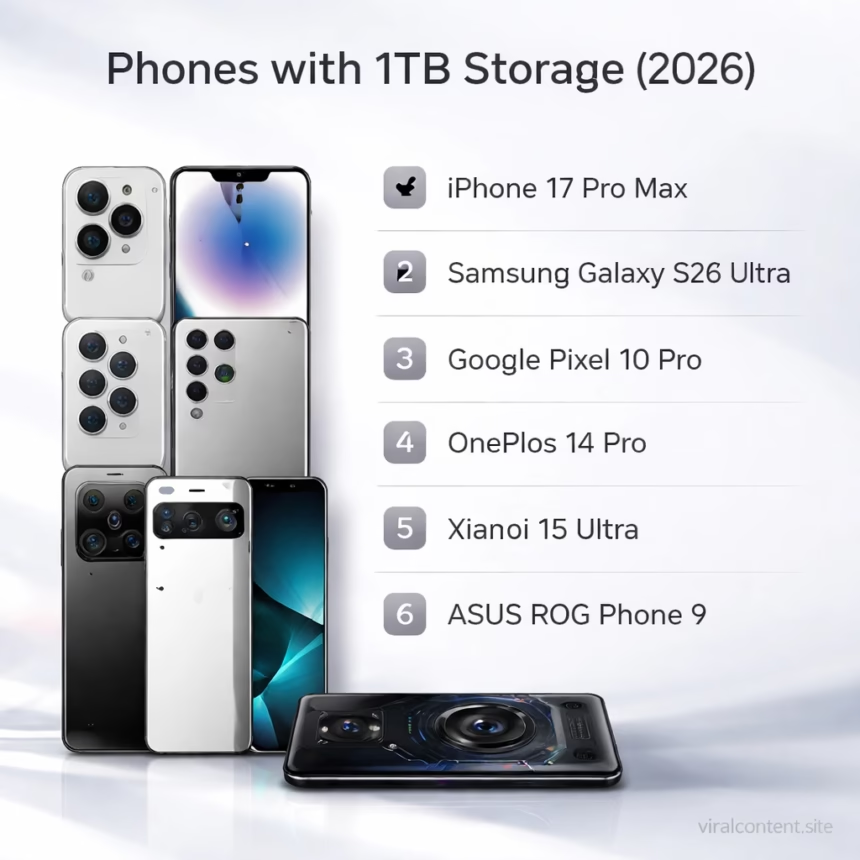
Storage Wars: Every Flagship Phone Expected to Pack 1TB by 2026
By 2026, the internal storage capacity of flagship smartphones is set to undergo a significant transformation. Industry analysts and supply chain forecasts indicate that 1TB of onboard storage will transition from a premium, niche offering to a standard expectation across most high-end mobile devices, fundamentally reshaping user experience and developer capabilities globally.
The Relentless March of Mobile Storage
The evolution of smartphone storage has been marked by exponential growth. Early smartphones, barely two decades ago, often shipped with a mere 16MB or 64MB of memory. The mid-2010s saw 32GB and 64GB become common, with 128GB marking the high-end. By the early 2020s, 256GB became the baseline for many premium devices, and 512GB emerged as a popular upgrade option.
The 1TB milestone first appeared in select, ultra-premium models around 2022, primarily catering to professional users, avid mobile gamers, and early adopters of 8K video recording. Devices like the Samsung Galaxy S22 Ultra and specific iPhone Pro Max variants pioneered this capacity, demonstrating the potential for vast local data retention.
This rapid expansion has been driven by several factors: increasingly sophisticated mobile operating systems, larger application sizes, the proliferation of high-resolution cameras, and the burgeoning demand for mobile gaming with console-quality graphics. Each new generation of smartphone hardware pushes these boundaries, with storage capacity consistently being a key battleground for innovation.
More Read

Key Developments Accelerating 1TB Adoption
Several converging technological and market trends are accelerating the widespread adoption of 1TB storage by 2026 across the mobile industry.
NAND Flash Technology Advancements
The underlying technology, NAND flash memory, continues its rapid advancement. Manufacturers like Samsung, SK Hynix, and Micron are consistently improving density, speed, and cost-efficiency. By 2026, the widespread deployment of Universal Flash Storage (UFS) 4.0 and potentially the early stages of UFS 5.0 will be critical. UFS 4.0, introduced in 2022, offers read speeds up to 4,200 MB/s and write speeds up to 2,800 MB/s. These speeds significantly enhance the user experience for managing large files and running demanding applications, making larger storage capacities not just feasible but practical.
More Read

Explosive Growth of Data-Intensive Content
The average file size for photos and videos continues to swell. With mainstream smartphone cameras now regularly featuring 108MP, 200MP, and even higher pixel counts, supporting advanced computational photography modes, individual image files can easily exceed 50MB. Furthermore, 4K video recording at 60fps is standard, and 8K video recording at 30fps or 60fps is becoming more common, consuming gigabytes of storage per minute.
Mobile gaming is another significant driver. Titles like “Genshin Impact,” “Call of Duty: Mobile,” and “PUBG Mobile” often require 20GB to 30GB or more of installation space, with frequent updates adding further bulk. As mobile chipsets approach console-level performance, game developers are creating increasingly immersive and graphically intensive experiences that demand substantial local storage.
On-Device AI and Edge Computing
The push for artificial intelligence (AI) to be processed directly on the device, rather than relying solely on cloud servers, is a growing trend. This “edge AI” requires significant local storage for AI models, datasets, and the results of complex computations. Features like advanced real-time language translation, sophisticated image and video editing, and personalized digital assistants will leverage these large local models, necessitating ample internal storage for optimal performance and privacy.
Decreasing Manufacturing Costs
As with most semiconductor technologies, the cost per gigabyte of NAND flash memory consistently declines over time due to manufacturing efficiencies, economies of scale, and increased competition. What was prohibitively expensive for mass market adoption a few years ago becomes economically viable for standard configurations. This cost reduction is a primary enabler for 1TB to become a mainstream offering by 2026.
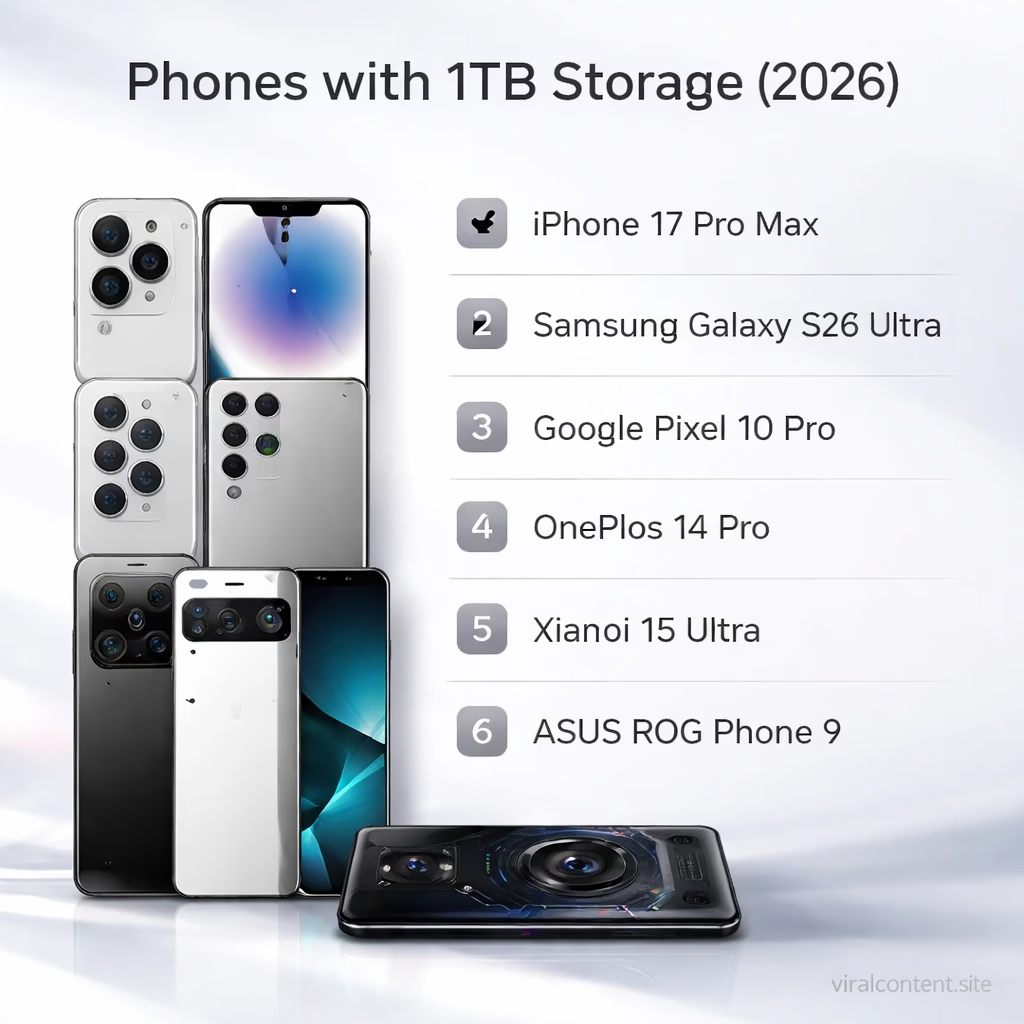
Expected Contenders: Phones with 1TB Storage in 2026
While a definitive list for 2026 remains speculative, current market trends and technological roadmaps point to several leading manufacturers and their flagship series adopting 1TB as a standard or readily available option:
Samsung Galaxy S Series (e.g., Galaxy S26 Ultra): A consistent leader in storage innovation, Samsung's Ultra models are prime candidates for a 1TB baseline.
Apple iPhone Pro Series (e.g., iPhone 18 Pro Max): Catering to professional content creators, Apple's Pro Max variants are expected to feature 1TB as a standard upgrade or even a base configuration.
Google Pixel Pro Series (e.g., Pixel 11 Pro): With an emphasis on on-device AI and advanced photography, 1TB will be crucial for Google's Pro lineup.
Xiaomi 16 Series / Ultra Models: Known for aggressive specifications, Xiaomi's top-tier flagships are strong contenders for 1TB, particularly in key Asian markets.
OnePlus Pro Series (e.g., OnePlus 14 Pro): Performance-focused, OnePlus devices will likely embrace 1TB for their power-user and gaming demographics.
Vivo X Series / Ultra Models: Vivo's camera-centric X series will require substantial storage for its high-resolution imaging and video capabilities.
Oppo Find X Series / Ultra Models: Oppo's premium Find X line is anticipated to integrate 1TB to support its advanced features and design.
ASUS ROG Phone Series (e.g., ROG Phone 10): As dedicated gaming phones, the ROG series consistently pushes storage boundaries, making 1TB a standard expectation.
Nubia RedMagic Series: Similar to ASUS ROG, RedMagic phones for hardcore mobile gamers will undoubtedly feature 1TB or higher.
More Read

Profound Impact Across the Mobile Ecosystem
The mainstreaming of 1TB storage will have far-reaching consequences for consumers, developers, and the broader mobile industry.
For Consumers: Unprecedented Freedom and Performance
Users will experience unparalleled freedom from storage anxiety. They can capture countless 8K videos, download entire seasons of high-definition shows for offline viewing, store vast music libraries, and install dozens of graphically intensive games without constantly managing space. This translates to a smoother, more reliable user experience, reducing the need for cloud offloading or frequent data transfers.
Local storage also guarantees faster access speeds compared to even the fastest cloud connections, crucial for editing large media files on the go or loading complex game environments instantly.
For Content Creators and Professionals: A Mobile Studio
For mobile photographers, videographers, and content creators, a 1TB phone transforms into a portable professional studio. They can record extended 8K footage, store multiple projects, and run demanding editing applications directly on their device without worrying about filling up space mid-shoot. This enables a more seamless and efficient workflow, blurring the lines between mobile and traditional creative workstations.
For Developers: Unleashing Innovation
App and game developers will be liberated from the constraints of optimizing for smaller storage footprints. This freedom allows for richer, more detailed game worlds, higher-fidelity textures, more comprehensive offline capabilities for applications, and larger on-device AI models. It opens doors for entirely new categories of mobile applications that were previously impractical due to storage limitations.
Industry-Wide Shift and New Baselines
The widespread adoption of 1TB will reset the baseline for “premium” in the smartphone market. While other features like camera quality, display technology, and processing power will remain crucial, generous storage will become a non-negotiable expectation for high-end devices. This shift will likely push 512GB into the upper-mid-range segment and 256GB into the mainstream mid-range, elevating the overall capabilities of smartphones across all price points.
What Comes Next: Beyond 1TB
The journey doesn't end at 1TB. As data consumption continues its upward trajectory, the industry is already looking ahead.
The 2TB Horizon
By the late 2020s, 2TB internal storage is expected to become the new frontier for ultra-premium smartphones. Prototypes and specialized memory modules are already in development, suggesting that 2TB could be a reality for top-tier flagships by 2027-2028. This will further cement the smartphone’s role as a primary computing and content creation device.
Integration with AI and Persistent Memory
Future advancements may see even tighter integration of storage with processing units, especially for AI accelerators. Concepts like persistent memory, which combines the speed of RAM with the non-volatility of storage, could revolutionize how data is handled on mobile devices, offering instantaneous boot-ups and seamless application switching. This could also pave the way for more sophisticated, always-on AI capabilities.
Continued Price Accessibility
As higher capacities become available, the cost of 1TB storage will continue to decrease, making it accessible to an even wider range of devices beyond just flagships. This democratization of vast storage will empower more users globally, further fueling the demand for mobile content and services.
The transition to 1TB as a standard in flagship phones by 2026 marks a pivotal moment in mobile technology. It underscores a fundamental shift in how we perceive and utilize our smartphones, transforming them into increasingly powerful, self-contained digital hubs capable of handling virtually any data demand thrown their way.