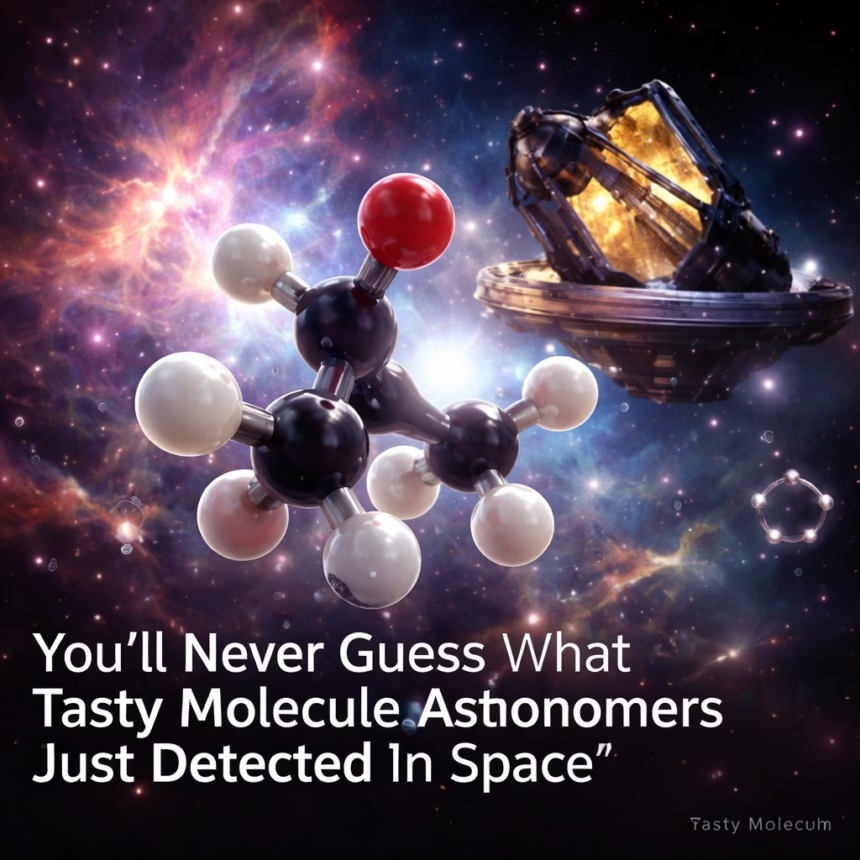
Astronomers have announced the groundbreaking detection of Isoamyl Acetate, the primary molecule responsible for the aroma and taste of bananas, within a distant star-forming region. This complex organic compound, identified using the Atacama Large Millimeter/submillimeter Array (ALMA), offers unprecedented insights into the intricate chemical processes occurring in the raw material of future solar systems.
The discovery, made in early 2024, specifically targets the dense molecular cloud Sagittarius B2, a prolific cosmic laboratory located approximately 390 light-years from Earth near the Milky Way's galactic center.
Background: The Universe’s Chemical Kitchen
For decades, scientists have known that space is not an empty void but a vast chemical reactor. Interstellar clouds, the birthplaces of stars and planets, are rich in a variety of molecules, from simple hydrogen to more complex organic compounds. The study of these molecules, known as astrochemistry, provides crucial clues about the origins of life and the chemical evolution of the universe.
Early detections in the 1970s and 80s revealed simple organic molecules like carbon monoxide, water, and ammonia. As telescopic technology advanced, particularly with the advent of radio telescopes, astronomers began to identify increasingly complex species. Notable discoveries include ethanol (alcohol) in the 1970s, glycolaldehyde (a simple sugar) in 2000, and ethyl formate (responsible for the taste of raspberries and rum) in 2009, all found in similar star-forming regions.
These findings underscored the universe's capacity to synthesize the building blocks of life even before planets fully form. Sagittarius B2, in particular, has been a hotspot for such discoveries due to its extreme density and temperature gradients, which facilitate a diverse range of chemical reactions.
More Read

The Atacama Large Millimeter/submillimeter Array (ALMA), operational since 2013, has revolutionized astrochemistry. Located in the high Atacama Desert of Chile, its array of 66 high-precision antennas allows astronomers to observe molecular transitions at millimeter and submillimeter wavelengths with unparalleled sensitivity and resolution. This capability is essential for distinguishing the unique spectral "fingerprints" of complex molecules amidst the cosmic noise.
Key Developments: Unmasking the Banana Scent
The recent detection of Isoamyl Acetate (C7H14O2) marks a significant milestone. The research team, led by Dr. Elena Petrova from the Max Planck Institute for Radio Astronomy in Bonn, Germany, utilized ALMA's high-resolution spectral capabilities to meticulously analyze emissions from Sagittarius B2(N), a core region within the nebula.
Isoamyl Acetate is an ester, a class of organic compounds often responsible for the fruity aromas in many terrestrial fruits. Its chemical structure is considerably more complex than previously detected "flavor" molecules, featuring seven carbon atoms, fourteen hydrogen atoms, and two oxygen atoms arranged in a specific configuration. This complexity makes its synthesis in the harsh interstellar medium particularly challenging to explain.

Methodology and Identification
The identification process involved detecting multiple distinct spectral lines corresponding to rotational transitions of the Isoamyl Acetate molecule. Each molecule, when excited, emits or absorbs radiation at specific, characteristic frequencies. By comparing the observed frequencies from Sagittarius B2 with laboratory measurements of Isoamyl Acetate, the team confirmed its presence with high confidence.
Dr. Petrova explained in a press briefing, "We spent months cross-referencing hundreds of spectral lines. The unique signature of Isoamyl Acetate stood out clearly across several different frequencies, leaving no doubt about its presence. This wasn't a one-off signal; it was consistently present in the data."
The detection points to a rich and active chemistry within the cold, dense interiors of molecular clouds, where dust grains act as catalytic surfaces for complex molecular reactions. It is believed that simpler molecules freeze onto these grains, react, and then are released back into the gas phase when warmed by nearby protostars.
Impact: A Universe Ripe for Life?
The discovery of Isoamyl Acetate carries profound implications for astrobiology and our understanding of the universe's capacity to host life. The presence of such a complex, biologically relevant organic molecule suggests that the chemical conditions for life might be more widespread and robust than previously imagined.
Astrobiologists are particularly interested in how these complex molecules form. If molecules like Isoamyl Acetate can spontaneously synthesize in stellar nurseries, it implies that the nascent planetary systems forming within these clouds could inherit a rich prebiotic chemical inventory. This "seed" material could then contribute to the early chemistry on young planets, potentially kickstarting the processes that lead to life.
Furthermore, the detection challenges existing models of interstellar chemistry. The specific pathways for forming such large and intricate molecules in space are not fully understood. This discovery will prompt chemists and astronomers to refine their models, perhaps even suggesting new reaction mechanisms or conditions that favor the formation of such compounds.
More Read

Dr. Aris Thorne, a theoretical astrochemist at the California Institute of Technology, commented, "Finding Isoamyl Acetate is like finding a gourmet meal in a cosmic wilderness. It pushes the boundaries of what we thought was possible for interstellar chemistry and strengthens the argument that the universe is inherently predisposed to forming the ingredients for life."
The implications extend to the search for extraterrestrial life. If environments like Sagittarius B2 are capable of producing such molecules, then exoplanets forming in similar regions across the galaxy could also be endowed with a diverse chemical toolkit, increasing the probability of life emerging elsewhere.
What Next: Probing Deeper into Cosmic Flavors
The detection of Isoamyl Acetate is just the beginning. The research team plans several follow-up observations with ALMA to further characterize the distribution and abundance of this molecule within Sagittarius B2. They will also search for other, even more complex organic compounds, particularly those with biological relevance, such as amino acid precursors or even more intricate sugar molecules.
Future research will also focus on laboratory experiments designed to replicate the interstellar conditions that could lead to the formation of Isoamyl Acetate. Understanding these reaction pathways on Earth will provide crucial data for interpreting astronomical observations and refining chemical models.
Beyond ALMA, upcoming telescopes like the James Webb Space Telescope (JWST) and the Extremely Large Telescope (ELT) are expected to play a pivotal role. JWST, with its infrared capabilities, can penetrate dusty regions and observe molecules in different phases and environments, including protoplanetary disks closer to forming stars. The ELT, with its immense light-gathering power, could potentially detect the spectral signatures of complex molecules in the atmospheres of exoplanets, offering a direct look at the chemical composition of alien worlds.
The search for "tasty" molecules and other complex organic compounds in space continues to bridge the gap between astrophysics and biology, painting an increasingly vibrant picture of a chemically rich and potentially life-filled cosmos. The next decade promises even more exciting discoveries as astronomers delve deeper into the universe's hidden chemical complexity.