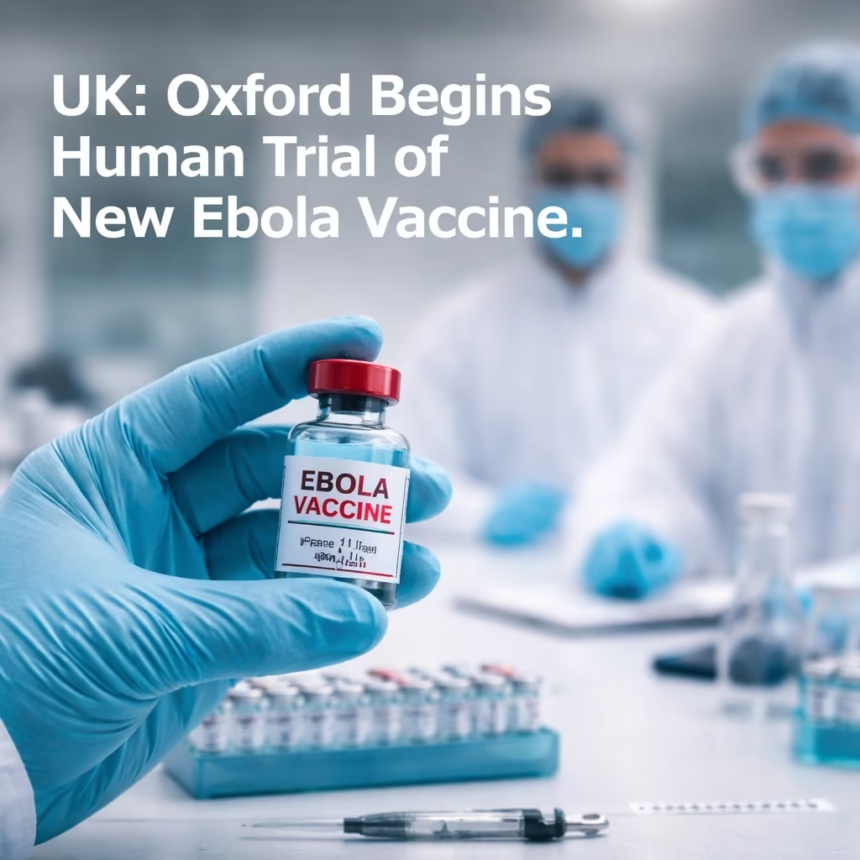
The University of Oxford's Jenner Institute and Oxford Vaccine Group have initiated a pioneering Phase 1 clinical trial for a novel Ebola vaccine, marking a significant step in global efforts to combat the deadly virus. This crucial study, conducted in Oxford, United Kingdom, commenced this week, enrolling its first cohort of healthy volunteers to assess the vaccine's safety and immune response.
Background: A Persistent Global Threat
Ebola virus disease (EVD) remains one of the most severe and fatal infectious diseases known to humanity. Caused by the Ebola virus, it is transmitted to humans from wild animals and spreads through human-to-human transmission via direct contact with the blood, secretions, organs, or other bodily fluids of infected people, and with surfaces and materials contaminated with these fluids. Symptoms typically include fever, severe headache, muscle pain, fatigue, and sudden onset of internal and external bleeding. The fatality rate can be as high as 90%, depending on the specific virus species and quality of healthcare.
The world first became acutely aware of Ebola's devastating potential during the 2014-2016 West African epidemic, which saw over 28,000 cases and more than 11,000 deaths across Guinea, Liberia, and Sierra Leone. This unprecedented outbreak highlighted critical gaps in global health preparedness and spurred accelerated research into vaccines and treatments. Subsequent outbreaks, particularly in the Democratic Republic of Congo (DRC), have underscored the ongoing need for robust preventative measures.
Prior to the current Oxford trial, significant progress has been made in vaccine development. The rVSV-ZEBOV vaccine, marketed as Ervebo, received regulatory approval from the European Medicines Agency (EMA) and the U.S. Food and Drug Administration (FDA) in late 2019, followed by WHO prequalification. Another two-dose regimen, Ad26.ZEBOV/MVA-BN-Filo (marketed as Zabdeno and Mvabea), also gained EMA approval. These vaccines have proven highly effective against the Zaire ebolavirus, the most common and deadliest species. However, the Ebola family comprises several species, including Sudan ebolavirus and Bundibugyo ebolavirus, for which approved vaccines are not yet widely available.
The new vaccine being trialed at Oxford, designated ChAdOx1 bi-valent, leverages the same viral vector platform used successfully for the Oxford/AstraZeneca COVID-19 vaccine. This ChAdOx1 platform, derived from a chimpanzee adenovirus, is known for its strong immune response generation and established safety profile, having been administered to hundreds of millions globally. Pre-clinical studies of this specific Ebola vaccine candidate have demonstrated promising results in animal models, showing strong immune responses against multiple ebolavirus species, paving the way for human trials.
More Read

Key Developments: The Current Trial
The Phase 1 clinical trial, named "EBOVAC-Oxford," is designed to evaluate the safety, tolerability, and immunogenicity of the ChAdOx1 bi-valent Ebola vaccine. A total of 26 healthy adult volunteers, aged between 18 and 50, have been recruited for this initial stage. Participants undergo a rigorous screening process to ensure their eligibility and overall health.
Upon enrollment, volunteers receive a single intramuscular dose of the vaccine. Following vaccination, they are closely monitored by a dedicated team of medical professionals at the Oxford Vaccine Group's clinical research facility. This monitoring includes regular health check-ups, blood tests, and detailed symptom diaries to track any potential side effects or adverse reactions. The primary objective is to determine the vaccine's safety profile, identifying any common or severe adverse events.
Beyond safety, the trial will also assess the vaccine's immunogenicity, meaning its ability to provoke an immune response. Blood samples collected at various time points post-vaccination will be analyzed for the presence and levels of antibodies specific to the Ebola virus. Researchers will look for the generation of both neutralizing antibodies, which can directly block the virus, and other immune markers indicative of a robust and protective response. A key advantage of this ChAdOx1 bi-valent candidate is its design to elicit protection against multiple ebolavirus species, including both Zaire and Sudan ebolaviruses, and potentially Marburg virus, addressing a critical gap in existing vaccine portfolios.
More Read

The EBOVAC-Oxford trial is a collaborative effort, benefiting from funding and support from various international bodies. The Coalition for Epidemic Preparedness Innovations (CEPI), a global partnership dedicated to accelerating vaccine development against emerging infectious diseases, has been a significant financial backer. Additional support comes from the UK government and the National Institute for Health and Care Research (NIHR), underscoring the international commitment to addressing the ongoing threat of Ebola.
Impact: A Broader Shield Against Ebola
The successful development and deployment of this new ChAdOx1 bi-valent Ebola vaccine could have a transformative impact on global public health, particularly in regions frequently affected by outbreaks. Current approved vaccines primarily target the Zaire ebolavirus, leaving populations vulnerable to other, albeit less common, species such as Sudan ebolavirus, which caused a significant outbreak in Uganda in 2022. A vaccine offering broader protection would provide a more comprehensive shield against the entire Ebola family.
Regions in Sub-Saharan Africa, including the Democratic Republic of Congo, Uganda, and Guinea, bear the brunt of Ebola outbreaks. These events not only claim lives but also cripple fragile healthcare systems, disrupt economies, and sow widespread fear and instability. The ability to proactively immunize at-risk populations with a broadly protective vaccine could significantly reduce the frequency and scale of future epidemics, saving countless lives and protecting livelihoods.
Furthermore, the ChAdOx1 platform offers potential logistical advantages. Vaccines developed using this platform often demonstrate good thermal stability, meaning they may not require ultra-cold storage facilities, which are scarce in many remote and resource-limited settings where outbreaks typically occur. This enhanced stability could simplify transportation, storage, and distribution, making mass vaccination campaigns more feasible and efficient in challenging environments. A single-dose regimen, if proven effective, would also streamline vaccination efforts compared to multi-dose schedules.
This new vaccine could complement existing strategies, moving beyond reactive ring vaccination – where contacts of infected individuals are vaccinated – towards more widespread, proactive immunization. This shift could help establish a stronger immunological barrier within communities, making it harder for the virus to gain a foothold and spread. Ultimately, a broadly effective and easily deployable vaccine is crucial for moving towards a future where Ebola outbreaks are rare, contained, and no longer pose a severe threat to public health.
More Read

What Next: Pathways to Global Availability
Following the completion of the Phase 1 EBOVAC-Oxford trial, researchers will meticulously analyze the collected data on safety and immunogenicity. If the results are positive and the vaccine demonstrates a favorable safety profile and robust immune response, the development will progress to subsequent phases.
The next critical step would be Phase 2 trials, likely to be conducted in countries where Ebola is endemic. These trials would involve a larger number of participants, including those in populations at higher risk of exposure, to further assess safety, optimal dosing, and preliminary efficacy. If Phase 2 results are promising, the vaccine would then advance to Phase 3 efficacy trials. These large-scale studies, typically involving thousands of participants, would directly evaluate the vaccine's ability to prevent Ebola infection in real-world settings.
The timeline for these subsequent phases can vary significantly, often spanning several years, depending on funding, regulatory approvals, and the occurrence of outbreaks suitable for efficacy assessment. Regulatory approval from major bodies like the European Medicines Agency (EMA), the U.S. Food and Drug Administration (FDA), and the World Health Organization (WHO) prequalification process would be essential for widespread adoption and distribution.
Beyond clinical trials, significant efforts would be required for manufacturing scale-up. Establishing robust production capabilities to meet global demand, especially for a vaccine targeting multiple ebolavirus species, would be a complex undertaking. Public health agencies and international organizations would then collaborate on distribution strategies, prioritizing at-risk populations and ensuring equitable access. The long-term vision is to integrate this new vaccine into routine immunization programs in high-risk regions, alongside existing public health measures and outbreak response protocols, with the ultimate goal of achieving comprehensive control, and potentially eradication, of Ebola virus disease.