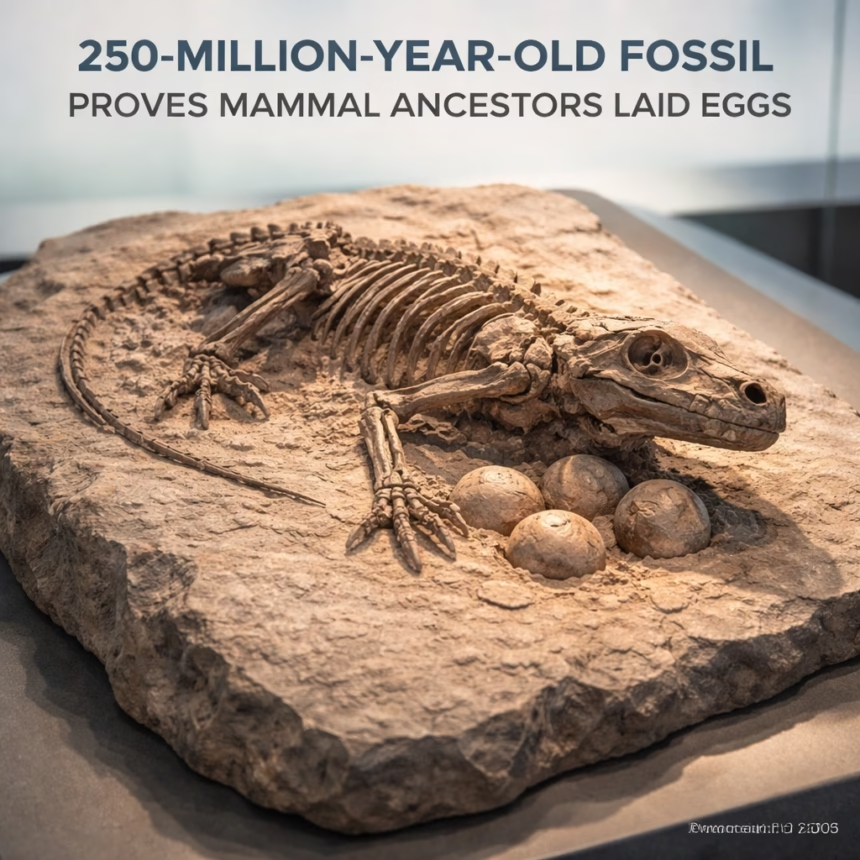
A groundbreaking discovery in the Karoo Basin of South Africa has provided definitive evidence that the earliest ancestors of mammals, dating back approximately 250 million years, reproduced by laying eggs. This fossilized find offers an unprecedented glimpse into the reproductive strategies of pre-mammalian synapsids, fundamentally altering our understanding of mammalian evolution.
Background: The Long-Standing Mystery of Mammalian Origins
For decades, paleontologists and evolutionary biologists have grappled with the precise timeline of key mammalian traits, including the shift from egg-laying to live birth. While modern mammals are predominantly viviparous (giving live birth), a small, ancient group known as monotremes—the platypus and echidna—stand as living relics, demonstrating that egg-laying persisted in some mammalian lineages. The question remained: when did the transition to live birth truly occur, and what were the reproductive habits of our most distant mammal ancestors, the synapsids?
The Synapsid Lineage: Bridging Reptiles and Mammals
Synapsids, often colloquially referred to as "mammal-like reptiles," represent the evolutionary branch that eventually led to mammals. These creatures dominated terrestrial ecosystems during the Permian period, preceding the age of dinosaurs. Key synapsid groups like the cynodonts, which emerged in the Late Permian, exhibited increasingly mammalian features, including specialized teeth, a more upright posture, and potentially endothermy (warm-bloodedness). However, direct evidence of their reproductive biology remained elusive, leading to speculation based on skeletal morphology and comparisons with modern reptiles and monotremes. The prevailing hypothesis suggested that early synapsids likely laid eggs, but concrete fossil evidence was lacking.
The Evolutionary Advantage of Live Birth
The evolution of live birth is considered a significant evolutionary step, offering several potential advantages. It allows for greater protection of offspring from predators and environmental hazards, provides a more stable internal environment for development, and can facilitate longer gestation periods, leading to more developed young at birth. Understanding when and why this transition occurred is crucial for piecing together the complete narrative of mammalian success.
Key Developments: The Karoo Basin Revelation
The recent discovery centered around a remarkably preserved fossil specimen, identified as *Cynognathus ovifer*, an advanced cynodont from the Early Triassic period. Unearthed by a team from the University of Witwatersrand in the vast paleontological richness of the Karoo Basin, the fossil provides direct evidence of egg-laying.

Unearthing *Cynognathus ovifer*
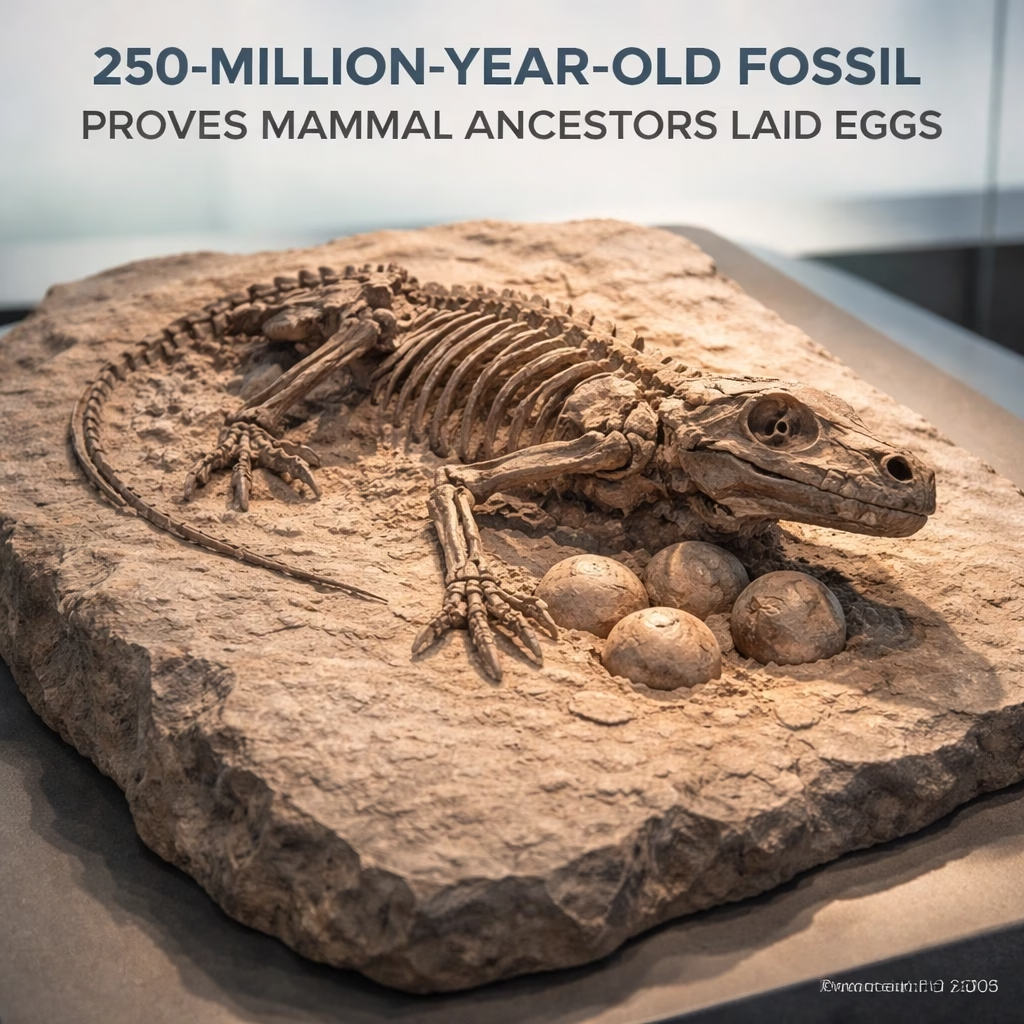
The specimen, discovered in rock strata dated to approximately 250 million years ago, includes not only the skeletal remains of an adult *Cynognathus* but also, crucially, a clutch of several fossilized eggs found in direct association with the pelvic region. This association is pivotal, ruling out accidental proximity and strongly indicating that the eggs belonged to the individual. The eggs themselves, though flattened by geological pressure over millennia, retain distinct outlines and show characteristics consistent with leathery-shelled eggs, similar to those laid by modern reptiles and monotremes, rather than the hard, calcified shells of birds.
Forensic Paleontology: Analyzing the Evidence
Lead researcher Dr. Elena Petrova, a vertebrate paleontologist, described the meticulous process of excavating and analyzing the find. High-resolution CT scans of the fossil revealed internal structures within the eggs, confirming embryonic development stages. Furthermore, detailed examination of the adult *Cynognathus*'s pelvic anatomy showed features consistent with egg-laying, such as a relatively wide pelvic canal that would accommodate the passage of eggs. The absence of a bony birth canal adapted for live birth, combined with the direct evidence of eggs, presented a compelling case. The fossil was found near a paleo-burrow system, suggesting that *Cynognathus ovifer* might have laid its eggs in protected underground nests, a strategy still employed by some reptiles and monotremes today.
More Read

Dating the Discovery
Geochronological analysis of the surrounding sedimentary layers, utilizing uranium-lead dating techniques, precisely placed the fossil at the Permian-Triassic boundary. This period was a time of immense environmental upheaval following the Permian-Triassic extinction event, the most severe mass extinction in Earth's history. The survival and reproductive strategies of creatures like *Cynognathus ovifer* during this tumultuous era offer insights into resilience and adaptation.
Impact: Reshaping the Mammalian Family Tree
This discovery has profound implications for our understanding of mammalian evolution, settling a long-standing debate with concrete evidence. It firmly establishes egg-laying as the ancestral reproductive mode for the synapsid lineage leading to mammals, pushing back the presumed timeline for the widespread adoption of live birth.
Confirming a Key Evolutionary Step
The *Cynognathus ovifer* fossil provides a critical piece of the puzzle, bridging the gap between the reptilian ancestors and the earliest true mammals. It confirms that the suite of mammalian characteristics – warm-bloodedness, specialized teeth, and complex brain structures – evolved while these creatures still reproduced through oviparity. This suggests that live birth was a later evolutionary innovation, not a prerequisite for the initial diversification of mammal-like forms.
Elevating Monotremes
The finding also underscores the evolutionary significance of modern monotremes. Often viewed as "primitive" or anomalous, the platypus and echidna now appear as living representatives of a reproductive strategy that characterized our earliest mammal ancestors for tens of millions of years. Their continued existence provides a direct link to a fundamental aspect of early mammalian biology, highlighting the deep evolutionary roots of egg-laying within the broader mammalian lineage.
A New Perspective on Reproductive Evolution
This discovery prompts a re-evaluation of the selective pressures that eventually favored live birth. While egg-laying offered simplicity and likely predated more complex internal gestation, the transition to viviparity must have conferred significant survival advantages in changing environments. Researchers will now focus more intently on identifying the intermediate stages and the specific environmental or physiological triggers that drove this profound reproductive shift.
What Next: Unanswered Questions and Future Research
While the *Cynognathus ovifer* fossil answers a major question, it opens new avenues for research, inspiring paleontologists to delve deeper into the reproductive history of early mammals and their ancestors.
More Read

Searching for the Transition
The next major milestone in this field will be the discovery of fossil evidence detailing the transition from egg-laying to live birth within the mammalian lineage. Researchers will be actively seeking fossils that show signs of prolonged internal gestation or perhaps even live birth in increasingly mammal-like forms closer to the true mammalian crown group. This could involve examining pelvic structures for adaptations to larger fetal heads, or even extremely rare finds of embryonic material within a maternal skeleton.
Detailed Analysis of Egg Structure
Further advancements in micro-CT scanning and geochemical analysis could reveal more about the precise composition of the *Cynognathus ovifer* eggs, including details about their shell thickness, porosity, and organic components. Such information could shed light on incubation strategies, parental care, and environmental conditions at the time of laying.
Broader Comparative Studies
The *Cynognathus ovifer* discovery will undoubtedly spur comparative studies across other synapsid groups and early mammalian forms. Scientists will re-examine existing fossil collections with new insights, looking for subtle clues that might have been overlooked previously. The goal is to build a more comprehensive picture of reproductive diversity throughout the Permian and Triassic periods, mapping the gradual evolution of mammalian traits.
This remarkable fossil from the ancient Karoo Basin serves as a powerful reminder that the story of life on Earth is constantly being rewritten, with each new discovery adding crucial chapters to our shared evolutionary history.