Global Alarm: China's Hypersonic Missile Test Rewrites Strategic Playbook
Global Alarm: China's Hypersonic Missile Test Rewrites Strategic Playbook
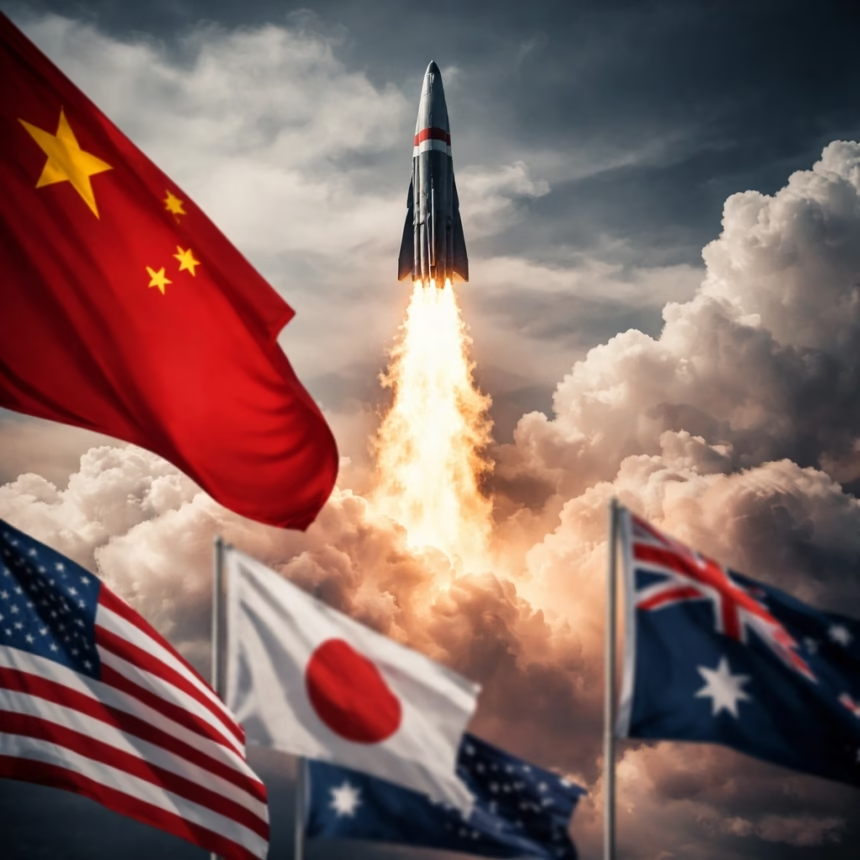
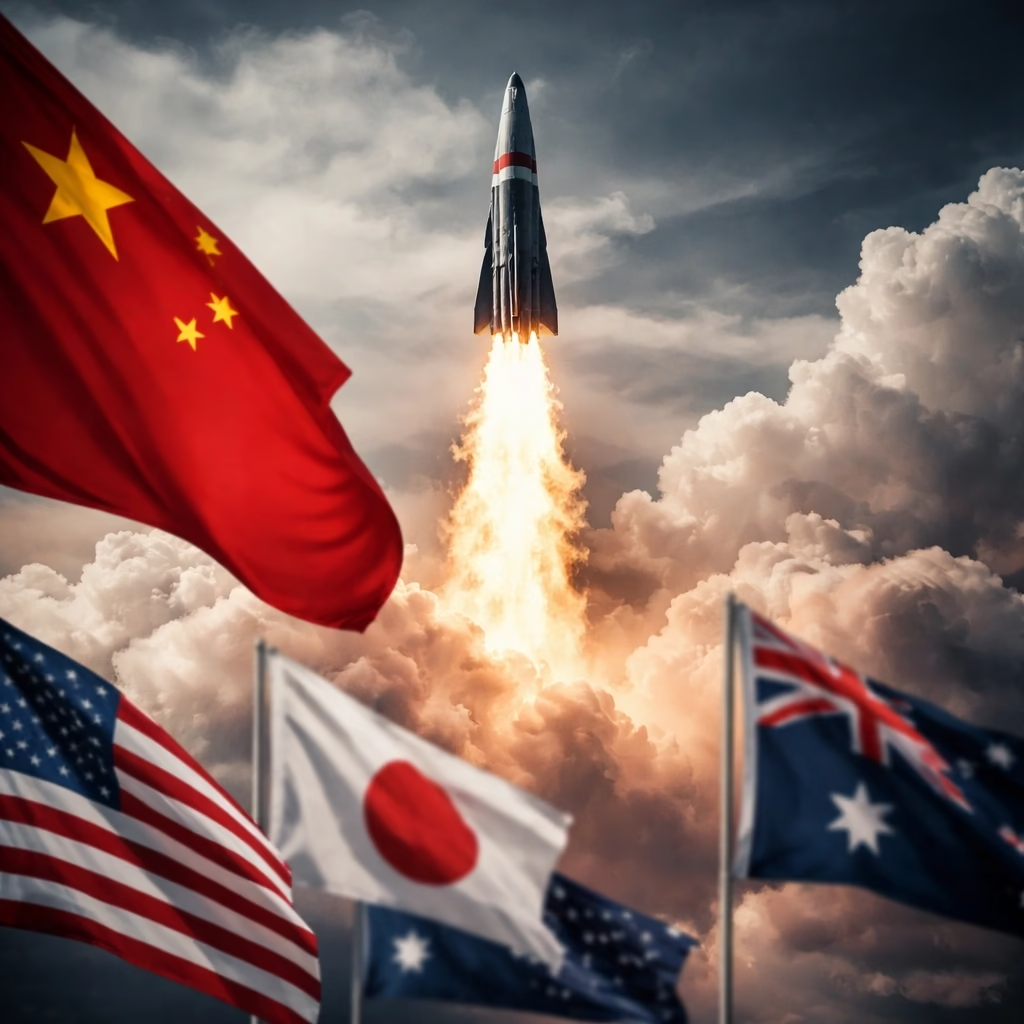
In the summer of 2021, China conducted a clandestine test of a nuclear-capable hypersonic glide vehicle, launching it into low-Earth orbit before it maneuvered and struck a target. This unprecedented demonstration of advanced military technology, revealed to the public in October 2021, immediately triggered significant alarm within the United States and its allies, prompting a reassessment of global strategic stability.
Background: The Evolving Arms Landscape
The development of advanced weaponry has historically been a cornerstone of geopolitical power dynamics. Following the Cold War, the United States enjoyed a period of unchallenged military supremacy, with its technological edge in areas like precision-guided munitions and stealth aircraft largely unmatched. However, this landscape has shifted dramatically over the past two decades.
China, under the leadership of President Xi Jinping, has embarked on an ambitious military modernization program, transforming the People's Liberation Army (PLA) into a formidable force. A key component of this strategy has been the development of "anti-access/area denial" (A2/AD) capabilities, designed to deter or prevent foreign military intervention, particularly from the U.S., in regions like the Western Pacific and the South China Sea. This includes a robust arsenal of ballistic missiles, such as the DF-21D "carrier killer" and the DF-26 "Guam killer," which pose significant threats to U.S. naval assets and regional bases.
More Read

Hypersonic technology represents the next frontier in this arms race. These weapons are defined by their ability to fly at speeds exceeding Mach 5 (five times the speed of sound), often along non-ballistic trajectories, making them exceptionally difficult for conventional missile defense systems to detect and intercept. Both the U.S. and Russia have been pursuing hypersonic capabilities for years, but China's rapid progress has caught many observers by surprise.
The Rise of Hypersonic Glide Vehicles (HGVs)
Unlike traditional ballistic missiles, which follow a predictable arc into space before re-entering the atmosphere, hypersonic glide vehicles are launched into the upper atmosphere or low-Earth orbit by a rocket. Once released, the HGV glides through the atmosphere at extreme speeds, capable of making sharp, unpredictable maneuvers. This combination of speed and agility allows them to evade existing missile defense radars and interceptors, which are designed to track and target less maneuverable, higher-flying threats.
More Read

Fractional Orbital Bombardment System (FOBS)
The August 2021 test was particularly alarming because it reportedly involved a Fractional Orbital Bombardment System (FOBS). A FOBS launches a warhead into low-Earth orbit, where it travels partially around the globe before de-orbiting and striking a target. This system offers a significant advantage: it can approach a target from any direction, bypassing traditional missile defense arrays that are typically oriented to detect threats from specific vectors. The Soviet Union first developed FOBS in the 1960s, but China’s integration of this concept with a hypersonic glide vehicle represents a new and potent capability.
Key Developments: The August 2021 Test and Its Aftermath
The specific details of China's August 2021 test, initially reported by the Financial Times in October, were stark. A Long March rocket launched a vehicle that orbited the Earth before deploying a hypersonic glide vehicle. This HGV then re-entered the atmosphere, demonstrated significant maneuverability, and eventually missed its target by approximately two dozen miles (38 kilometers). While the precision was not perfect, the successful demonstration of the technology itself was the critical factor.
U.S. Intelligence Assessment
U.S. intelligence officials were reportedly taken aback by the sophistication and speed of China’s hypersonic program. General Mark Milley, Chairman of the Joint Chiefs of Staff, publicly acknowledged the test, describing it as “very concerning” and comparing it to a “Sputnik moment” – a reference to the Soviet Union’s launch of the first artificial satellite in 1957, which shocked the U.S. and spurred its own space and missile programs. Pentagon officials expressed surprise not only at the successful test but also at the rapid pace of development, suggesting that China’s capabilities were more advanced than previously understood.
Allies’ Reactions
The alarm was not confined to Washington. Key U.S. allies in the Indo-Pacific and Europe also voiced significant concerns. UK Defense Secretary Ben Wallace stated that the test “raises global concerns about what it means for the future.” In Japan, Chief Cabinet Secretary Hirokazu Matsuno noted that China’s military advancements, including hypersonics, “raise serious concerns for regional and international security,” emphasizing the need for continued vigilance. Australia, a crucial U.S. partner, also echoed these sentiments, highlighting the broader implications for stability in the Indo-Pacific region.
China’s Response
Beijing swiftly denied that the August launch was a missile test. Chinese Foreign Ministry spokesperson Zhao Lijian asserted that it was a “routine test of space vehicle technology for the purpose of testing reusable technologies,” intended for peaceful purposes. He emphasized that the vehicle was not a missile and was designed for “cost reduction for space utilization.” This explanation, however, was widely dismissed by Western defense analysts and officials, who pointed to the military implications of such a system.
Impact: Reshaping Strategic Stability and Defense
The Chinese hypersonic test carries profound implications for global strategic stability, existing arms control frameworks, and the future of military deterrence. It has directly challenged the technological superiority long held by the U.S. and its allies, potentially ushering in a new era of strategic competition.

Erosion of Strategic Stability
The core of nuclear deterrence, famously known as Mutually Assured Destruction (MAD), relies on the ability of each side to absorb a first strike and retaliate with devastating force. Hypersonic weapons complicate this equation significantly. Their speed and maneuverability drastically reduce warning times and make them incredibly difficult to intercept, raising the specter of a successful first strike that could cripple an adversary’s retaliatory capabilities. This could lead to greater instability in a crisis, potentially incentivizing pre-emptive action rather than de-escalation.
Challenges to Missile Defense
Current U.S. missile defense systems, such as the Ground-based Midcourse Defense (GMD) system, are primarily designed to intercept intercontinental ballistic missiles (ICBMs) that follow predictable, high-altitude trajectories. Hypersonic glide vehicles, flying at lower altitudes and capable of evading maneuvers, render these existing defenses largely ineffective. This creates a critical vulnerability for the U.S. homeland and its forward-deployed forces and allies. Defending against HGVs would require entirely new sensor layers, including extensive space-based networks, and advanced interceptor technologies, representing a monumental technological and financial challenge.
Regional Security Implications
The test exacerbates security concerns in flashpoints like Taiwan and the South China Sea. A hypersonic capability could significantly enhance China’s ability to deter U.S. intervention in a conflict over Taiwan, potentially overwhelming U.S. naval assets and airbases in the region before they can respond effectively. For allies like Japan, South Korea, and Australia, the threat landscape becomes more complex, placing greater pressure on their own defense capabilities and their reliance on U.S. extended deterrence.
Acceleration of Arms Race
The successful Chinese test is expected to accelerate a global hypersonic arms race. While Russia already possesses some operational hypersonic systems (like the Avangard HGV and Kinzhal air-launched missile), China’s FOBS-HGV combination represents a distinct and potent threat. Other nations, including North Korea and Iran, are also reportedly pursuing hypersonic technologies. This proliferation could lead to a more dangerous and unpredictable world, where the risk of miscalculation and escalation is heightened.
What Next: Countermeasures and the Future of Arms Control
The U.S. and its allies are now grappling with how to respond to China's demonstrated hypersonic capabilities. The path forward involves a multi-pronged approach encompassing accelerated technological development, enhanced strategic partnerships, and renewed diplomatic efforts.
U.S. Countermeasures and Investment
The Pentagon has intensified its own research and development into hypersonic weapons, with programs like DARPA’s Hypersonic Air-breathing Weapon Concept (HAWC) and the Air Force’s AGM-183A Air-launched Rapid Response Weapon (ARRW). The focus is not only on developing offensive hypersonic capabilities but also on creating effective defensive systems. This includes investing in a new generation of missile defense, particularly space-based sensor constellations to track HGVs and advanced interceptors capable of countering their speed and maneuverability. This will require significant budgetary allocations and a rapid pace of innovation.
Strengthening Alliances and Deterrence
The U.S. is expected to further strengthen its alliances and partnerships in the Indo-Pacific. Initiatives like the Quad (U.S., Japan, Australia, India) and AUKUS (Australia, UK, U.S. security pact) are likely to play an even more critical role in pooling resources, sharing intelligence, and coordinating defense strategies against emerging threats. Enhanced military exercises and joint development programs will aim to bolster regional deterrence and reassure allies.
The Future of Arms Control
The emergence of hypersonic weapons has rendered many existing arms control treaties obsolete, as they do not specifically address these new technologies. There will be increasing calls for new international frameworks to manage the proliferation and deployment of hypersonics, potentially involving China and Russia. However, negotiating such agreements will be exceptionally challenging, given the strategic competition, the dual-use nature of some technologies (conventional vs. nuclear), and the inherent distrust among major powers. Diplomatic engagement with Beijing on strategic stability and risk reduction will be crucial, even if immediate breakthroughs on arms control are unlikely.
China's hypersonic missile test has undeniably reshaped the global strategic landscape, injecting a new level of urgency into the arms race and forcing a fundamental re-evaluation of defense doctrines. The coming years will likely witness a rapid evolution in military technology and a complex dance of deterrence and diplomacy as nations adapt to this new era of high-speed warfare.