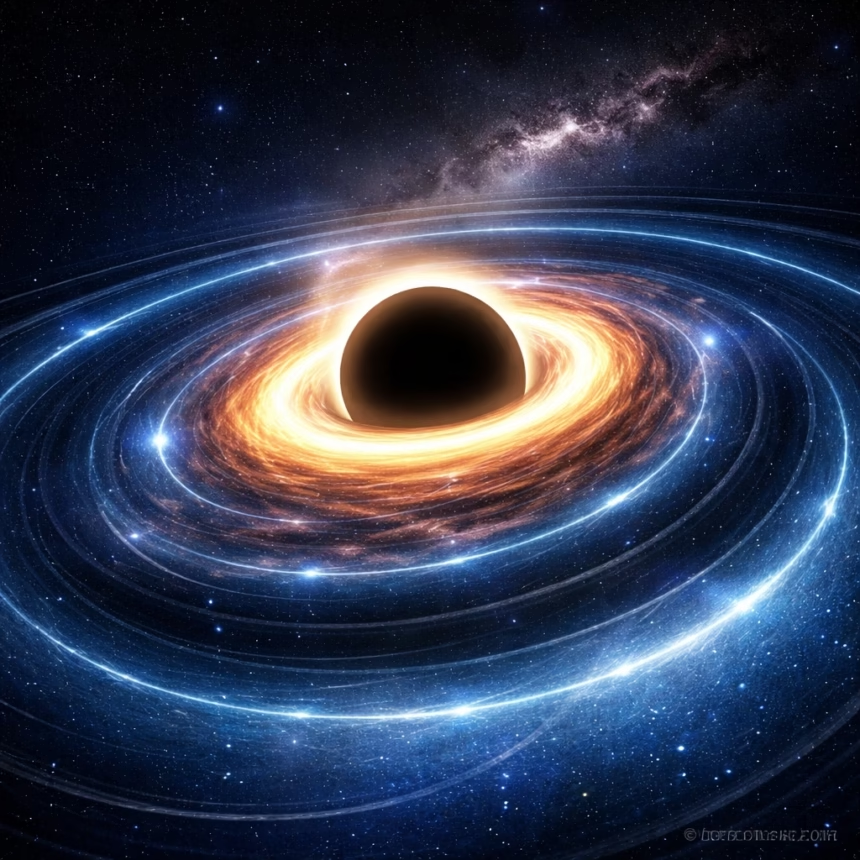
Recent breakthroughs in astrophysics, particularly from observatories across North America and Europe, are providing unprecedented insights into one of the universe's most enduring mysteries: the formation of supermassive black holes. Scientists are now analyzing subtle ripples in spacetime, known as gravitational waves, to piece together how these colossal cosmic entities grew to billions of times the mass of our Sun, especially in the early cosmos.
Background: The Enigma of Cosmic Monsters
Supermassive black holes (SMBHs) are gargantuan gravitational wells, millions to billions of times the mass of our Sun, residing at the hearts of most large galaxies, including our own Milky Way, which hosts Sagittarius A*. Their existence poses a profound puzzle: how did these behemoths form so rapidly in the relatively young universe?
Astronomers refer to this as the "seed problem." The universe's first stars, known as Population III stars, are thought to have been extremely massive, collapsing into stellar-mass black holes (tens to hundreds of solar masses) shortly after their birth. However, for these "seeds" to grow into supermassive black holes within the first billion years of the universe's existence, they would need to accrete matter and merge with other black holes at an astonishing rate.
Another leading theory suggests the formation of "Direct Collapse Black Holes" (DCBHs). In this scenario, pristine gas clouds in the early universe, lacking heavier elements, would have collapsed directly into black holes with masses ranging from thousands to hundreds of thousands of solar masses. These more massive seeds would then have a head start in their journey to supermassive status. Both theories have their strengths and weaknesses, and observational evidence has been scarce.
The concept of gravitational waves, disturbances in the fabric of spacetime, was first predicted by Albert Einstein's theory of General Relativity over a century ago. These waves are generated by the acceleration of massive objects, such as colliding black holes or neutron stars. It wasn't until 2015 that the Laser Interferometer Gravitational-Wave Observatory (LIGO) in the United States, in collaboration with Virgo in Italy, made the first direct detection of gravitational waves, stemming from the merger of two stellar-mass black holes. This landmark discovery opened a new window into the universe, allowing scientists to "hear" cosmic events previously invisible.
More Read

Key Developments: The Universe’s Low-Frequency Hum
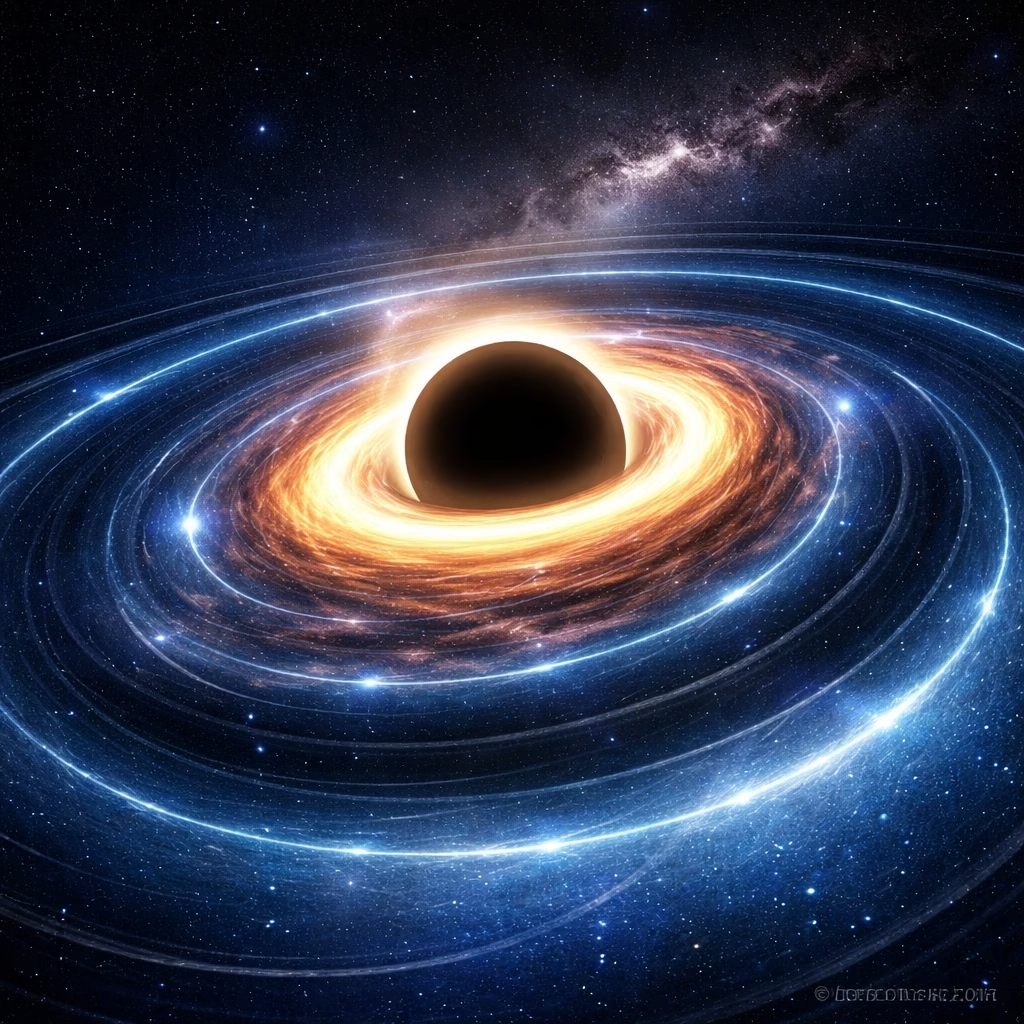
While LIGO and Virgo excel at detecting high-frequency gravitational waves from smaller, more violent mergers, the search for the gravitational waves emitted by supermassive black hole binaries requires a different approach. These colossal pairs, orbiting each other for millions of years before their eventual titanic collision, produce extremely low-frequency gravitational waves.
Pulsar Timing Arrays: Our Cosmic Clocks
This is where Pulsar Timing Arrays (PTAs) come into play. PTAs utilize an array of rapidly spinning neutron stars called pulsars, which emit incredibly precise radio pulses at regular intervals. These pulsars act as cosmic clocks, spread across our galaxy. As a low-frequency gravitational wave passes between Earth and a pulsar, it subtly stretches and compresses spacetime, causing tiny variations in the arrival times of the pulsar's radio signals. By monitoring dozens of these pulsars over decades, scientists can detect a collective "hum" – a gravitational wave background (GWB).
More Read

The Recent Breakthrough
In June 2023, a groundbreaking announcement came from multiple independent PTA collaborations worldwide: the North American Nanohertz Observatory for Gravitational Waves (NANOGrav), the European Pulsar Timing Array (EPTA), the Parkes Pulsar Timing Array (PPTA) in Australia, and the Chinese Pulsar Timing Array (CPTA). All four groups presented compelling evidence for the detection of a persistent, low-frequency gravitational wave background.
This isn't the detection of a single, isolated supermassive black hole merger. Instead, it's the statistical signature of potentially thousands, or even millions, of such binaries slowly spiraling towards each other across the universe. The observed signal matches theoretical predictions for the combined gravitational wave output from a vast population of supermassive black hole binaries, particularly those found in the cores of merging galaxies.
The implications are profound. This GWB provides robust evidence that supermassive black holes frequently engage in cosmic dances, merging as their host galaxies collide and coalesce. This continuous process of merging and accretion is now seen as a primary mechanism by which these cosmic giants reach their immense sizes. The characteristics of the detected background, such as its amplitude and spectral shape, offer crucial data points that favor certain models of SMBH formation and evolution over others.
While the current data strongly points to supermassive black hole mergers as the dominant source, scientists are also exploring other potential contributors to the GWB, such as cosmic strings or relics from the very early universe. However, the astrophysical origin from SMBH binaries remains the most favored explanation.
Impact: Reshaping Our Cosmic Narrative
The detection of the gravitational wave background marks a new era in astrophysics and cosmology, fundamentally altering our understanding of the universe's large-scale structure and evolution.
Galaxy Evolution
This discovery provides direct evidence for the hierarchical model of galaxy formation, where smaller galaxies merge to form larger ones. Each merger brings the central supermassive black holes closer, eventually forming a binary pair. The GWB confirms that these binaries are common and play a crucial role in the growth of SMBHs and, by extension, their host galaxies. It also offers a new way to study the dynamics of galactic mergers, which are otherwise challenging to observe directly over cosmic timescales.
More Read

Early Universe Conditions
By analyzing the properties of the GWB, scientists can gain insights into the conditions of the early universe. The existence and distribution of supermassive black holes in the early cosmos are intrinsically linked to the initial "seeds" and the mechanisms that allowed them to grow so rapidly. This data will help differentiate between the Direct Collapse Black Hole and Population III stellar remnant theories, potentially revealing which pathway was dominant in the universe's infancy.
Fundamental Physics
Gravitational wave astronomy also serves as a unique laboratory for testing Einstein's theory of General Relativity in extreme environments. Deviations from predicted gravitational wave signals could hint at new physics beyond our current understanding, such as the existence of extra dimensions or alternative theories of gravity. The precise measurements from PTAs will continue to constrain these theoretical models.
What Next: Peering Deeper into the Cosmic Roar
The initial detection of the gravitational wave background is just the beginning. The scientific community is already planning the next steps to refine these measurements and unlock further secrets.
Enhanced PTA Observations
Ongoing and future observations with PTAs will continue to accumulate data, improving the signal-to-noise ratio and allowing for more precise characterization of the GWB. As more pulsars are discovered and monitored, and observation times extend, scientists hope to eventually resolve individual supermassive black hole binaries within the background, pinpointing specific systems and studying their evolution in detail. This will require decades of continued monitoring from radio telescopes like Arecibo (though now defunct, its historical data is crucial), Green Bank Telescope, Effelsberg, and MeerKAT.
The LISA Mission
Looking further ahead, the European Space Agency's Laser Interferometer Space Antenna (LISA) mission, slated for launch in the early 2030s, promises to revolutionize the field. LISA will be a space-based observatory designed to directly detect the gravitational waves from individual supermassive black hole mergers. Unlike PTAs, which detect the long-term hum, LISA will "hear" the final, intense inspiral and merger of these behemoths, providing detailed information about their masses, spins, and the dynamics of their collisions. This will offer a complementary view to the PTA data, bridging the gap between the subtle background and individual catastrophic events.
Multi-Messenger Astronomy
The future of understanding supermassive black holes lies in multi-messenger astronomy. Combining gravitational wave data from PTAs and LISA with electromagnetic observations from powerful telescopes (like the Hubble Space Telescope, James Webb Space Telescope, and upcoming Vera C. Rubin Observatory) will provide a holistic view. Observing a supermassive black hole merger in both gravitational waves and light (e.g., X-rays, radio waves) would offer unprecedented insights into the physics of these extreme events, their environments, and their impact on galaxy evolution.
The universe's biggest black holes are slowly revealing their secrets, not through direct sight, but through the subtle, persistent whispers they imprint on the fabric of spacetime. As our technological capabilities advance, so too does our ability to listen, bringing us closer to understanding the grand cosmic symphony of creation and destruction.