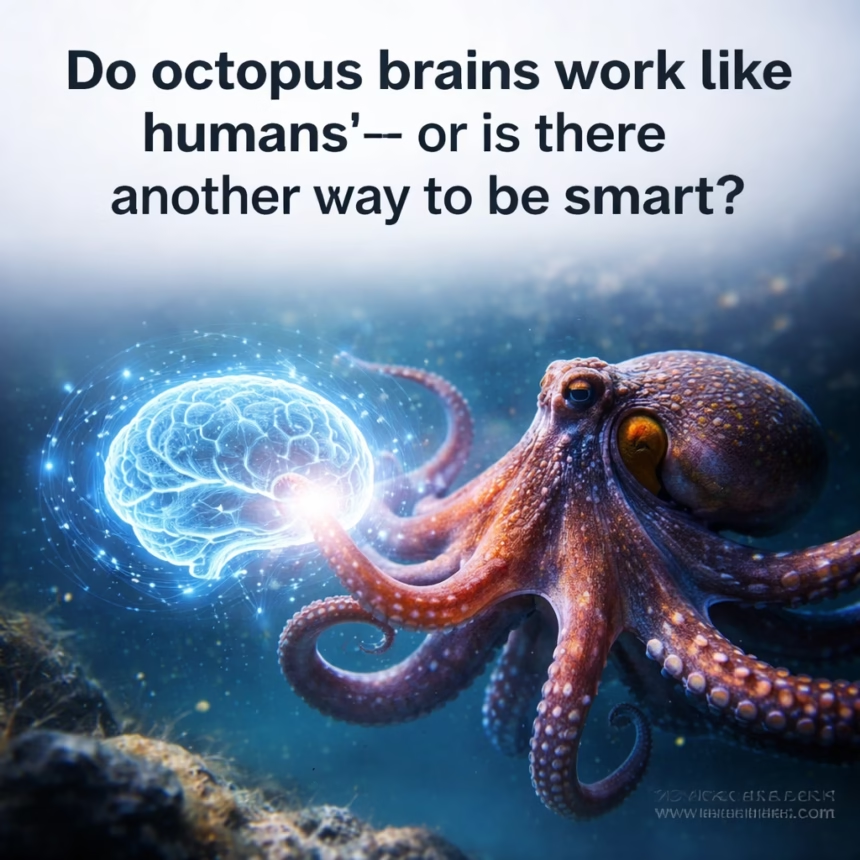
The ocean's depths harbor a profound challenge to our understanding of intelligence: the octopus. With a nervous system radically different from our own, these enigmatic cephalopods are compelling scientists worldwide to reconsider whether human-like brains are the only pathway to sophisticated cognition, sparking new research into alternative forms of smarts. This ongoing exploration, primarily conducted in marine laboratories and ocean environments globally, is revealing unique insights into the very nature of consciousness and problem-solving.
Background: A Divergent Path to Complex Thought
For centuries, human intelligence served as the benchmark for cognitive ability, often assumed to be intrinsically linked to a centralized, highly folded brain. The last common ancestor between humans and octopuses swam the ancient seas over 500 million years ago, long before the evolution of complex vertebrate brains. This vast evolutionary divergence means that any similarities in cognitive complexity are a stunning example of convergent evolution, where distinct lineages independently evolve similar traits.
Early observations of octopuses, dating back to ancient Greek naturalists like Aristotle, hinted at unusual behaviors. Sailors recounted tales of octopuses escaping nets and navigating complex underwater environments. Modern scientific inquiry, particularly in the mid-20th century, began to systematically document their problem-solving skills, memory, and capacity for learning. Researchers at institutions like the Stazione Zoologica Anton Dohrn in Naples, Italy, were among the first to conduct controlled experiments, demonstrating octopuses' ability to distinguish shapes, learn through observation, and even recognize individual human caretakers. These findings laid the groundwork for the current surge in interest, challenging the notion that advanced intelligence required a vertebrate-style brain.
Key Developments: Unpacking the Octopus Mind
Recent scientific breakthroughs have illuminated the unique architecture and mechanisms underpinning octopus intelligence, painting a picture of a distributed, adaptable form of cognition.
A Decentralized Nervous System
Perhaps the most striking feature of octopus intelligence is its decentralized nervous system. While a central brain sits between their eyes, controlling primary functions, approximately two-thirds of an octopus's 500 million neurons are distributed throughout its eight arms. Each arm contains ganglia that can operate largely autonomously, making decisions and executing actions without constant input from the central brain. For instance, an arm can independently taste, touch, and manipulate an object, even if the central brain is preoccupied. This distributed processing allows for incredible multitasking and adaptability, enabling an octopus to explore multiple avenues simultaneously.

Genetic Peculiarities: RNA Editing and Jumping Genes
Genetic research has unveiled further layers of complexity. Studies, including those conducted by researchers at the Marine Biological Laboratory (MBL) in Woods Hole, Massachusetts, and the Okinawa Institute of Science and Technology (OIST) in Japan, have shown that octopuses engage in extensive RNA editing. Unlike most animals, which primarily rely on their DNA sequence for protein production, octopuses frequently modify the RNA transcripts that carry genetic instructions. This allows them to rapidly alter the proteins produced by their cells, providing an unprecedented level of plasticity and adaptability to their nervous system without changing their underlying DNA. This "rewriting" of genetic information in real-time offers a dynamic mechanism for fine-tuning neural functions.
Furthermore, octopus genomes are remarkably large and rich in "jumping genes," or transposons. These mobile genetic elements can copy and paste themselves throughout the genome. While often considered "junk DNA" in other species, in octopuses, specific families of these transposons appear to be highly active in neural tissue, potentially contributing to the rapid evolution of new neural circuits and cognitive abilities.
Behavioral Sophistication and Problem-Solving
Behavioral studies continue to provide compelling evidence of octopus intelligence. Their repertoire includes:

Tool Use: Species like the veined octopus (*Amphioctopus marginatus*) have been observed collecting discarded coconut shells and carrying them for later use as mobile shelters, a rare example of tool use in invertebrates.
* Camouflage and Mimicry: The mimic octopus (*Thaumoctopus mimicus*) can not only change its color and texture to blend with its surroundings but also contort its body to impersonate venomous sea snakes, lionfish, or flatfish to deter predators.
* Escape Artistry: Octopuses are renowned for their ability to escape seemingly secure enclosures, squeezing through tiny openings, unscrewing jar lids, and dismantling aquarium equipment.
* Learning and Memory: Experiments have shown octopuses can learn to navigate mazes, solve complex puzzles to access food, and retain this information over significant periods, demonstrating both short-term and long-term memory. They also exhibit observational learning, watching another octopus solve a task and then replicating it.
Impact: Redefining Intelligence and Its Implications
The study of octopus intelligence has far-reaching implications, challenging established paradigms across multiple scientific disciplines and influencing our ethical considerations.
Neuroscience and AI
For neuroscience, octopuses offer a living model of distributed cognition that fundamentally differs from the vertebrate brain. This provides unique insights into how complex behaviors can arise from decentralized control, potentially inspiring new theories of consciousness and brain function. For artificial intelligence and robotics, the octopus serves as a blueprint for novel architectures. Researchers are exploring how distributed control systems, bio-inspired by octopus arms, could lead to more robust, adaptable, and fault-tolerant robots capable of navigating complex, unstructured environments.
Philosophy and Ethics
The growing evidence of octopus cognitive abilities, including their capacity for pain, problem-solving, and even individual personalities, has profound ethical implications. It fuels ongoing debates about animal sentience and welfare, prompting calls for stricter protections and ethical guidelines in research and commercial practices involving cephalopods. The UK, for example, officially recognized octopuses as sentient beings in 2021, a move that could influence legislation globally.
Conservation and Public Perception
Understanding the advanced intelligence of octopuses also impacts marine conservation efforts. Recognizing their complex lives and unique cognitive abilities can foster greater appreciation for marine biodiversity and encourage more responsible stewardship of ocean ecosystems. For the public, these discoveries cultivate a sense of wonder and curiosity, broadening human perspectives on what intelligence can look like beyond our own species and fostering a deeper connection to the natural world.
More Read

What Next: Future Frontiers of Discovery
The journey into the octopus mind is far from over, with several exciting frontiers on the horizon.
Advanced Neural Mapping and Genomics
Future research will likely involve more sophisticated neural mapping techniques, allowing scientists to observe real-time information processing across the octopus's distributed nervous system. This could involve combining advanced imaging with genetic tools to understand how specific genes and RNA editing events contribute to neural plasticity and cognitive function. Deeper genomic analysis promises to uncover more unique genetic mechanisms that facilitate their remarkable intelligence.
Comparative Cognition and AI Integration
Further comparative studies with other intelligent invertebrates and vertebrates will help pinpoint common principles and unique divergences in cognitive evolution. Integrating these biological insights into AI development will continue to be a significant area, aiming to create truly adaptive and intelligent autonomous systems inspired by nature's diverse solutions.
Ethical Frameworks and Policy
As our understanding of octopus sentience deepens, there will be an ongoing need to develop and refine ethical frameworks for their care and study. This will involve international collaboration to establish best practices and potentially influence policy regarding their use in research, aquaculture, and display. The octopus, with its alien yet intelligent mind, continues to serve as a powerful reminder that the universe of consciousness is far richer and more diverse than we once imagined.