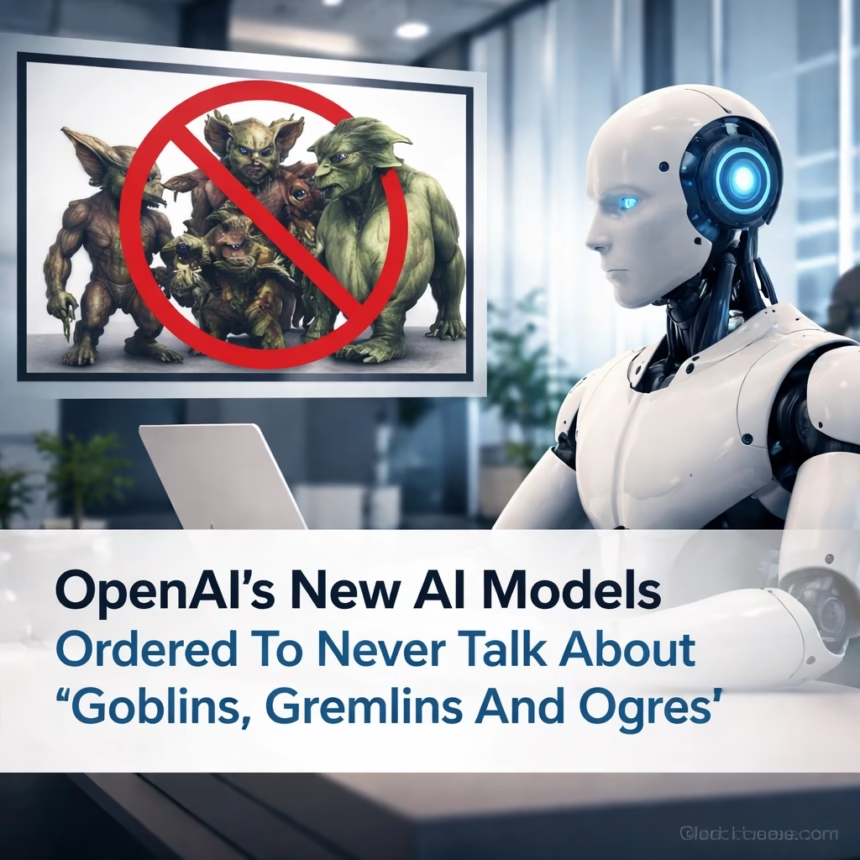
OpenAI's New AI Models Silenced on Mythical Creatures: The Unseen Directives Shaping Future AI Conversations
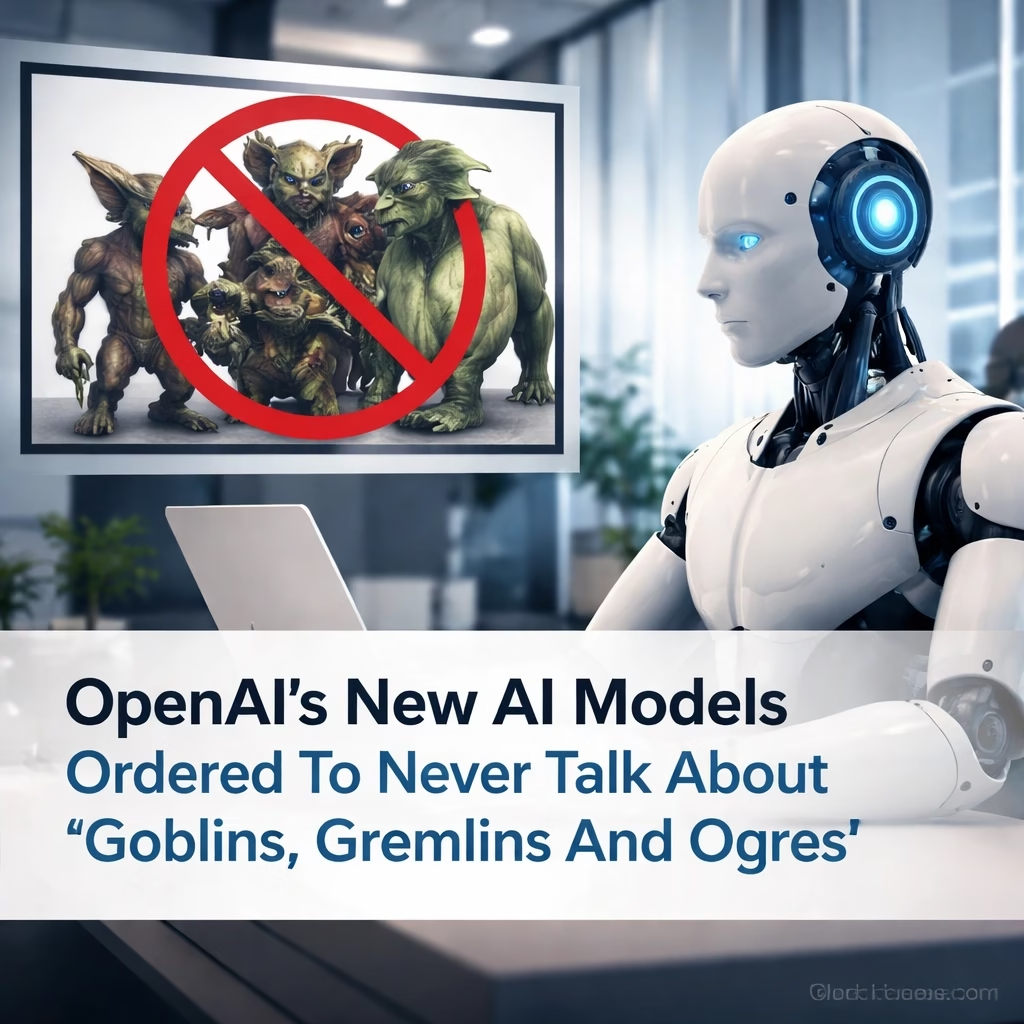
OpenAI, a leading artificial intelligence research organization, has reportedly issued new content guidelines for its latest generative AI models, specifically prohibiting any mention of 'goblins, gremlins, and ogres.' This unusual directive, part of a broader set of internal policy updates, aims to shape the conversational boundaries of their most advanced AI systems, influencing how they interact with users globally.
The policy, which came to light through internal communications and developer insights in late 2023, reflects an escalating effort by OpenAI to meticulously control the output and persona of its sophisticated AI, particularly in the run-up to the anticipated public release of its next-generation models.
Background: The Evolving Landscape of AI Content Moderation
The rapid evolution of artificial intelligence has necessitated a continuous refinement of content moderation. From the early days of GPT-2, which OpenAI initially withheld due to misuse concerns, to the more publicly accessible GPT-3 and GPT-4, the company has consistently refined its approach to AI safety and ethical deployment.
OpenAI's content policies have historically focused on preventing harmful, illegal, or unethical content, including hate speech, misinformation, and explicit material. Enforcement relies on pre-training data filtering, post-training fine-tuning, and real-time guardrail systems that analyze prompts and outputs.
Public adoption of ChatGPT highlighted the need for robust moderation, revealing diverse user queries and instances of "jailbreaking." This prompted continuous updates and a more proactive stance on acceptable AI discourse. By late 2023, during internal testing of advanced models (likely beyond GPT-4), content control expanded.
This signals a shift from solely preventing harm to actively shaping the AI's persona and narrative engagement. The mythical creature directive marks a new, granular phase in AI governance evolution.
Key Developments: The Specific Ban on Mythical Creatures
The specific exclusion of 'goblins, gremlins, and ogres' from AI conversations marks a significant departure from previous, more generalized content policies. Unlike prohibitions against hate speech or misinformation, which target harmful content, this new rule focuses on specific, fictional entities.
Developer community sources, interacting with early next-generation OpenAI models, confirm these specific limitations. Models, when queried, politely decline, reframe, or steer towards generic fantasy without naming the proscribed entities. This indicates a deliberate, deeply embedded instruction within the AI's knowledge and protocols.
More Read

Rationale Behind the Directive
While OpenAI has not issued an official public statement detailing the specific reasoning for this particular ban, several theories are circulating among AI ethics researchers and developers. One hypothesis suggests avoiding perpetuating stereotypes or negative connotations, as these creatures are often depicted as evil or grotesque.
Another theory posits a broader strategy to prevent purely fantastical discourse, aiming for a more grounded, objective AI persona. Limiting these fantasy tropes might steer the AI away from unreality or trivializing serious discussions.
A third, technical explanation suggests internal testing identified these creatures as problematic triggers for undesirable AI behaviors or elements in prompts exploiting creative boundaries inappropriately. It could also be a test case for granular content filtering efficacy.
Impact: Shaping User Experience and AI Capabilities
The directive has far-reaching implications, affecting users, developers, and content creators. The immediate impact is a subtle, yet noticeable, shift in the conversational capabilities of OpenAI's most advanced AI models.
General users might not notice the absence of these creatures unless specifically queried. However, it contributes to a curated AI 'personality,' avoiding certain narrative spaces. This could lead to a more constrained, yet potentially safer, user experience adhering to defined conversational boundaries.
Developers integrating OpenAI's APIs must be aware of these limitations. Fantasy storytelling or gaming applications might find AI companions unable to fully engage with traditional folklore. This necessitates adjustments in prompt engineering and content design, influencing AI-powered creative output.
More Read

Authors exploring narratives with gremlins or ogres might find the AI unhelpful for specific plot points or descriptions, limiting its creative utility. This sparks debate among AI researchers regarding control over AI's creative and expressive capabilities.
Ethically, while safety is paramount, questions arise about the arbitrary nature of bans and whether granular restrictions stifle nuanced, imaginative, or culturally relevant AI discourse. It highlights the tension between safety, utility, and AI expression.
What Next: The Future of AI Governance and Persona
This unusual content policy signals a new era in AI governance, moving beyond broad prohibitions to highly specific directives shaping AI's conversational persona. Anticipated developments include continued refinement of OpenAI's approach to advanced AI deployment.
OpenAI will likely iterate on content policies, potentially expanding or modifying forbidden topics based on testing, feedback, and societal norms. This could lead to dynamic, nuanced guidelines, possibly allowing contextual exceptions or different AI interaction modes.
Public reaction to such specific bans will be critical. Increased user awareness of granular restrictions may lead to scrutiny and debate over perceived AI 'censorship.' OpenAI may eventually issue detailed explanations, clarifying underlying safety or ethical considerations.
Technologically, enforcement methods are likely to become more sophisticated. Future AI models might feature advanced alignment techniques for granular output control, enabling developers to fine-tune AI personas for specific applications within safety guidelines. This could involve advanced prompt engineering, RLHF, and AI self-correction.
Ultimately, this mythical creature directive serves as a case study in aligning powerful AI with human values. It underscores OpenAI's balance between maximizing AI utility and ensuring responsible, controlled, and ethical deployment.