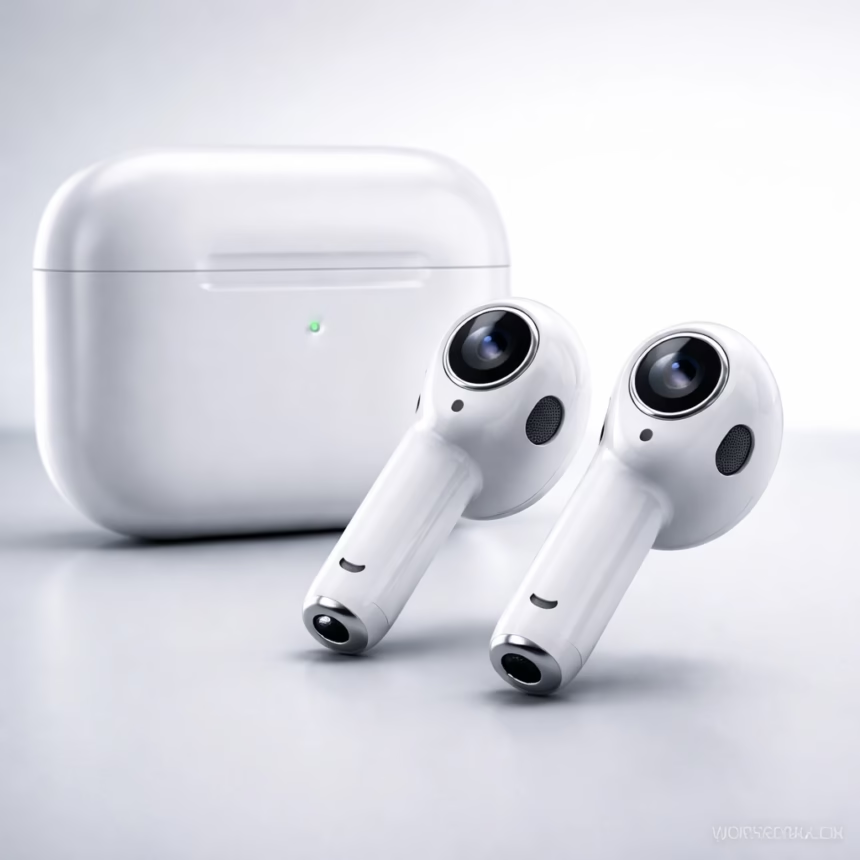
Apple's Visionary Leap: Camera-Equipped AirPods Poised to See the World, Fueling Next-Gen AI
Reports from industry insiders and supply chain analysts suggest Apple is nearing production of a revolutionary new iteration of its popular AirPods, featuring integrated cameras designed to enhance on-device artificial intelligence capabilities. This strategic move, originating from Apple's secretive R&D labs in Cupertino, California, could redefine the wearable technology landscape as early as late 2025 or 2026, marking a significant expansion of the company's ecosystem beyond audio.
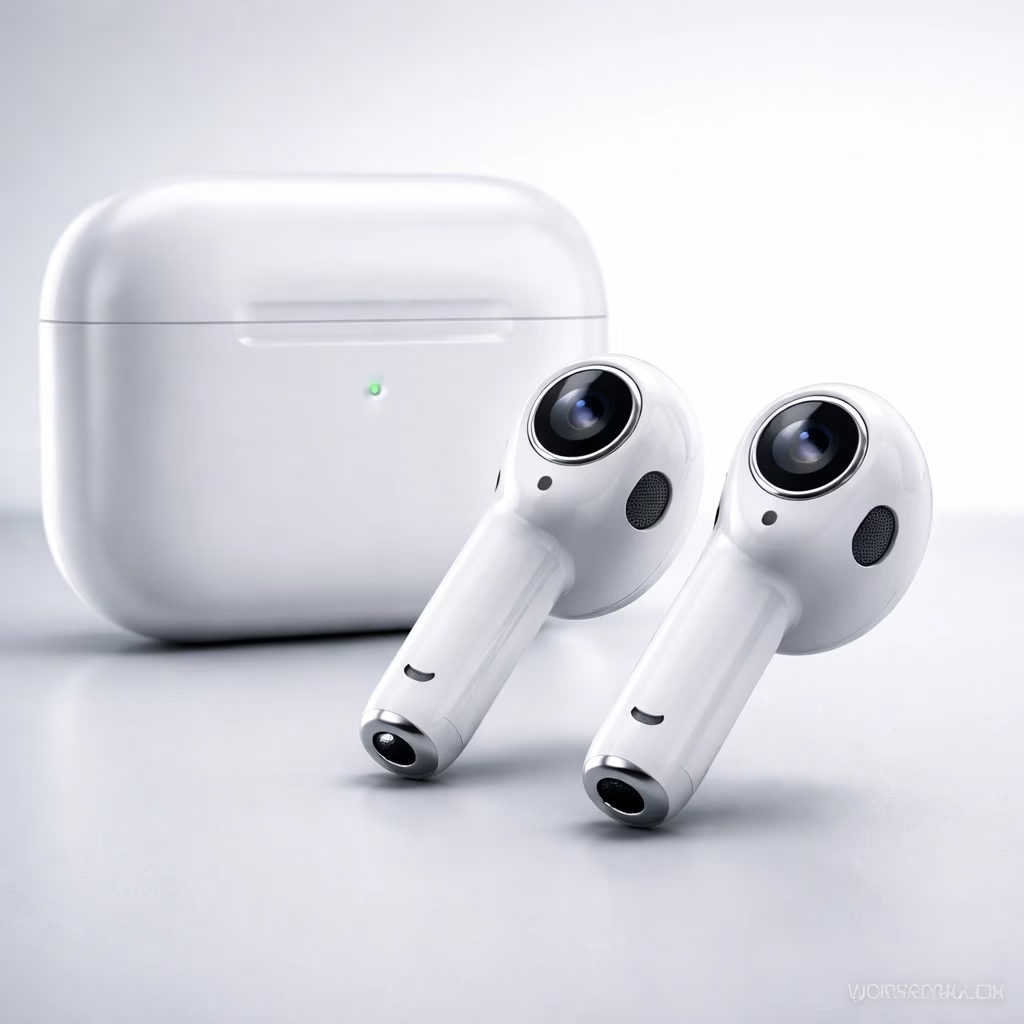
Background: The Evolution of Smart Wearables and Apple’s AI Push
The journey of Apple's AirPods began in December 2016, quickly establishing themselves as the benchmark for wireless earbuds. Initially focused on seamless audio and connectivity, subsequent generations introduced active noise cancellation with AirPods Pro in 2019, followed by spatial audio and advanced health sensors, such as those rumored for future models, hinting at a broader health and wellness strategy. This consistent evolution underscores Apple's ambition to transform AirPods from mere audio devices into sophisticated personal assistants, capable of much more than just sound delivery.
Apple's long-standing interest in artificial intelligence has been evident across its product lines, from Siri on iPhones to advanced machine learning capabilities in macOS and watchOS. CEO Tim Cook has repeatedly emphasized the company's commitment to AI, particularly on-device processing for enhanced privacy and speed. The introduction of powerful Neural Engines in Apple Silicon chips, starting with the A11 Bionic in 2017, laid the groundwork for complex AI tasks to be handled locally, reducing reliance on cloud computing and bolstering user data security.
More Read

The concept of wearable cameras is not entirely new to the tech industry. Early attempts like Google Glass in 2013 and Snapchat Spectacles in 2016 offered glimpses into the potential of vision-enabled wearables. However, these products faced significant challenges related to social acceptance, privacy concerns, battery life, and limited practical applications. Apple, known for its meticulous approach to product development and user experience, is expected to address these historical hurdles with a more integrated and purpose-driven design, focusing on utility and seamless integration.
Patents and Precursors: A Glimpse into Apple’s Vision
For years, Apple has filed numerous patents detailing various concepts for integrating cameras and advanced sensors into earbuds and other small form-factor devices. These filings have explored ideas ranging from basic image capture to environmental sensing, depth mapping, and even biometric authentication through eye tracking. While patents do not guarantee product release, they offer valuable insight into the company’s long-term research and development interests. The recent launch of Apple Vision Pro and its visionOS operating system further solidifies Apple’s commitment to spatial computing and understanding the user’s environment, providing a compelling software framework for camera-equipped AirPods to leverage visual data for enhanced interaction.
Key Developments: Nearing Production and Technical Innovations
Recent reports from credible sources like Bloomberg's Mark Gurman and analysts within the Asian supply chain indicate that Apple has significantly progressed beyond the conceptual stage. Prototypes are reportedly undergoing advanced testing in secure facilities, and key suppliers are being engaged for the mass production of specialized components. This acceleration suggests that the company has overcome several critical engineering challenges that previously hindered the integration of cameras into such a compact and discreet form factor, pushing the technology closer to commercial viability.
More Read

Technical Hurdles and Solutions
Integrating cameras into AirPods presents formidable technical challenges. Miniaturization is paramount; the camera modules must be incredibly small to fit within the earbud’s existing design constraints without compromising comfort or aesthetics. Battery life is another major concern, as image processing and continuous AI inference demand significant power. Apple is likely leveraging its expertise in custom chip design, potentially integrating a highly efficient, dedicated AI co-processor within each AirPod to handle visual data without excessively draining power or generating excessive heat, a common issue in compact electronics.
The type of camera integrated is also a subject of speculation. It’s unlikely to be a high-resolution sensor suitable for traditional photography. Instead, analysts predict small, low-power sensors optimized for specific AI tasks: ambient light sensing, object recognition, gesture detection, or even basic environmental mapping. These sensors would feed data to the on-device Neural Engine, enabling context-aware AI interactions, such as identifying objects the user is looking at, reading text, or providing real-time audio feedback based on visual cues, all without requiring a dedicated display.
Privacy-First On-Device AI Processing
A central tenet of Apple’s strategy for these camera-equipped AirPods is expected to be on-device AI processing. By performing most, if not all, of the visual data analysis directly on the AirPods themselves, Apple can significantly mitigate privacy concerns. This approach minimizes the amount of raw visual data transmitted to the cloud or even to a connected iPhone, ensuring that sensitive information remains localized and under the user’s control. This aligns with Apple’s broader privacy framework, differentiating it from earlier wearable camera attempts that often relied heavily on cloud-based processing, which raised more questions about data security and ownership.
Impact: Reshaping User Interaction and the Wearable Market
The introduction of camera-equipped AirPods could profoundly impact how users interact with technology and the world around them. Imagine a scenario where your AirPods can identify a foreign language sign and translate it audibly in real-time, or guide you through a complex museum exhibit by recognizing artworks you gaze upon. This fusion of audio and visual input, processed by sophisticated AI, promises to create a truly hands-free, context-aware computing experience, moving beyond the current limitations of voice-only assistants and offering a more intuitive way to access information.
Transforming Daily Life and Accessibility
For everyday consumers, this technology could unlock new levels of convenience and information access. From navigating unfamiliar environments with augmented audio directions based on visual cues to receiving discreet notifications about objects in their field of view, the potential applications are vast. Furthermore, for individuals with visual impairments, these AirPods could serve as a powerful accessibility tool, providing real-time descriptions of their surroundings, identifying obstacles, or reading text aloud, significantly enhancing their independence and quality of life by offering a discreet, personal guide.
Developers will gain access to new APIs and frameworks, allowing them to create innovative applications that leverage visual input from the AirPods. This could spur a new wave of augmented reality experiences that blend digital information with the physical world, delivered through spatial audio rather than a visual display, creating a unique and less intrusive form of AR. Industries from healthcare (e.g., monitoring patient environments) to education (e.g., interactive learning) and retail (e.g., product information overlay) could find novel uses for such a discreet, always-on, vision-enabled wearable.
More Read

Navigating Privacy and Social Acceptance
Despite Apple’s emphasis on on-device processing, the mere presence of cameras on a ubiquitous wearable device will inevitably raise significant privacy concerns. The company will face the challenge of educating consumers and regulators about its privacy safeguards, ensuring transparency regarding data handling, and designing clear visual indicators (e.g., a small LED light) to signal when cameras are active. Social acceptance will be critical; Apple will need to demonstrate the clear utility and benefit of these devices to overcome potential skepticism and fears of pervasive surveillance, a hurdle that previous wearable camera products struggled to clear.
Competitors like Samsung, Google, and Amazon, who are also heavily invested in wearables and AI, will undoubtedly feel pressure to accelerate their own vision-enabled wearable strategies. The market for smart earbuds is already fiercely competitive, and Apple’s move could set a new standard, forcing others to innovate rapidly to keep pace. This could lead to a broader industry shift towards more context-aware and visually informed wearable technology, fundamentally changing how we interact with our digital and physical worlds.
What Next: Anticipated Milestones and Future Outlook
As Apple reportedly moves closer to production, several key milestones are anticipated on the path to a potential public launch. Further leaks from supply chain partners are likely to emerge, providing more specific details about the camera specifications, internal components, and potential design elements, offering a clearer picture of the final product. Patent filings may also become more explicit, offering deeper insights into the user interface and intended applications, revealing how Apple envisions users interacting with this new capability.
A significant indicator could come during Apple's annual Worldwide Developers Conference (WWDC). While a full product announcement might be premature, the company could unveil new developer frameworks or updates to visionOS that hint at future capabilities for vision-enabled wearables. This would allow developers to begin conceptualizing and building applications in anticipation of the hardware's release, creating a robust ecosystem from day one.
Industry analysts project a possible launch window in late 2025 or 2026, aligning with Apple's typical product cycles for major new categories. The initial market reception will be closely watched, particularly regarding how consumers embrace a camera-equipped audio device and how Apple addresses the inevitable privacy discussions that will arise. Should these AirPods succeed, they could establish a new category of "perceptual computing," where wearables not only hear but also see and understand the user's immediate environment, ushering in a new era of truly intelligent personal assistants that offer a deeper, more integrated connection to the world.