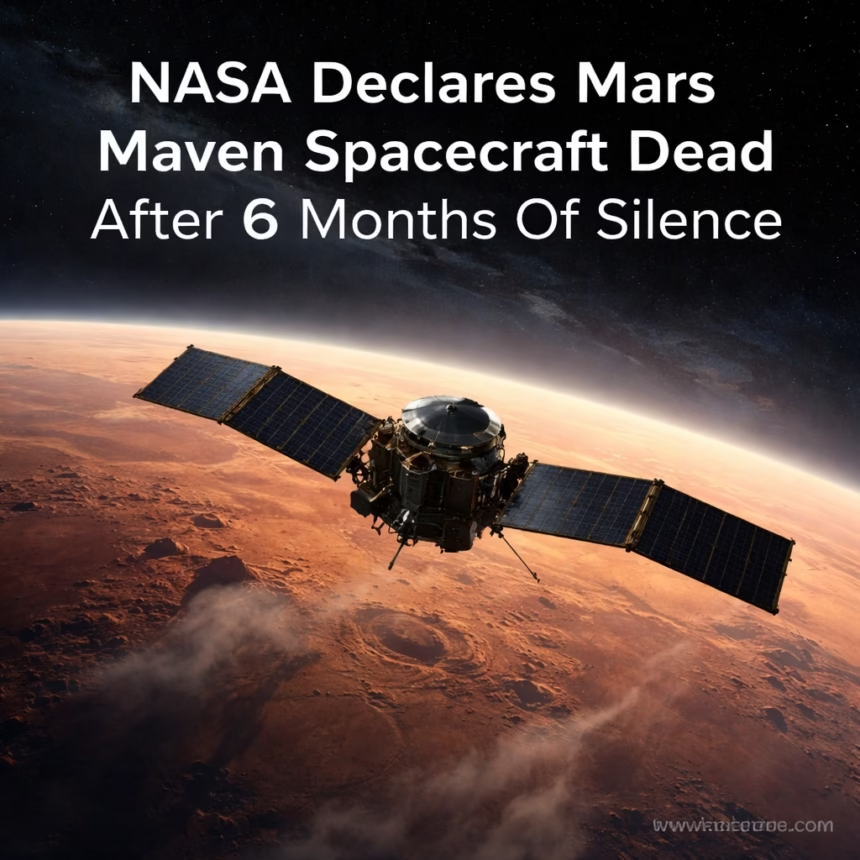
NASA has officially declared its Mars Atmosphere and Volatile Evolution (MAVEN) spacecraft defunct, concluding a nearly decade-long mission dedicated to understanding the Martian atmosphere. The announcement follows six months of unsuccessful attempts to re-establish communication with the orbiter, which had been a critical asset in the study of Mars' climate evolution and a vital relay for surface missions. The decision marks the end of an era for a mission that profoundly reshaped our understanding of the Red Planet.
Background: Unveiling Mars’ Ancient Past
The MAVEN mission was conceived to address a fundamental question about Mars: how did a planet once believed to harbor liquid water and a thicker atmosphere transform into the cold, arid world we observe today? Launched on November 18, 2013, aboard an Atlas V rocket from Cape Canaveral Air Force Station, Florida, the spacecraft embarked on a 10-month journey to Mars. It successfully entered orbit around the Red Planet on September 21, 2014, commencing its primary science mission shortly thereafter.
A Pioneer in Atmospheric Science
MAVEN's suite of eight scientific instruments was designed to investigate the planet's upper atmosphere, ionosphere, and interactions with the solar wind. Key instruments included the Solar Energetic Particle (SEP) instrument, the Imaging Ultraviolet Spectrograph (IUVS), the Neutral Gas and Ion Mass Spectrometer (NGIMS), and the Magnetometer (MAG). These tools allowed scientists to directly measure the rate at which Mars' atmosphere was being stripped away by solar radiation and solar wind, providing crucial insights into the planet's dramatic climate change over billions of years.
The orbiter's initial mission was planned for one Earth year, but its exceptional performance and valuable data led to multiple extensions. Over its operational lifetime, MAVEN far exceeded its design life, continuing to provide invaluable data long after its initial objectives were met. It became a cornerstone of NASA's Mars exploration program, working in tandem with other orbiters and surface rovers.
Key Discoveries and Contributions
MAVEN's scientific contributions have been transformative. The mission confirmed that the stripping of Mars' atmosphere by the solar wind was a primary driver of its transformation from a potentially habitable world to a barren desert. It observed global auroras, studied the effects of solar flares and coronal mass ejections on the Martian atmosphere, and provided unprecedented details about the escape of water and carbon dioxide. These findings have been instrumental in understanding planetary habitability and the evolution of atmospheres across the solar system. Beyond its scientific pursuits, MAVEN also played a crucial role as a communications relay satellite for NASA's Curiosity and Perseverance rovers on the Martian surface, transmitting vital data back to Earth.
More Read

Key Developments: The Silent Vigil
The first indications of trouble emerged approximately six months ago when MAVEN unexpectedly ceased communicating with Earth. Mission controllers at NASA's Goddard Space Flight Center in Greenbelt, Maryland, and Lockheed Martin Space in Littleton, Colorado, initiated a rigorous campaign to restore contact.
Unanswered Calls
Engineers and scientists launched an intensive effort, using the Deep Space Network (DSN) to send commands and listen for any faint signals from the spacecraft. Attempts included transmitting various commands to prompt MAVEN to reorient its antennas, reset its systems, or switch to backup components. The DSN, with its massive antennas located in California, Spain, and Australia, is the world's most sensitive radio communication system for deep space missions, yet even its capabilities proved insufficient to elicit a response.
The silence was particularly concerning given MAVEN's robust design and its history of reliable operation. While the exact cause of the anomaly remains unknown, engineers speculate that it could be related to a power system failure, a critical hardware malfunction, or an issue with its communication transponders. Over six months, without the ability to charge its batteries or receive commands, the spacecraft likely entered a deep-sleep state, or its systems suffered irreparable damage from the harsh space environment. The prolonged silence, coupled with the diminishing probability of recovery, ultimately led to the difficult decision to declare the mission concluded.
More Read

Impact: A Gap in Mars’ Orbiting Network
The loss of MAVEN represents a significant void in the international fleet of spacecraft orbiting Mars. Its demise impacts not only ongoing scientific research but also the operational capabilities of other critical missions.
Scientific Implications
For the scientific community, the cessation of MAVEN's operations means the loss of a unique platform for studying the Martian upper atmosphere and its interaction with the space environment. While other orbiters provide valuable data, none possess the exact instrument suite or orbital parameters tailored to MAVEN's specific atmospheric science objectives. Scientists will now rely on historical MAVEN data and observations from other missions to continue their research into Mars' atmospheric evolution. The insights gained from MAVEN's decade of data will continue to be analyzed for years to come, providing a rich legacy of knowledge.
Filling the Void: Relay Network Adjustments
Perhaps the most immediate operational impact is on the communication relay network for NASA's Mars rovers. MAVEN, alongside the Mars Reconnaissance Orbiter (MRO) and the European Space Agency's (ESA) Trace Gas Orbiter (TGO), served as a crucial data link for Curiosity and Perseverance. These orbiters download data from the rovers and transmit it back to Earth, a process far more efficient than direct-to-Earth communication from the surface.
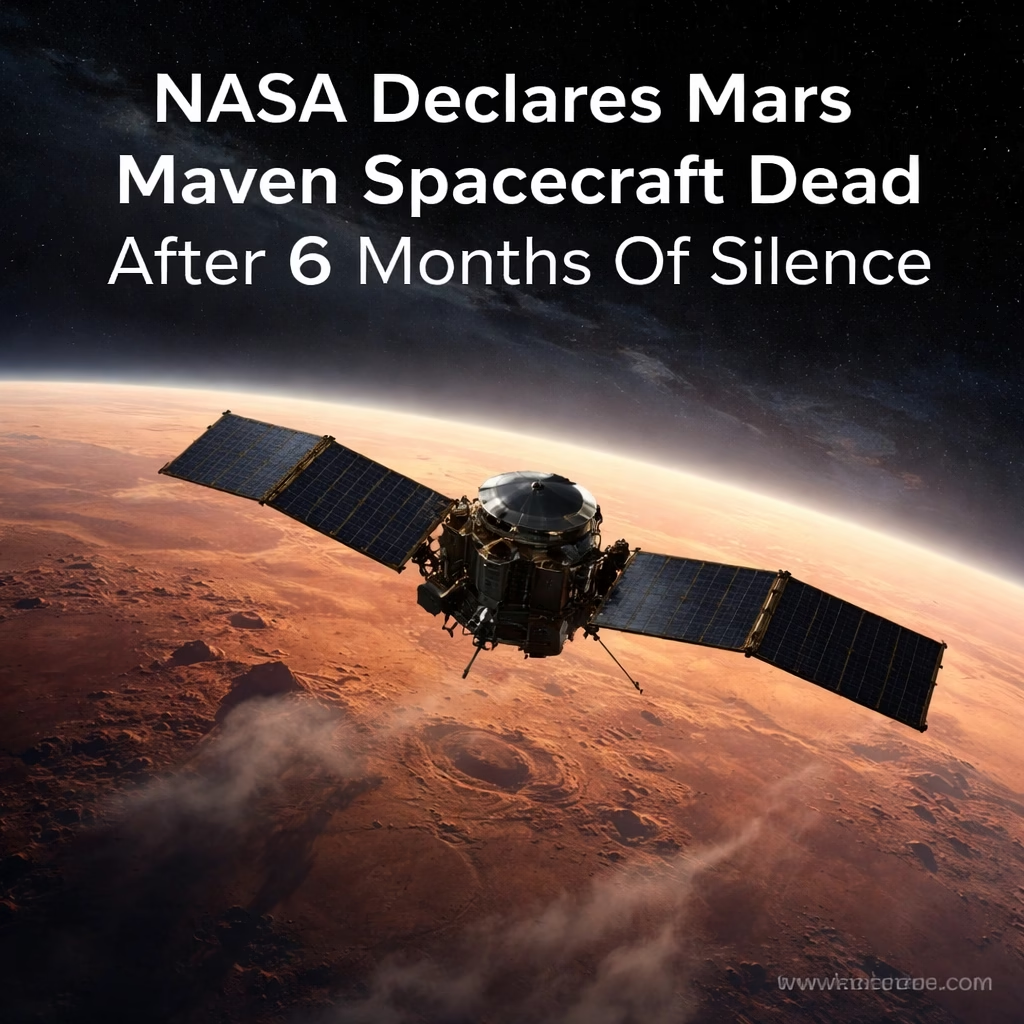
With MAVEN no longer operational, the remaining orbiters, primarily MRO and TGO, will need to shoulder an increased workload. While these assets are robust and capable, the loss of redundancy could potentially lead to minor adjustments in data transmission schedules or a slight reduction in overall data throughput from the rovers. NASA and ESA mission planners are already implementing strategies to optimize the use of the remaining relay assets to ensure continuous support for the surface missions.
What Next: Maven’s Enduring Legacy
While MAVEN's operational phase has concluded, its scientific legacy will endure for decades. The vast trove of data it collected has fundamentally altered our understanding of Mars' past and future habitability.
More Read

Continued Data Analysis and Future Missions
Scientists worldwide will continue to pore over the petabytes of data MAVEN transmitted during its operational lifetime. This data will inform future missions, helping engineers design spacecraft better equipped to withstand the Martian environment and scientists formulate new hypotheses about planetary evolution. The insights gained from MAVEN are already being incorporated into the planning for future Mars exploration, including potential human missions, which require a deeper understanding of the Martian environment.
A Silent Sentinel
The MAVEN spacecraft itself will remain in orbit around Mars, a silent testament to human ingenuity and perseverance. Its orbital path is carefully designed to eventually decay and safely burn up in the Martian atmosphere, preventing it from becoming space debris that could endanger future missions. This ensures that MAVEN's final act, though passive, continues to contribute to the long-term sustainability of Mars exploration.
MAVEN's journey, from its ambitious launch to its silent farewell, underscores the challenges and triumphs of deep space exploration. Its mission may be over, but its profound impact on our understanding of Mars and planetary science will continue to resonate for generations. The lessons learned from MAVEN will undoubtedly pave the way for the next generation of explorers seeking to unravel the mysteries of our solar system.