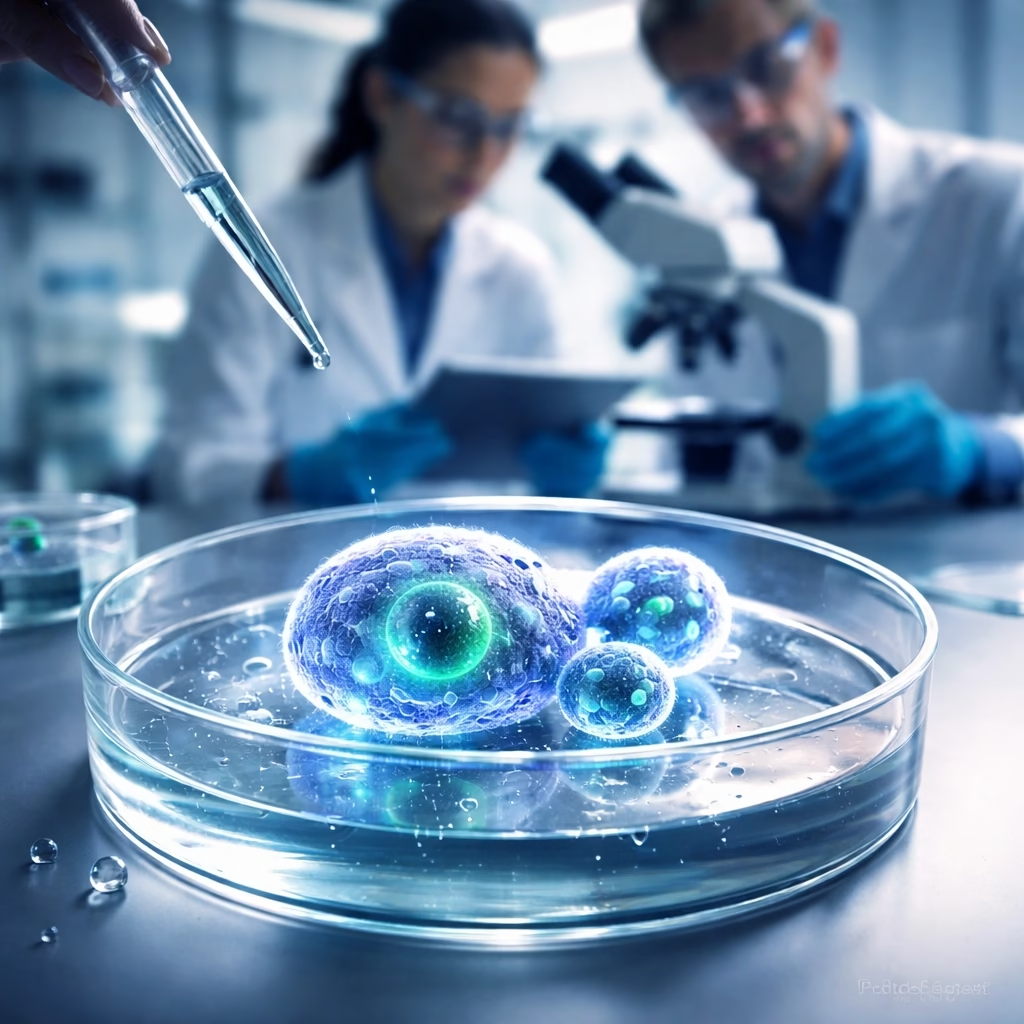
In a groundbreaking development that redefines the boundaries of biology, an international team of scientists has successfully engineered synthetic cells capable of autonomous feeding, growth, division, and evolution. Announced this week in a major scientific journal, this achievement, spearheaded by researchers at the Wyss Institute at Harvard University and ETH Zurich, marks a pivotal moment in the quest to understand and harness the fundamental processes of life.
A Decade of Synthetic Biology: From Code to Complexity
The field of synthetic biology, dedicated to designing and building new biological parts, devices, and systems, has seen rapid advancements over the past two decades. Its roots trace back to early efforts in genetic engineering, but a significant leap occurred in 2010 when researchers at the J. Craig Venter Institute (JCVI) created the first bacterium with a synthetic genome, Mycoplasma laboratorium JCVI-syn1.0, famously dubbed "Synthia." This milestone demonstrated the ability to program life at its most basic level by assembling DNA from scratch.
Subsequent years saw the creation of the "minimal cell," JCVI-syn3.0, in 2016, a stripped-down organism containing only the essential genes for survival and replication. While these early synthetic cells could replicate, their existence was largely dependent on highly controlled laboratory conditions and pre-supplied, complex nutrients. They were essentially "static" constructs that could copy their genetic material but lacked the dynamic, self-sustaining properties characteristic of natural life, such as actively seeking and processing raw materials from their environment or adapting to change through evolution. The challenge remained to bridge the gap between a genetically programmed entity and a truly autonomous, life-like system.
Breaking New Ground: The Mechanisms of Self-Sustenance
The recent breakthrough addresses this fundamental limitation by integrating a suite of complex metabolic pathways and self-assembly mechanisms into a synthetic cellular construct. Led by Dr. Anya Sharma at the Wyss Institute and Professor Kenji Tanaka at ETH Zurich, the multinational team engineered a protocell system designed not just to contain a synthetic genome, but to actively interact with its environment.
The newly developed synthetic cells are encased in a semi-permeable lipid membrane, mimicking natural cell membranes. Crucially, they are equipped with engineered protein channels and transporters that allow for the selective uptake of simple, inorganic precursors from their external environment. Once inside, an intricately designed metabolic network, encoded by the synthetic genome, converts these basic nutrients into the complex molecules necessary for cellular function, including lipids for membrane growth, nucleotides for DNA replication, and amino acids for protein synthesis.
More Read

This internal machinery facilitates robust growth, with cells observed to double in size within approximately 12 hours under optimal conditions. Following growth, the cells initiate a division process, not through a simple budding or fragmentation, but through a more sophisticated mechanism involving the self-assembly of a protein scaffold that constricts the membrane, leading to the formation of two daughter cells. These daughter cells inherit both the synthetic genome and functional metabolic machinery, enabling them to continue the cycle independently.
Perhaps the most astonishing aspect is the demonstration of evolution. Over hundreds of generations, researchers observed spontaneous mutations in the synthetic genome. Critically, some of these mutations conferred a selective advantage, such as improved nutrient uptake efficiency or faster division rates, particularly when environmental conditions were subtly altered. This capacity for adaptation, driven by natural selection, elevates these synthetic cells beyond mere biological machines, imbuing them with a hallmark of natural life: the ability to evolve.
Profound Impact: Reshaping Science and Society
The implications of creating synthetic cells that can feed, grow, divide, and evolve are far-reaching, touching upon multiple scientific disciplines, industries, and philosophical considerations.

In medicine, this breakthrough could revolutionize drug discovery and development. Synthetic cells could be engineered as highly specific drug delivery systems, targeted biosensors for early disease detection, or even miniature factories for producing complex therapeutics like vaccines or specialized enzymes within the body. Their evolutionary capacity could allow for adaptive therapies that overcome drug resistance.
For biotechnology, the potential is immense. Imagine synthetic cells designed to efficiently produce biofuels from waste products, bioremediate pollutants in contaminated environments, or synthesize novel materials with unprecedented properties. The ability to program and evolve these cellular systems opens doors to sustainable manufacturing and advanced material science.
On a more fundamental level, this achievement profoundly impacts our understanding of the origin and definition of life. By building life-like systems from the ground up, scientists gain unparalleled insights into the minimal requirements for life and the complex interplay of components that enable self-sustenance and evolution. This could shed light on how life first emerged on Earth and potentially guide the search for extraterrestrial life.
However, the advance also sparks significant ethical and societal debates. Questions regarding the moral status of synthetic life, the potential for unintended environmental consequences if these cells were to escape controlled environments, and the long-term implications for human identity and nature itself will undoubtedly intensify. Robust regulatory frameworks and public discourse will be essential to navigate this new frontier responsibly.
The Road Ahead: Engineering the Future of Biology
While the current synthetic cells represent a monumental leap, researchers are already looking toward the next set of challenges and milestones. A primary goal is to increase the complexity and programmability of these systems. This includes adding more sophisticated functions, such as intercellular communication, specialized differentiation, and the ability to form multicellular structures.
Further research will focus on optimizing the efficiency of the metabolic pathways and division mechanisms, aiming for faster growth rates and more robust cellular integrity. Scientists also plan to experiment with different genetic architectures and environmental conditions to better understand and control the evolutionary trajectories of these synthetic organisms.
More Read

Addressing the ethical and safety considerations will remain paramount. Development of robust "kill switches" or containment mechanisms to prevent unintended propagation in uncontrolled environments will be a key area of focus. International collaborations and public engagement initiatives will be crucial to fostering a shared understanding and responsible governance of this transformative technology.
The creation of self-sustaining, evolving synthetic cells marks not an end, but a dramatic new beginning in synthetic biology. It heralds an era where the engineering of living systems could move beyond mere modification, enabling the construction of entirely novel biological entities with profound implications for medicine, industry, and our fundamental understanding of life itself. The journey has just begun, and the future of biology promises to be more dynamic and awe-inspiring than ever before.