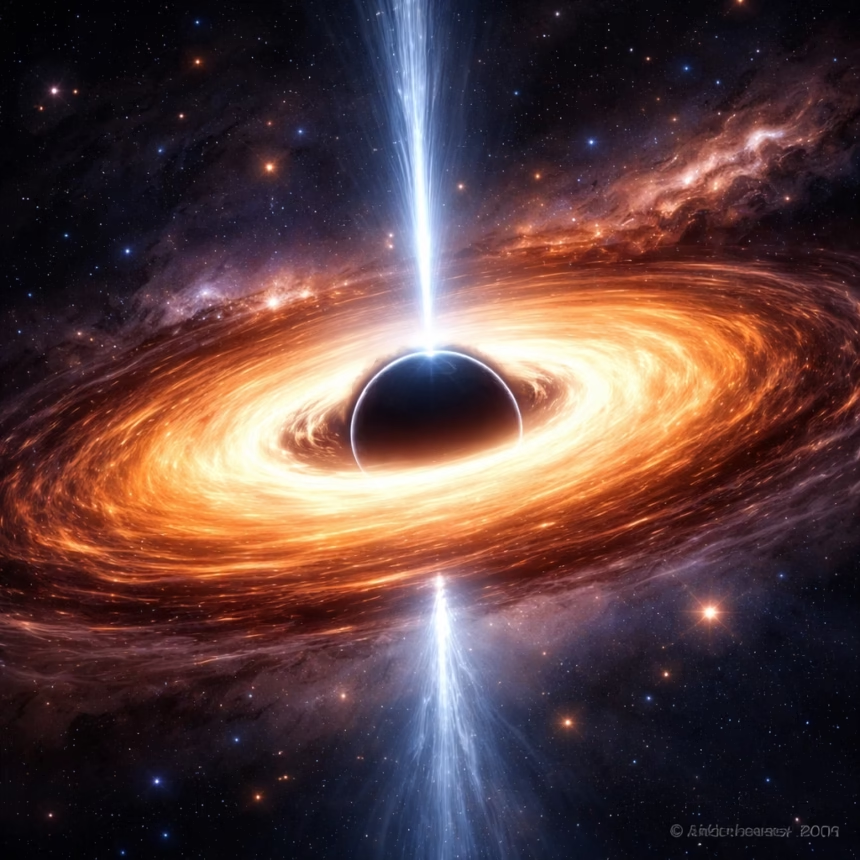
A groundbreaking discovery by an international team of astronomers has unveiled a potential "black hole star" in the nascent stages of the Universe. This extraordinary celestial object, characterized by a supermassive black hole at its core, presents a significant challenge to prevailing theories of cosmic evolution and the rapid growth of black holes in the early cosmos. The observations, primarily utilizing advanced space telescopes, pinpoint this anomaly in the Universe's first billion years, offering an unprecedented glimpse into the extreme conditions of cosmic dawn.
Background: The Early Universe and Black Hole Mysteries
The Universe's infancy, a period often referred to as "cosmic dawn," was a tumultuous era marked by the formation of the first stars and galaxies. Within this epoch, a persistent enigma has been the rapid emergence of supermassive black holes (SMBHs), objects millions to billions of times the mass of our Sun. Standard models struggle to explain how these colossal black holes could have grown to such immense sizes so quickly after the Big Bang, given the limited time available for accretion.
Formation Theories for Supermassive Black Holes
Traditional theories for SMBH formation include the direct collapse of massive gas clouds, bypassing the stellar stage, or the growth from "seed" black holes left behind by the collapse of the first massive stars (Population III stars). These stellar-mass black holes would then gradually accrete matter over billions of years. However, the discovery of numerous luminous quasars, powered by actively feeding SMBHs, at very high redshifts (indicating extreme distance and thus early cosmic times) suggests a faster, more efficient growth mechanism. The concept of a "black hole star" has long been a theoretical possibility, positing a star so massive that its core collapses into a black hole while the outer layers continue to burn, feeding the nascent black hole from within.
The Role of Early Stars
The first stars were exceptionally massive, short-lived, and metal-free, burning brightly and quickly before collapsing to form the seeds of future galaxies and black holes. Understanding their properties and evolution is crucial for comprehending the subsequent development of the Universe. The existence of a "black hole star" could represent a missing link in this evolutionary chain, providing a novel pathway for SMBH growth.
Key Developments: Unveiling the Anomaly
The recent breakthrough stems from meticulous observations conducted by a collaborative effort involving scientists from institutions like the Space Telescope Science Institute and the European Space Agency. Utilizing the unparalleled sensitivity of the James Webb Space Telescope (JWST), particularly its Near-Infrared Spectrograph (NIRSpec) and Mid-Infrared Instrument (MIRI), astronomers detected an unusually bright and massive object at a redshift of approximately z=7.5. This corresponds to a time when the Universe was only about 700 million years old.
More Read

Observational Evidence
The candidate "black hole star," tentatively designated J0734+2926, exhibits a unique spectral signature. Its infrared emissions are significantly brighter and broader than expected for a typical early galaxy or quasar of that epoch. Analysis of the spectral lines, particularly broad emission lines of hydrogen and helium, suggests the presence of an extremely massive, hot, and dense stellar envelope surrounding an active accretion disk. The luminosity implies an object thousands of times brighter than typical early galaxies, yet its compact size, inferred from gravitational lensing models and spatial resolution, points away from a sprawling star-forming region.
The “Black Hole Star” Hypothesis
The leading hypothesis posits that J0734+2926 is not a galaxy, nor a conventional quasar, but rather a "black hole star" – a colossal star, potentially hundreds of thousands of times the mass of our Sun, with a rapidly growing black hole at its core. In this scenario, the black hole continuously consumes the star's inner layers, releasing immense energy that prevents the star from collapsing entirely and sustains its enormous luminosity. This internal feeding mechanism could explain how a black hole could gain mass so quickly in the early Universe, bypassing the slower process of accreting gas from the interstellar medium. The sheer scale of the observed emissions and the inferred mass suggest a black hole already approaching supermassive status, fed by its own stellar host.
Impact: Rewriting Cosmic History
The potential confirmation of a "black hole star" would send ripples throughout the astrophysical community, necessitating a re-evaluation of our understanding of stellar evolution, black hole formation, and galaxy assembly in the early Universe.
More Read

Revisiting Black Hole Growth Models
If "black hole stars" prove to be a viable and common pathway, it would provide a powerful mechanism for the rapid formation of SMBH seeds. This could resolve the "timing problem" of early quasars, explaining how black holes grew to billions of solar masses within the first billion years of the Universe's existence. It suggests that SMBHs might not always form through the direct collapse of gas or the slow accretion by stellar remnants, but through a unique symbiotic relationship with their host star.
Implications for Early Galaxy Formation
The presence of such luminous, massive objects in the early Universe could also influence the formation and evolution of the first galaxies. The intense radiation and energetic outflows from these "black hole stars" could either suppress or trigger star formation in their vicinity, thereby shaping the cosmic landscape. Understanding their prevalence could help explain the observed properties of early galaxies and the reionization of the Universe.
New Avenues for Research
This discovery opens entirely new avenues for theoretical and observational research. Theorists will scramble to refine models of supermassive star evolution, black hole accretion within stellar envelopes, and the stability of such exotic objects. Observers will actively search for more candidates, using the unique spectral and luminosity characteristics identified for J0734+2926 as a template.
What Next: Future Milestones and Investigations
The current findings, while compelling, represent the initial stages of understanding J0734+2926. Further observations and theoretical work are crucial for confirming its identity as a "black hole star."
Follow-up Observations
Astronomers plan extensive follow-up observations with JWST and potentially other advanced observatories like the upcoming Nancy Grace Roman Space Telescope. These will aim to obtain higher-resolution spectra to probe the kinematics of the gas, search for variability in brightness, and refine the object's mass estimates. X-ray observations, perhaps with the Chandra X-ray Observatory or future X-ray missions, would be particularly valuable, as an active black hole core is expected to emit strong X-rays. Detailed imaging could also reveal any host galaxy structure, or lack thereof, around the compact object.
Theoretical Modeling and Simulations
On the theoretical front, astrophysicists will engage in sophisticated numerical simulations to model the formation, evolution, and stability of "black hole stars." These models will explore the conditions under which such objects could form in the early Universe, their expected lifetimes, and their observational signatures. Understanding the physics of accretion within a stellar envelope, and the interplay between the black hole and the star's nuclear fusion, will be paramount.
More Read

Searching for More Candidates
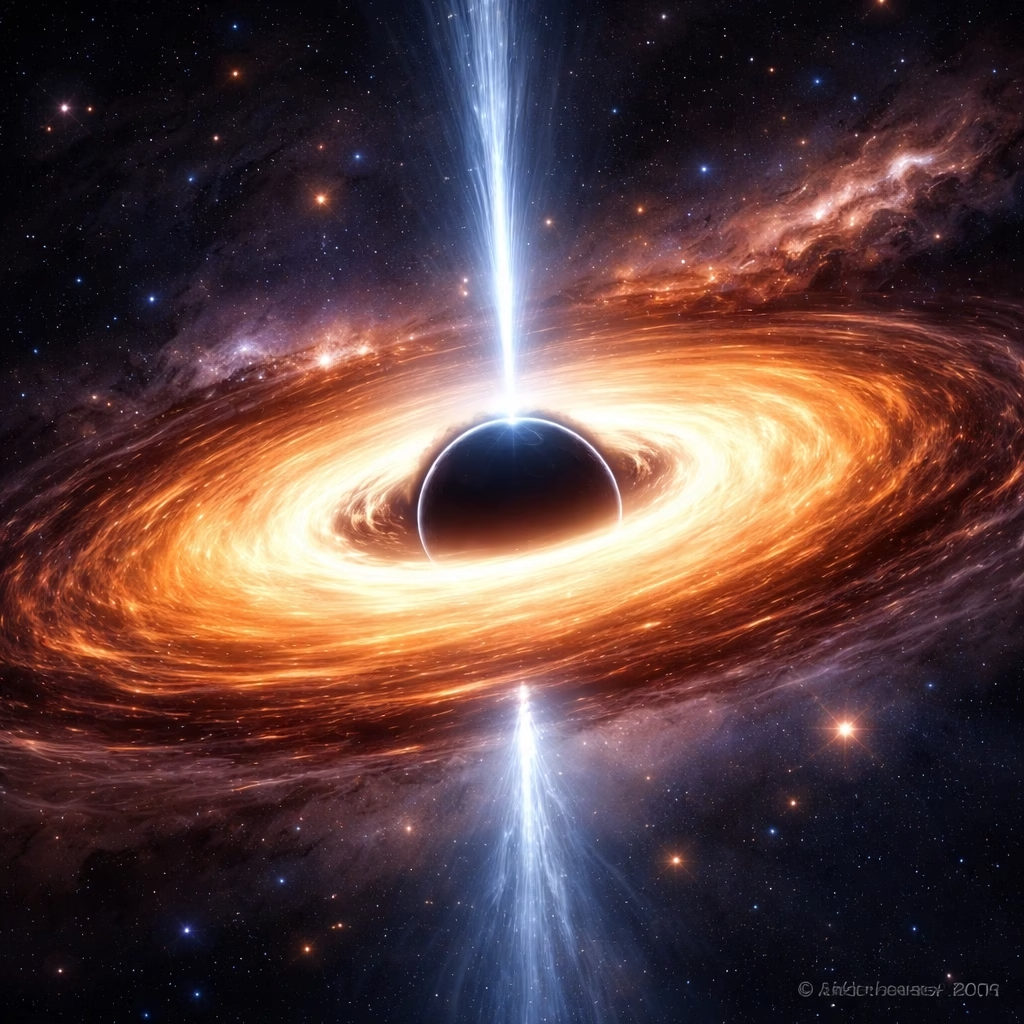
A critical next step will be to search for more "black hole star" candidates across the early Universe. If J0734+2926 is not an isolated anomaly, its discovery could herald a new class of celestial objects. Large-scale surveys with JWST and future telescopes will be designed to identify similar spectral and photometric characteristics, potentially unveiling a population of these exotic stars that played a pivotal role in the Universe's early development. The hunt for these cosmic leviathans has just begun, promising to reshape our understanding of the most extreme objects in the cosmos.