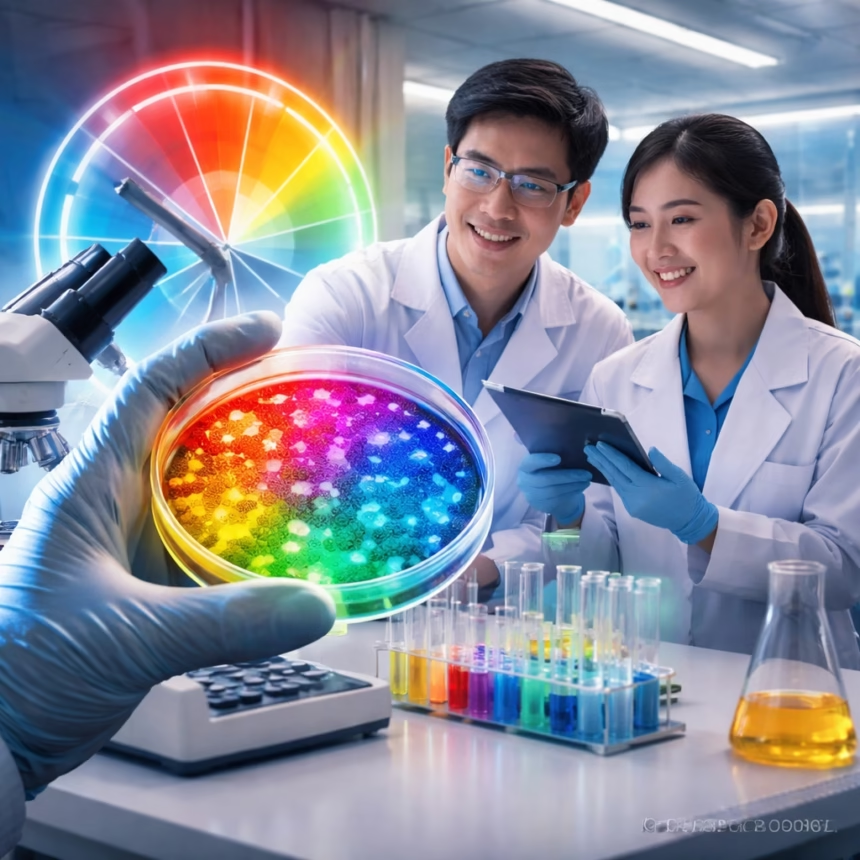
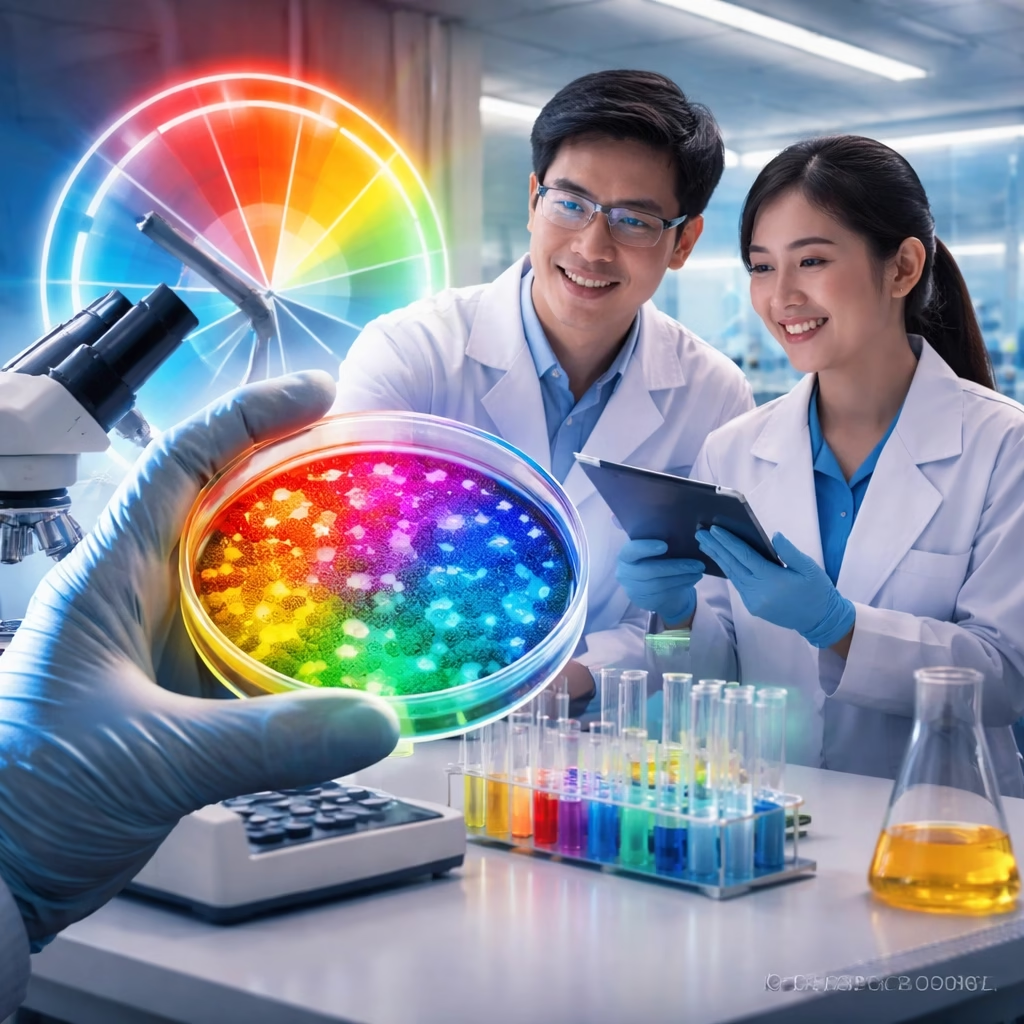
Researchers at the National University of Singapore (NUS) have recently unveiled a groundbreaking achievement in synthetic biology: successfully engineering common baker's yeast (Saccharomyces cerevisiae) to detect and differentiate specific colours. This innovation, developed at the forefront of biological engineering, promises to revolutionize various fields, from medical diagnostics to environmental monitoring, by creating highly versatile and cost-effective living biosensors. The discovery, published last month in a leading scientific journal, marks a significant leap in our ability to program complex sensory functions into simple eukaryotic cells.
Background: The Quest for Smarter Biosensors
The field of biosensors has long sought methods for rapid, accurate, and accessible detection of biological and chemical substances. Traditional biosensors often rely on complex instruments, delicate molecular probes, or intricate chemical reactions, presenting limitations in terms of cost, portability, and the need for specialized personnel. These constraints frequently hinder their deployment in resource-limited settings or for widespread, continuous monitoring.
Yeast, a single-celled eukaryotic microorganism, has emerged as a powerful chassis for synthetic biology due to its well-understood genetics, ease of cultivation, safety profile, and scalability. For decades, scientists have engineered yeast for diverse applications, including the production of biofuels, pharmaceuticals, and industrial enzymes. However, imparting complex sensory capabilities, particularly the nuanced perception of light and colour, into these simple cells has remained a significant challenge. Early attempts to integrate light-sensing mechanisms often faced hurdles related to cellular compatibility and the complexity of signal transduction pathways in eukaryotic systems.
NUS's Synthetic Biology for Clinical and Technological Innovation (SynCTI), a hub for interdisciplinary research, has been at the forefront of this pursuit for over a decade. Led by Professor Lim Siew Ling and Dr. Chen Wei, their foundational work focused on understanding and manipulating genetic circuits within yeast. Previous research within the group explored integrating bacterial photoreceptors into yeast, but achieving broad-spectrum, specific colour detection without significant cellular interference proved elusive. This new breakthrough builds upon years of incremental advancements in genetic engineering and protein optimization, addressing these long-standing technical barriers.
Key Developments: Engineering Yeast to ‘See’
The recent breakthrough by the NUS team, primarily based at the Department of Biomedical Engineering and the NUS Centre for Advanced 3D Fabrication, lies in a sophisticated genetic engineering strategy that equips yeast with unprecedented colour-sensing abilities. The core of this innovation involves integrating highly specialized light-sensitive proteins, known as rhodopsins, into the yeast cell membrane. These rhodopsins, carefully selected and modified from marine organisms for optimal performance in a yeast environment, are exquisitely tuned to absorb light at specific wavelengths, corresponding to distinct colours.
More Read

The “Vision” Mechanism
Upon absorbing light of a particular colour (e.g., blue, green, or red), the integrated rhodopsin undergoes a precise conformational change. This subtle shift acts as the initial trigger for a meticulously designed intracellular signalling cascade. The NUS researchers engineered a novel genetic circuit within the yeast that translates this rhodopsin activation into a measurable and interpretable output. For instance, the detection of a specific colour might activate a reporter gene, leading to the production of a fluorescent protein (such as Green Fluorescent Protein, GFP, for green light detection or Red Fluorescent Protein, RFP, for red light detection). Alternatively, the signal could be channeled to activate an enzyme that produces a detectable metabolic compound, offering versatile readout options.
Multiplexed Detection and High Fidelity
A significant achievement of this research is the development of a multiplexed detection system. The team engineered different strains of yeast, each specifically sensitive to a distinct colour. By combining these specialized strains, researchers can create a "living colour palette" capable of decoding a broader spectrum of light or identifying complex colour patterns. This multiplexing capability significantly enhances the versatility of the system, allowing for the simultaneous detection of multiple optical cues.
The engineered yeast exhibits remarkable sensitivity, capable of detecting light at very low intensities, and high specificity, effectively distinguishing target colours from background noise or other light sources. This precision is critical for real-world applications where accuracy is paramount. Furthermore, the inherent ease and low cost of cultivating yeast make this platform exceptionally scalable and significantly more economical than traditional, often fragile, optical sensors or complex laboratory instrumentation, paving the way for widespread adoption.
More Read

Impact: Transforming Diagnostics and Monitoring
The implications of colour-sensing yeast extend across a multitude of sectors, promising to redefine how we approach diagnostics, environmental monitoring, and industrial processes. Its low cost, portability, and biological nature offer distinct advantages over conventional technologies.
Medical Diagnostics and Healthcare
Point-of-Care Testing: Imagine a simple, yeast-based test strip that changes colour in response to specific biomarkers indicative of disease. This could revolutionize rapid diagnostics for conditions like diabetes (by optically detecting glucose levels via a linked pathway), infectious diseases (by sensing specific pathogen-associated optical signatures), or early cancer markers. Such affordable, portable tests could be deployed in remote clinics or homes, democratizing access to crucial healthcare information.
* Drug Screening: Pharmaceutical companies could leverage this platform for high-throughput screening of drug candidates. By engineering yeast to display a colour change or fluorescent signal when a drug interacts with a target protein or pathway, researchers can rapidly assess drug efficacy and toxicity, accelerating drug discovery.
* Infectious Disease Detection: The ability to rapidly and cost-effectively detect viral or bacterial infections through their unique optical signatures or metabolic byproducts could be a game-changer, especially during outbreaks or in regions with limited diagnostic infrastructure.
Environmental Monitoring and Food Safety
Water Quality Assessment: Colour-sensing yeast could be engineered to detect specific pollutants, such as heavy metals or organic dyes, in water. A change in the yeast's emitted or reflected colour would provide immediate, on-site alerts about contamination, enhancing public health and ecological protection.
* Air Quality Monitoring: Similarly, the platform could be adapted to monitor airborne toxins or particulate matter that possess specific optical characteristics, offering a biological alternative to current sensor networks.
* Food Spoilage Detection: In the food industry, yeast engineered to detect specific pigments or light patterns associated with spoilage microorganisms or chemical degradation could be integrated into packaging, providing consumers with real-time indicators of food freshness and safety.
* Quality Control: Ensuring consistency in food and beverage production, where colour is often a critical parameter, could be streamlined through continuous, automated monitoring using these living biosensors.
Industrial and Research Applications
Biomanufacturing: Real-time monitoring of bioreactor conditions during the production of biopharmaceuticals or industrial enzymes can be achieved by detecting specific light-emitting or light-absorbing compounds, ensuring optimal yield and quality.
* Synthetic Biology Research: This breakthrough provides a powerful new tool for fundamental research in synthetic biology, allowing scientists to design and test complex genetic circuits with optical inputs, opening new avenues for understanding cellular communication and control.
* Global Accessibility: The low cost, simplicity, and robustness of the yeast platform make advanced diagnostic and monitoring tools accessible to developing nations and underserved communities, significantly bridging existing gaps in healthcare and environmental surveillance.
What Next: Future Horizons and Milestones
The NUS team's breakthrough is a foundational step, and significant work lies ahead to translate this laboratory success into widespread real-world applications. The roadmap involves several key phases, from further technological refinement to commercialization.
More Read

Expanding Capabilities and Integration
Future research efforts will focus on engineering yeast to detect an even broader range of the electromagnetic spectrum, including ultraviolet (UV) and infrared (IR) light. This expansion would unlock a new array of applications, from specialized material analysis to advanced medical imaging. Concurrently, the team aims to enhance the specificity and sensitivity of the existing colour-sensing mechanisms, continuously refining the genetic circuits and rhodopsin variants to achieve unparalleled precision and lower detection limits.
A critical next step involves the integration and miniaturization of these living biosensors. The goal is to develop user-friendly, portable devices—potentially hand-held biosensors—that can seamlessly incorporate the colour-sensing yeast. This would enable on-site, immediate analysis without the need for sophisticated laboratory infrastructure.
Pilot Projects and Commercialization
Within the next two years, the NUS team plans to initiate pilot projects focusing on specific high-impact applications, such as rapid infectious disease detection in clinical settings or real-time water quality monitoring in urban environments. These proof-of-concept demonstrations will be crucial for validating the technology's efficacy and reliability outside controlled laboratory conditions.
NUS Enterprise, the university's entrepreneurial arm, is actively exploring partnerships with leading biotech companies and venture capitalists to accelerate the translation of this research into market-ready products. Several spin-off companies are anticipated within the next five years, focusing on specialized applications in medical diagnostics, environmental technology, and industrial biotechnology.
Ethical Considerations and Long-Term Vision
As with any living biosensor technology, the NUS team acknowledges the paramount importance of robust regulatory frameworks and ethical guidelines. Discussions with regulatory bodies are already underway, particularly concerning potential environmental release or direct human application of these engineered organisms. Ensuring safety, containment, and public trust will be integral to the successful deployment of these innovations.
The long-term vision is to establish a versatile, modular platform for "living diagnostics." This platform would allow for the rapid customization and deployment of engineered yeast strains for a myriad of sensing tasks, from personalized medicine, where individual patient biomarkers could be monitored in real-time, to smart agriculture, optimizing crop health through precise environmental sensing. Within the next decade, these colour-sensing yeast could become ubiquitous tools, transforming how we interact with and understand our biological and physical world.