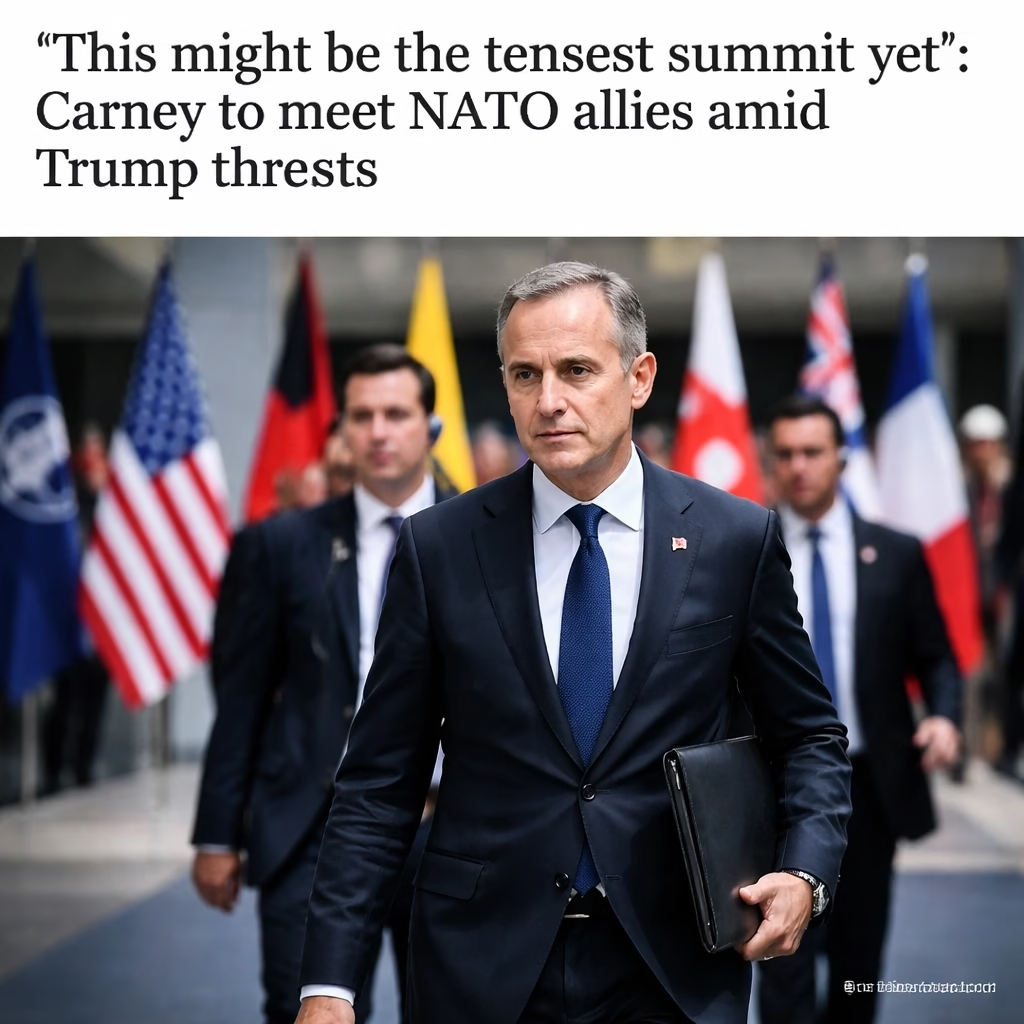
Mark Carney, former Bank of England Governor and current UN Special Envoy for Climate Action and Finance, is reportedly engaging with NATO allies in a series of high-stakes discussions. These meetings are unfolding against a backdrop of heightened geopolitical tension and renewed threats from former U.S. President Donald Trump regarding American commitment to the transatlantic alliance. The dialogue aims to navigate the complex economic and security implications of these challenges.
Background to the Crisis
The North Atlantic Treaty Organization (NATO), founded in 1949, stands as a cornerstone of transatlantic security, built on the principle of collective defense enshrined in Article 5 of its founding treaty. This article stipulates that an attack on one member is an attack on all, obliging allies to come to the aid of the attacked nation. For decades, the United States has been the alliance's largest contributor, both militarily and financially.
The 2% Defense Spending Target
A persistent point of contention within NATO has been the defense spending target. At the 2014 Wales Summit, following Russia's annexation of Crimea, all allies pledged to move towards spending at least 2% of their Gross Domestic Product (GDP) on defense by 2024. This commitment was intended to ensure a more equitable burden-sharing among members and strengthen the alliance's overall capabilities. However, progress towards this goal has been uneven, with many European nations lagging behind.
Trump’s Past Criticisms and Warnings
During his presidency from 2017 to 2021, Donald Trump frequently criticized NATO members he deemed "delinquent" in their financial contributions. He repeatedly questioned the value of the alliance, famously calling it "obsolete" and suggesting the U.S. might not come to the aid of allies who failed to meet the 2% spending target. These remarks sowed considerable unease among European capitals, prompting a renewed, albeit gradual, focus on increasing defense budgets.
The Ukraine War’s Impact
Russia's full-scale invasion of Ukraine in February 2022 served as a stark wake-up call for European security. The conflict dramatically underscored the need for robust defense capabilities and greater strategic autonomy. This event galvanized many European nations to accelerate their defense spending plans, with several countries, including Germany, announcing significant increases and special funds for military modernization.
More Read

Carney’s Potential Role
Mark Carney, with his extensive background in global finance and economic policy, brings a unique perspective to these discussions. While not a direct defense or foreign policy official, his involvement likely centers on the economic resilience of the alliance, the financial implications of increased defense spending, and the broader economic risks posed by geopolitical instability. His expertise could be crucial in advising on sustainable funding models, managing economic shocks, or even exploring the financial architecture required to support enhanced collective security.
Key Developments and Recent Threats
The current wave of tension was significantly amplified by former President Trump's statements in February 2024. Speaking at a rally, Trump recounted a conversation with an unnamed NATO leader, stating he would "encourage" Russia to do "whatever the hell they want" to any NATO member that did not meet its financial obligations.
European Reactions and Accelerated Spending
These comments triggered immediate and widespread condemnation from European leaders and senior NATO officials, who reaffirmed the inviolability of Article 5. In response, several European nations have further accelerated their efforts to meet or exceed the 2% GDP defense spending target.
More Read

Poland: Has been a frontrunner, consistently exceeding the 2% target and planning further increases.
* Germany: Following its "Zeitenwende" (turning point) announcement, Germany established a €100 billion special fund for defense modernization and is on track to meet the 2% target this year for the first time since the Cold War.
* France: Has also committed to significant increases in its military budget, aiming for long-term strategic autonomy.
* Nordic Expansion: The recent accessions of Finland (April 2023) and Sweden (March 2024) to NATO, directly spurred by Russian aggression, have significantly bolstered the alliance's northern flank and overall military strength. Both nations bring advanced military capabilities and a strong commitment to collective defense.
Bolstering Defense Industrial Capacity
Beyond financial commitments, there is a growing focus on strengthening Europe's defense industrial base. The war in Ukraine exposed critical shortcomings in the production capacity for ammunition and military equipment. NATO members are now actively working to scale up manufacturing, streamline procurement processes, and foster greater interoperability among national forces. Carney's discussions could involve the financial mechanisms to support such industrial expansion and supply chain resilience.
Impact on Global Security and Economy
The ongoing uncertainty surrounding NATO's future has far-reaching implications, extending beyond military strategy to global economic stability and international relations.
NATO’s Credibility and Deterrence
The most immediate impact is on NATO's credibility as a collective defense organization. Doubts about the steadfastness of the U.S. commitment could embolden adversaries and undermine the alliance's deterrent posture, particularly for frontline states bordering Russia. This uncertainty risks fragmenting the unity that has been NATO's greatest strength.
European Security Architecture
For Europe, the situation has intensified debates about "strategic autonomy." While few advocate for a complete decoupling from the U.S., there is a growing consensus that Europe must enhance its own defense capabilities and coordination to reduce reliance on Washington. This could lead to greater integration of European defense industries and command structures.
Transatlantic Relations
The fundamental bond between the United States and its European allies is under significant strain. A potential shift in U.S. foreign policy could reshape diplomatic ties, trade agreements, and cooperation on global challenges ranging from climate change to cybersecurity. Mark Carney's involvement underscores the recognition that economic and financial stability are inextricably linked to this geopolitical balance.

Global Financial Markets
Instability within a major security alliance like NATO can send shockwaves through global financial markets. Increased geopolitical risk often leads to volatility, impacting investment, trade, and currency values. Carney, as an expert in financial stability, would be acutely aware of these potential cascading effects and the need for robust economic frameworks to mitigate them.
Defense Industry Boom
Paradoxically, the heightened tension has spurred a boom in the defense industry. Companies producing armaments, surveillance technology, and military logistics are seeing increased orders and investment. While this strengthens military capabilities, it also raises questions about the long-term economic sustainability of such rapid expansion and its potential diversion of resources from other sectors.
What Lies Ahead
The coming months are poised to be critical for the future of NATO and transatlantic security, with several key milestones on the horizon.
Washington D.C. Summit (July 2024)
The next NATO Summit, scheduled for July 2024 in Washington D.C., will be a pivotal moment. Leaders will gather to commemorate NATO's 75th anniversary and are expected to reaffirm their commitment to collective defense and the 2% spending target. This summit will provide a crucial platform for diplomatic efforts to project unity and address the concerns raised by recent threats. The outcomes of these discussions will be closely watched for signs of resolve and concrete plans for the alliance's future.
U.S. Presidential Election (November 2024)
The most significant variable remains the U.S. presidential election in November 2024. The outcome will profoundly shape U.S. foreign policy and its commitment to international alliances, including NATO. A second Trump presidency could lead to a dramatic re-evaluation of the American role in the alliance, potentially forcing European nations into unprecedented levels of self-reliance.
Continued European Defense Spending
Regardless of the U.S. election results, European nations are expected to continue their trajectory of increased defense spending. The geopolitical realities underscored by the war in Ukraine have created a lasting imperative for stronger national and collective defense capabilities. More countries are anticipated to meet or exceed the 2% GDP target in the coming years, driven by both external threats and internal political will.
Carney’s Ongoing Consultations
Mark Carney's engagement with NATO allies is likely to be an ongoing process. His consultations could extend to developing strategies for economic resilience in an era of heightened geopolitical risk, exploring innovative financial instruments to support defense investment, or advising on the interplay between climate security and military readiness. His insights could help bridge the gap between financial prudence and strategic necessity, ensuring the alliance remains robust in a rapidly changing world.