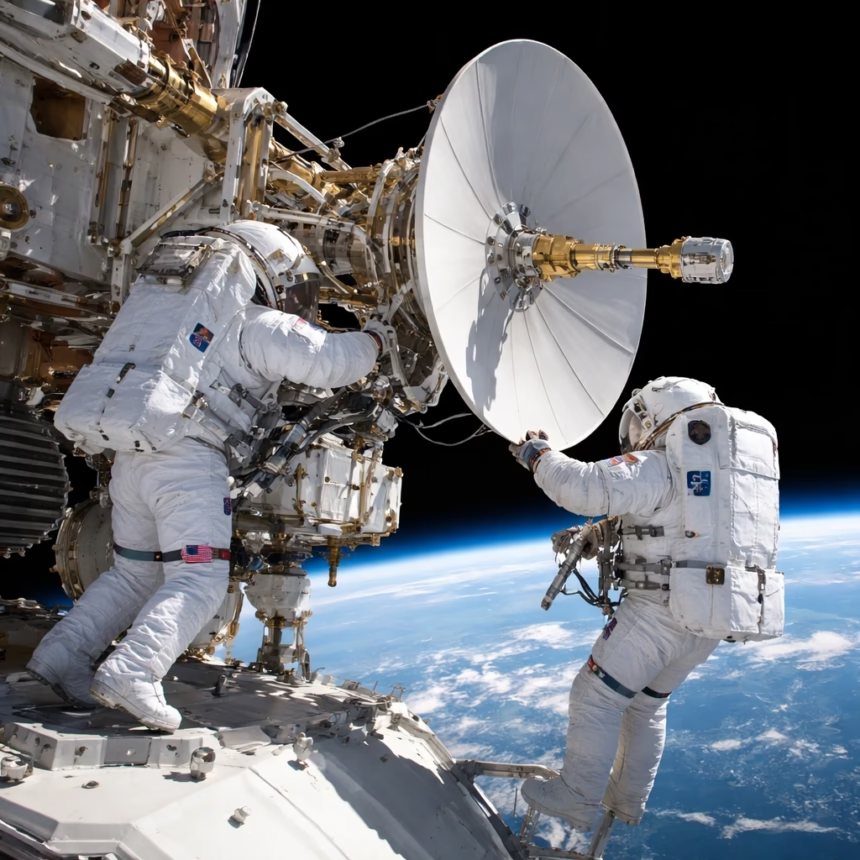
NASA and ESA astronauts successfully concluded a complex spacewalk on October 26, 2023, to install a crucial Next-Generation Space-to-Ground Antenna (NG-SGA) on the International Space Station (ISS). This significant upgrade, meticulously executed on the orbiting laboratory's exterior, promises to revolutionize its communication capabilities with Earth. The operation marks a pivotal moment for scientific data transmission and operational efficiency for the orbital outpost.
Background: The ISS’s Evolving Voice
The International Space Station relies heavily on robust communication systems for its daily operations, critical scientific experiments, and the safety of its international crew. Since its inception, the ISS has utilized a combination of S-band for voice and telemetry, and Ku-band for higher-rate data transfer, primarily through NASA's Tracking and Data Relay Satellite (TDRS) network.
As scientific research on the ISS has grown in complexity and volume, so has the demand for greater bandwidth. Advanced experiments in areas like Earth observation, materials science, and biological research generate enormous datasets that require rapid and efficient downlink to ground-based scientists. The existing communication infrastructure, while reliable, has faced increasing pressure to accommodate these expanding data requirements.
Previous antenna systems have served the station well, but the accelerating pace of scientific discovery and the need for near real-time data access necessitated an upgrade. The newly installed NG-SGA is a key component of a broader modernization initiative designed to future-proof the station's communication backbone. This strategic enhancement ensures the ISS remains a cutting-edge research platform capable of supporting the most demanding scientific endeavors.
Key Developments: A Precision Orbital Operation
The Astronauts and Their Mission
The Extravehicular Activity (EVA), designated US EVA-90, was performed by NASA astronaut Jasmin Moghbeli and ESA astronaut Andreas Mogensen. Donning their bulky Extravehicular Mobility Units (EMUs), the duo ventured outside the Quest airlock for an impressive 6 hours and 42 minutes. Their primary objective was the precise installation of the NG-SGA onto the port-side P1 truss segment of the International Space Station.
Step-by-Step Installation
The spacewalk began with Moghbeli and Mogensen meticulously preparing their tools and safety tethers inside the airlock before egressing into the vacuum of space. They then translated along the station's exterior, navigating the complex truss structure to reach the designated worksite on the P1 truss.
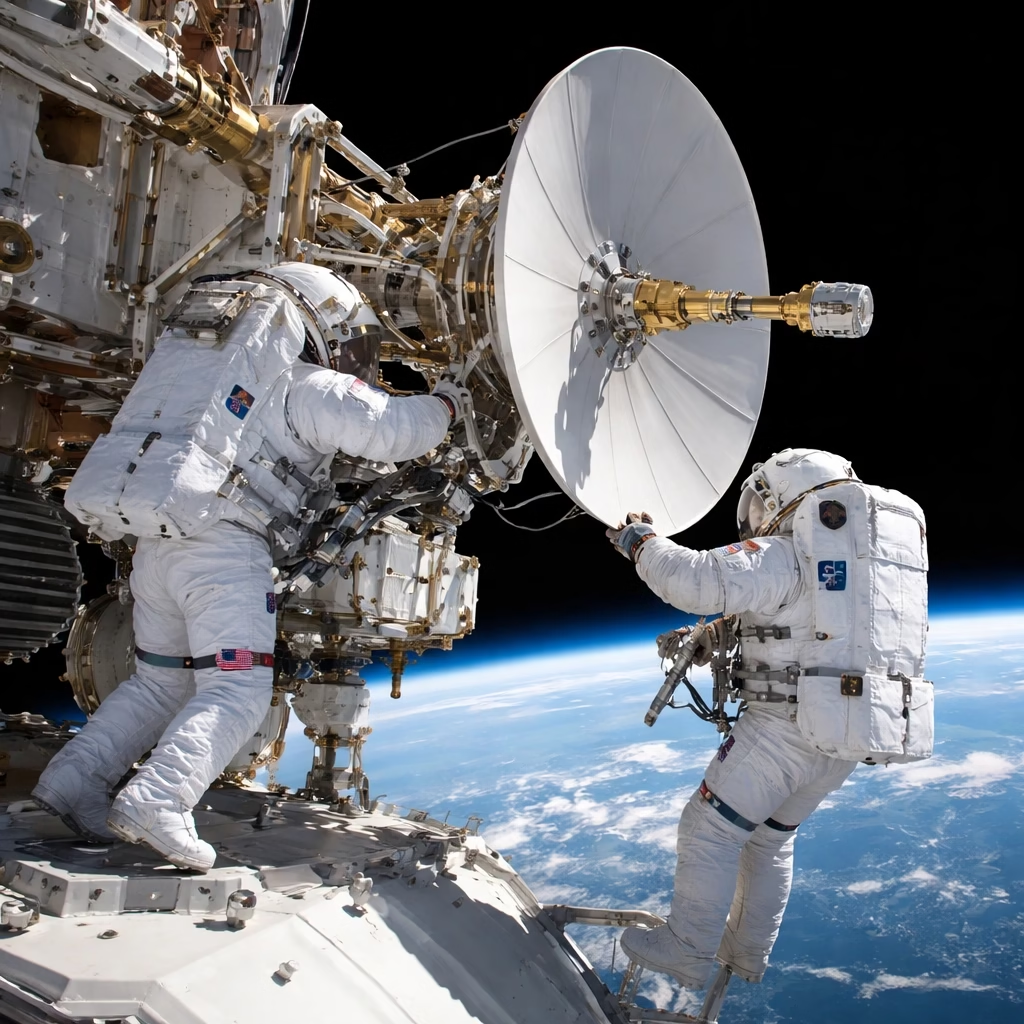
Upon arrival, the astronauts first removed protective covers and prepared the mounting interface. The NG-SGA, which had been previously delivered to the station aboard a cargo spacecraft, was then carefully unpacked and maneuvered into position. This delicate process involved precise handling to ensure no damage occurred to the sensitive antenna components.
More Read

Once aligned, the astronauts mechanically secured the antenna to the truss using specialized tools, tightening multiple bolts to ensure a rigid attachment. Following the mechanical installation, they proceeded to connect the necessary electrical and data cables, integrating the new hardware into the station's intricate power and communication networks. Throughout the process, continuous verification checks were performed by both the spacewalkers and flight controllers at Mission Control Centers in Houston and Oberpfaffenhofen.
Challenges and Coordination
Working in the unforgiving environment of microgravity presents numerous challenges, including extreme temperature fluctuations, the absence of atmospheric pressure, and limited visibility during orbital night passes. Moghbeli and Mogensen demonstrated exceptional dexterity and spatial awareness, meticulously executing each step of the complex installation.
The operation required seamless coordination not only between the two astronauts but also with ground control teams. Mission Control provided constant guidance, monitoring vital signs, tool status, and the overall progress of the EVA. This intricate dance of human skill and ground support was crucial for the successful completion of the antenna installation.
Impact: Bridging the Gap from Orbit to Earth
Enhanced Data Downlink
The installation of the NG-SGA is expected to usher in a new era of data transmission rates for the ISS. This significant increase in bandwidth will facilitate quicker and more efficient transfer of high-resolution imagery, real-time video feeds, and vast amounts of scientific telemetry generated by experiments onboard. For scientists on Earth, this means faster access to critical data, accelerating the pace of discovery across various disciplines. Experiments generating large datasets, such as advanced microscopy or intricate fluid physics studies, will particularly benefit from this enhanced capacity.
Operational Efficiency and Safety
Beyond scientific data, the improved communication capabilities will also boost the overall operational efficiency of the International Space Station. Enhanced bandwidth allows for more robust real-time communication between the crew and ground control, improving responsiveness during critical operations or unexpected events. Faster diagnostics and troubleshooting for ISS systems can be performed, potentially reducing downtime and mitigating risks. Furthermore, the increased data flow supports better telemedicine capabilities and psychological support for astronauts undertaking long-duration missions, ensuring their well-being in the isolated orbital environment.
Scientific Breakthroughs and Public Engagement
By enabling more complex and data-intensive research, the NG-SGA directly contributes to the potential for groundbreaking scientific discoveries on orbit. Researchers can now design experiments that were previously constrained by data transmission limitations, pushing the boundaries of what is possible in microgravity. The upgrade also facilitates better quality live broadcasts and educational outreach from the ISS, offering clearer views and more engaging content for the global public. This enhanced engagement is vital for fostering continued public interest in space exploration and inspiring future generations of scientists and engineers.
More Read

What Next: Activating the Future of Space Communication
Post-Installation Procedures
With the NG-SGA mechanically and electrically integrated, the immediate next steps involve a series of crucial post-installation procedures. Over the coming weeks, ground teams will initiate the antenna's power-up and conduct extensive functional checks. This includes calibrating the antenna's pointing mechanisms and integrating it seamlessly into the ISS's existing communication network. Rigorous testing with ground stations and the TDRS satellite constellation will be performed to verify its performance and ensure it meets all operational specifications before it becomes fully active.
Future Implications for Space Exploration
The successful deployment and operation of the NG-SGA sets a vital precedent for communication systems on future space platforms. Lessons learned from its installation and integration will directly inform the design and deployment of similar systems for upcoming lunar missions, including the Gateway outpost orbiting the Moon. This advancement is a critical step towards establishing robust communication infrastructure necessary for sustained human presence beyond low-Earth orbit, particularly for ambitious deep-space missions to the Moon and Mars.
This joint NASA-ESA endeavor further reinforces the power of international collaboration in space. The seamless teamwork demonstrated during this spacewalk is a testament to the shared commitment to advancing human presence and scientific research in orbit, paving the way for even more ambitious ventures in the cosmic frontier.