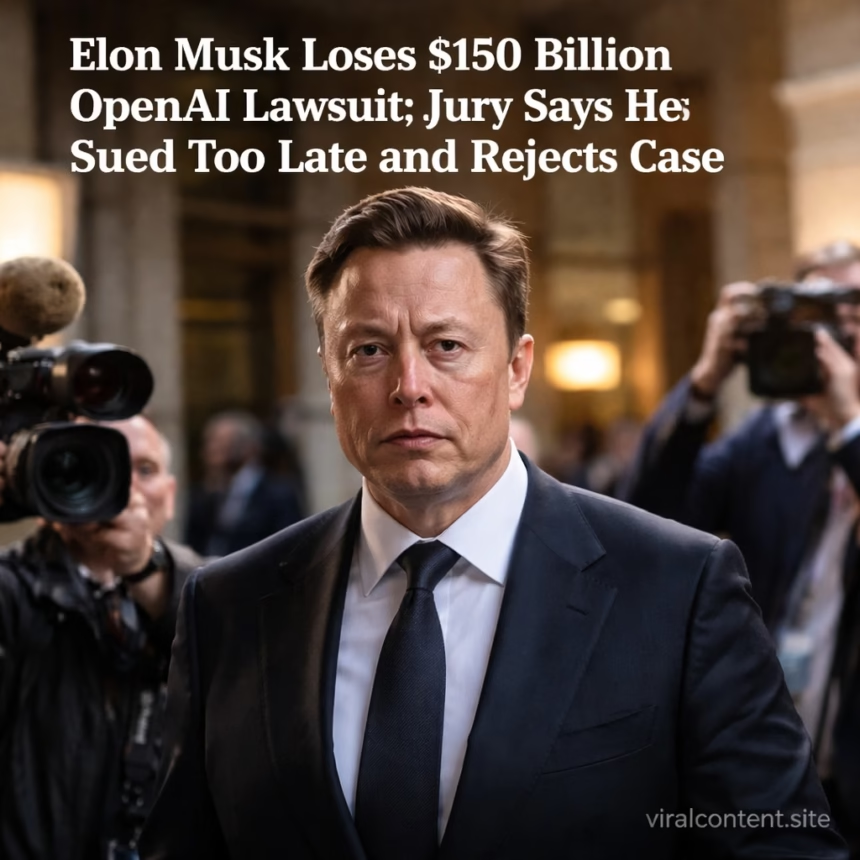
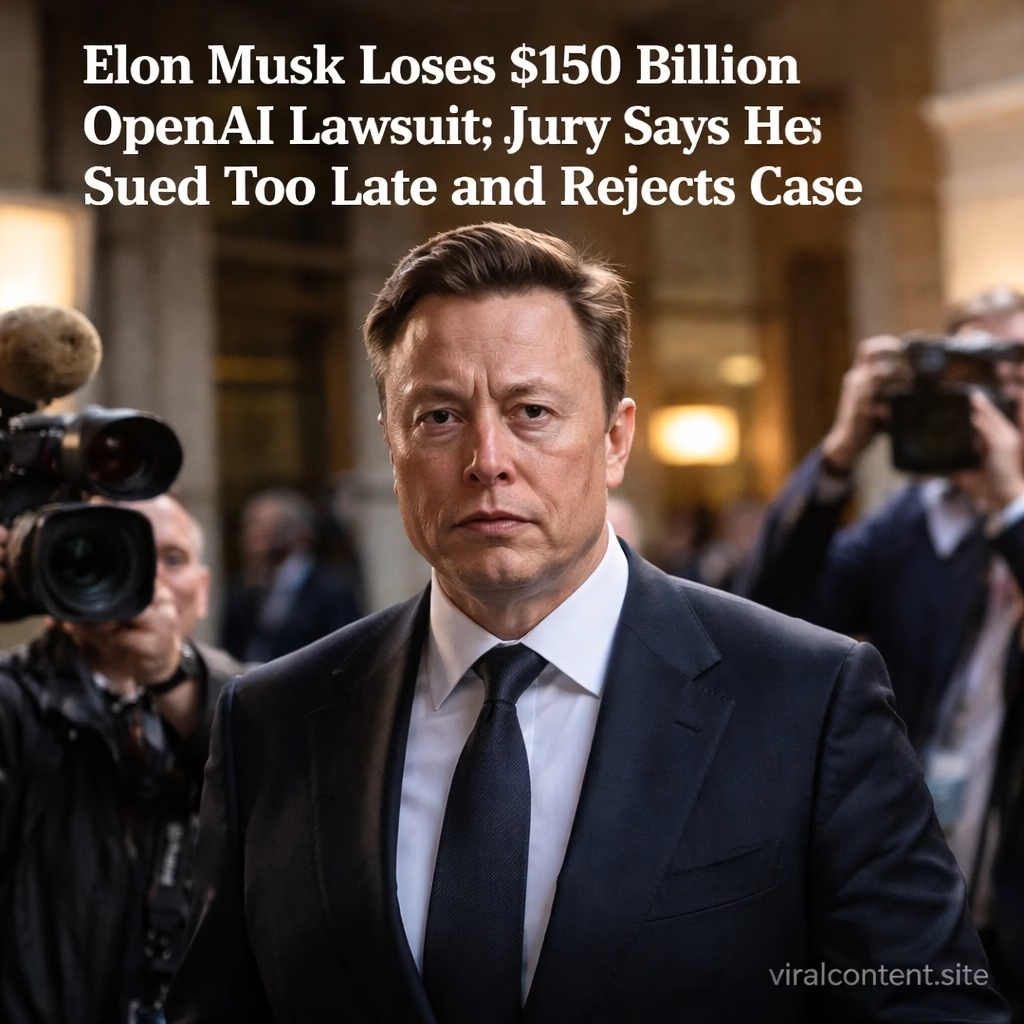
San Francisco, CA – A California jury has delivered a decisive blow to Elon Musk, rejecting his high-profile lawsuit against OpenAI, the artificial intelligence company he co-founded. The verdict, announced on June 10, 2024, found that Musk waited too long to file his claims, effectively dismissing his allegations that OpenAI had abandoned its foundational non-profit mission. The multi-billion dollar dispute, which centered on the direction and control of one of the world's leading AI developers, concludes a chapter in the increasingly contentious relationship between Musk and the company.
Background: From Shared Vision to Legal Battleground
The origins of this legal saga trace back to December 2015, when Elon Musk, alongside Sam Altman and others, co-founded OpenAI. The organization's stated mission was to ensure that artificial general intelligence (AGI) "benefits all of humanity," explicitly aiming to prevent it from becoming a proprietary tool for any single corporation. It was established as a non-profit entity, promising to develop AI openly and transparently.
Musk was a significant early donor, contributing tens of millions of dollars and serving on its board of directors. However, tensions began to mount as OpenAI's ambitions grew, requiring colossal computational resources and funding that a pure non-profit structure struggled to accommodate. In 2018, Musk departed from OpenAI's board, citing potential conflicts of interest with his own AI ventures at Tesla.
The pivotal shift occurred in 2019 when OpenAI established a "capped-profit" subsidiary, OpenAI LP, to attract the massive investments needed for advanced AI research and development. This move culminated in a multi-billion dollar investment from Microsoft, granting the tech giant significant access to OpenAI's cutting-edge models and technology. Musk publicly criticized this restructuring, alleging it betrayed the original non-profit ethos and transformed OpenAI into a de facto subsidiary of Microsoft, prioritizing profit over humanity's benefit. His criticisms intensified with the public release of ChatGPT in late 2022 and subsequent enterprise offerings.
More Read

Musk officially filed his lawsuit in the California Superior Court in San Francisco on March 1, 2024. He sought a return to OpenAI's original non-profit charter, the public release of its AGI research, and potentially billions in damages, arguing that the company had breached its founding agreement and fiduciary duties.
Key Developments: The Trial and the Timeliness Argument
The trial, which commenced in late May, saw both sides present their cases with intense scrutiny. Musk's legal team argued that OpenAI's transformation into a profit-seeking entity, especially after the Microsoft partnership, constituted a clear breach of the initial agreement and the spirit under which it was founded. They highlighted internal documents and communications from OpenAI's early days, emphasizing the commitment to open-source, non-profit development.
Conversely, OpenAI's defense centered on two main points: first, that Musk was fully aware of and, at times, even supported the strategic shift towards a for-profit model as the financial demands for AGI development became clear. They presented evidence suggesting Musk himself acknowledged the need for significant capital that a pure non-profit could not generate. Second, and ultimately decisive, was the argument that Musk's lawsuit was filed years too late.

The Statute of Limitations
OpenAI's legal counsel vehemently argued that the statute of limitations had long expired for Musk's claims. They contended that the critical changes to OpenAI's structure, including the establishment of the capped-profit entity and the initial Microsoft investment, were publicly disclosed and widely known by 2019 and early 2020. At that time, Musk was actively criticizing these changes on social media and in interviews, demonstrating his awareness of the alleged breaches.
The jury, after deliberating for three days, sided with OpenAI on this crucial procedural point. The verdict stated that while the jury acknowledged the complexities of the founding agreement, the evidence overwhelmingly indicated that Elon Musk had sufficient knowledge of OpenAI's structural and operational changes years before filing his lawsuit. Therefore, his claims were deemed time-barred under California law, meaning he had waited beyond the legally prescribed period to seek redress. The court did not proceed to evaluate the merits of the breach of contract claims themselves due to this procedural finding.
Impact: A Definitive Win for OpenAI, a Setback for Musk
The jury's decision marks a significant victory for OpenAI and its current leadership, including CEO Sam Altman. It removes a major legal cloud that had been hanging over the company, affirming its right to operate under its current capped-profit model and continue its partnership with Microsoft. For OpenAI, this means an unobstructed path forward in its ambitious pursuit of AGI, backed by substantial corporate funding.
For Elon Musk, the verdict represents a notable legal defeat. While no direct financial penalty was imposed on him, the lawsuit itself was valued at an estimated $150 billion in potential damages or the value attributed to the reversion of OpenAI's structure. His failure to reclaim control or influence over OpenAI's direction is a substantial blow to his public campaign against the company's current trajectory. It also underscores the challenges of enforcing founding principles in rapidly evolving technological landscapes where business models must adapt to unprecedented financial demands.
The outcome also has broader implications for the artificial intelligence industry. It could set a precedent regarding the enforceability of early-stage founding agreements, particularly in fast-moving tech sectors. It suggests that founders and early investors must act swiftly if they believe core principles are being violated, as delaying legal action can render even seemingly strong claims moot. For Microsoft, the decision solidifies its strategic investment in OpenAI, ensuring continued access to its advanced AI capabilities without legal encumbrance.
What Next: Appeals, New Ventures, and the Future of AI Governance
While the jury's verdict is a significant hurdle, it may not be the final word from Elon Musk. His legal team has indicated they are reviewing options, including a potential appeal to a higher court. Such an appeal would likely focus on the interpretation of the statute of limitations and when the "discovery" of the alleged breach truly occurred, or whether the nature of the founding agreement created a continuous obligation.
More Read

In the meantime, Musk continues to advance his own AI initiatives, most notably through xAI, his artificial intelligence company founded in 2023. xAI's stated goal is to "understand the true nature of the universe," with a strong emphasis on developing AI that is "maximally curious" and aligned with humanity. This legal outcome may further galvanize Musk to accelerate xAI's development as a direct competitor to OpenAI, potentially reigniting the debate over open-source versus proprietary AI development.
OpenAI, now free from the immediate legal threat, is expected to continue its aggressive development roadmap. This includes further advancements in its large language models, the expansion of its enterprise offerings, and continued research into AI safety and alignment. The company's leadership will likely emphasize its commitment to responsible AI development, albeit within its current for-profit structure.
The broader AI community and regulatory bodies will also be closely watching the aftermath. The verdict highlights the complex governance challenges inherent in developing powerful, transformative technologies like AGI. It may prompt renewed discussions about how to balance innovation, funding, and ethical considerations in the pursuit of advanced AI, potentially influencing future legislation or industry standards for transparency and accountability.